Alirezaeizanjani Zahra, Großmann Robert, Pfeifer Veronika, Hintsche Marius, Beta Carsten
Institute of Physics and Astronomy, University of Potsdam, 14476 Potsdam, Germany.
Sci Adv. 2020 May 27;6(22):eaaz6153. doi: 10.1126/sciadv.aaz6153. eCollection 2020 May.
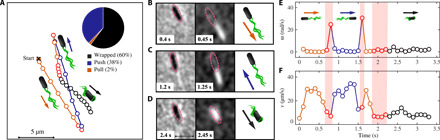
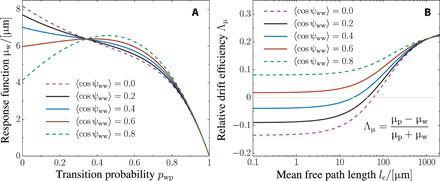
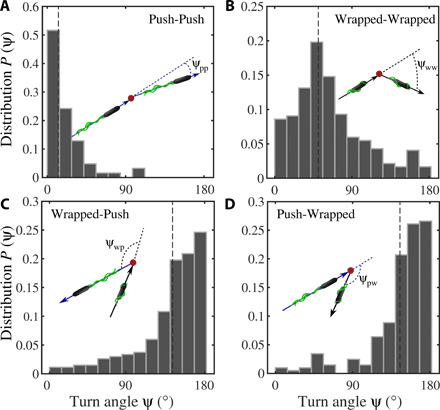
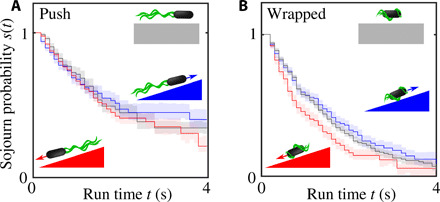
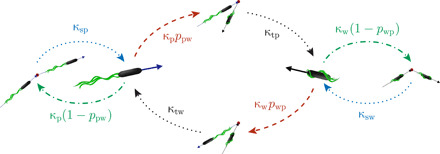
Bacterial chemotaxis-a fundamental example of directional navigation in the living world-is key to many biological processes, including the spreading of bacterial infections. Many bacterial species were recently reported to exhibit several distinct swimming modes-the flagella may, for example, push the cell body or wrap around it. How do the different run modes shape the chemotaxis strategy of a multimode swimmer? Here, we investigate chemotactic motion of the soil bacterium as a model organism. By simultaneously tracking the position of the cell body and the configuration of its flagella, we demonstrate that individual run modes show different chemotactic responses in nutrition gradients and, thus, constitute distinct behavioral states. On the basis of an active particle model, we demonstrate that switching between multiple run states that differ in their speed and responsiveness provides the basis for robust and efficient chemotaxis in complex natural habitats.
细菌趋化作用——生物界定向导航的一个基本实例——是许多生物过程的关键,包括细菌感染的传播。最近有报道称,许多细菌物种表现出几种不同的游动模式——例如,鞭毛可能推动细胞体或缠绕在细胞体周围。不同的游动模式如何塑造多模式游泳者的趋化策略?在这里,我们研究土壤细菌作为模式生物的趋化运动。通过同时跟踪细胞体的位置及其鞭毛的构型,我们证明单个游动模式在营养梯度中表现出不同的趋化反应,因此构成不同的行为状态。基于一个活性粒子模型,我们证明在速度和反应性上不同的多种游动状态之间切换为复杂自然栖息地中强大而有效的趋化作用提供了基础。