• 文献检索
  • 文档翻译
  • 深度研究
  • 学术资讯
  • Suppr Zotero 插件Zotero 插件
  • 邀请有礼
  • 套餐&价格
  • 历史记录
应用&插件
Suppr Zotero 插件Zotero 插件浏览器插件Mac 客户端Windows 客户端微信小程序
定价
高级版会员购买积分包购买API积分包
服务
文献检索文档翻译深度研究API 文档MCP 服务
关于我们
关于 Suppr公司介绍联系我们用户协议隐私条款
关注我们

Suppr 超能文献

核心技术专利:CN118964589B侵权必究
粤ICP备2023148730 号-1Suppr @ 2026

文献检索

告别复杂PubMed语法,用中文像聊天一样搜索,搜遍4000万医学文献。AI智能推荐,让科研检索更轻松。

立即免费搜索

文件翻译

保留排版,准确专业,支持PDF/Word/PPT等文件格式,支持 12+语言互译。

免费翻译文档

深度研究

AI帮你快速写综述,25分钟生成高质量综述,智能提取关键信息,辅助科研写作。

立即免费体验

用于预测 COVID-19 重症患者死亡率的评分系统。

Scoring systems for predicting mortality for severe patients with COVID-19.

作者信息

Shang Yufeng, Liu Tao, Wei Yongchang, Li Jingfeng, Shao Liang, Liu Minghui, Zhang Yongxi, Zhao Zhigang, Xu Haibo, Peng Zhiyong, Zhou Fuling, Wang Xinghuan

机构信息

Department of Hematology, Zhongnan Hospital of Wuhan University, 169 Donghu Road, Wuhan 430071, PR China.

Department of Urology, Zhongnan Hospital of Wuhan University, 169 Donghu Road, Wuhan 430071, PR China.

出版信息

EClinicalMedicine. 2020 Jul 3;24:100426. doi: 10.1016/j.eclinm.2020.100426. eCollection 2020 Jul.

DOI:10.1016/j.eclinm.2020.100426
PMID:32766541
原文链接:https://pmc.ncbi.nlm.nih.gov/articles/PMC7332889/
Abstract

BACKGROUND

Coronavirus disease 2019 (COVID-19) has been widely spread and caused tens of thousands of deaths, especially in patients with severe COVID-19. This analysis aimed to explore risk factors for mortality of severe COVID-19, and establish a scoring system to predict in-hospital deaths.

METHODS

Patients with COVID-19 were retrospectively analyzed and clinical characteristics were compared. LASSO regression as well as multivariable analysis were used to screen variables and establish prediction model.

FINDINGS

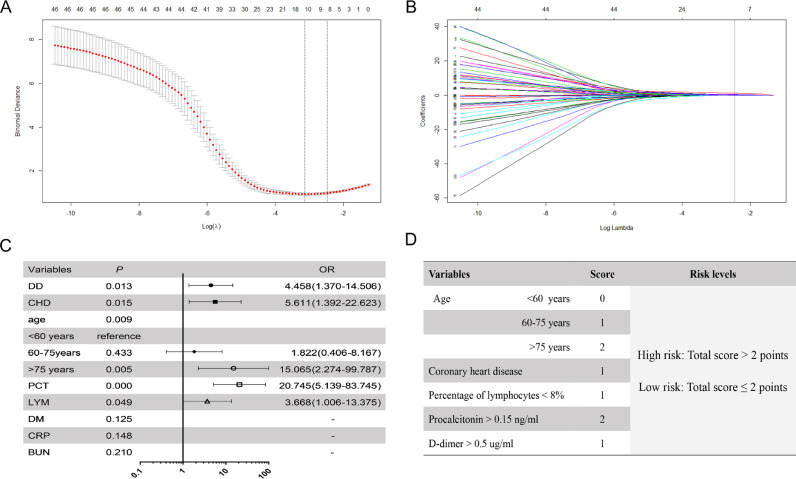
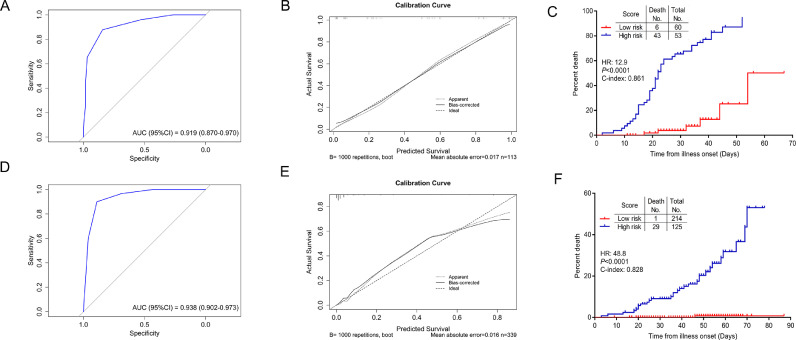
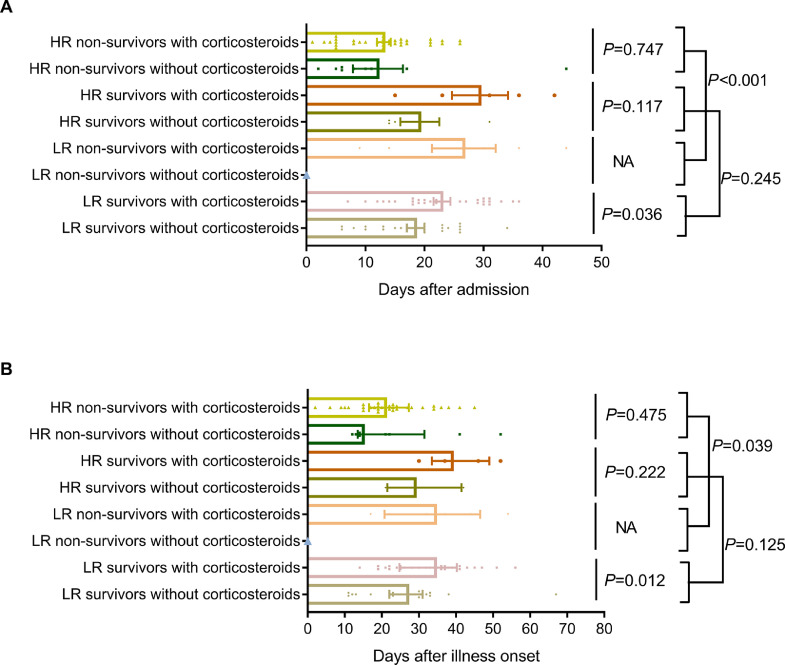
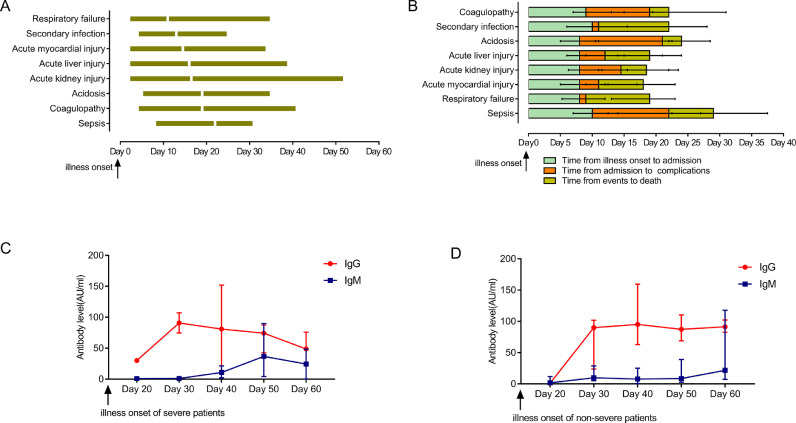
A total of 2529 patients with COVID-19 was retrospectively analyzed, and 452 eligible severe COVID-19 were used for finally analysis. In training cohort, the median age was 66•0 years while it was 73•0 years in non-survivors. Patients aged 60-75 years accounted for the largest proportion of infected populations and mortality toll. Anti-SARS-CoV-2 antibodies were monitored up to 54 days, and IgG levels reached the highest during 20-30 days. No differences were observed of antibody levels between severe and non-severe patients. About 60.2% of severe patients had complications. Among acute myocardial injury (AMI), acute kidney injury (AKI) and acute liver injury (ALI), the heart was the earliest injured organ, whereas the time from AKI to death was the shortest. Age, diabetes, coronary heart disease (CHD), percentage of lymphocytes (LYM%), procalcitonin (PCT), serum urea, C reactive protein and D-dimer (DD), were identified associated with mortality by LASSO binary logistic regression. Then multivariable analysis was performed to conclude that old age, CHD, LYM%, PCT and DD remained independent risk factors for mortality. Based on the above variables, a scoring system of COVID-19 (CSS) was established to divide patients into low-risk and high-risk groups. This model displayed good discrimination (AUC=0·919) and calibration (=0·264). Complications in low-risk and high-risk groups were significantly different (0·05). Use of corticosteroids in low-risk groups increased hospital stays by 4·5 days (=0·036) and durations of disease by 7·5 days (=0·012) compared with no corticosteroids.

INTERPRETATION

Old age, CHD, LYM%, PCT and DD were independently related to mortality. CSS was useful for predicting in-hospital mortality and complications, and it could help clinicians to identify high-risk patients with poor prognosis.

FUNDING

This work was supported by the Key Project for Anti-2019 novel Coronavirus Pneumonia from the Ministry of Science and Technology, China (grant number 2020YFC0845500).

摘要

背景

2019冠状病毒病(COVID-19)已广泛传播,导致数万人死亡,尤其是重症COVID-19患者。本分析旨在探讨重症COVID-19患者死亡的危险因素,并建立一个评分系统来预测住院死亡率。

方法

对COVID-19患者进行回顾性分析,并比较临床特征。采用LASSO回归和多变量分析来筛选变量并建立预测模型。

结果

共回顾性分析了2529例COVID-19患者,最终纳入452例符合条件的重症COVID-19患者进行分析。在训练队列中,患者的中位年龄为66.0岁,而死亡患者为73.0岁。60-75岁的患者在感染人群和死亡人数中占比最大。对患者的抗SARS-CoV-2抗体进行了长达54天的监测,IgG水平在20-30天达到最高。重症和非重症患者的抗体水平无差异。约60.2%的重症患者有并发症。在急性心肌损伤(AMI)、急性肾损伤(AKI)和急性肝损伤(ALI)中,心脏是最早受损的器官,而从AKI到死亡的时间最短。通过LASSO二元逻辑回归确定年龄、糖尿病、冠心病(CHD)、淋巴细胞百分比(LYM%)、降钙素原(PCT)、血清尿素、C反应蛋白和D-二聚体(DD)与死亡率相关。随后进行多变量分析得出,高龄、CHD、LYM%、PCT和DD仍然是死亡的独立危险因素。基于上述变量,建立了COVID-19评分系统(CSS),将患者分为低风险和高风险组。该模型显示出良好的区分度(AUC=0.919)和校准度(=0.264)。低风险组和高风险组的并发症有显著差异(<0.05)。与未使用糖皮质激素相比,低风险组使用糖皮质激素会使住院时间延长4.5天(=0.036),病程延长7.5天(=0.012)。

解读

高龄、CHD、LYM%、PCT和DD与死亡率独立相关。CSS有助于预测住院死亡率和并发症,可帮助临床医生识别预后不良的高风险患者。

资助

本研究得到了中国科学技术部抗2019新型冠状病毒肺炎重点项目(项目编号:2020YFC0845500)的支持。
https://cdn.ncbi.nlm.nih.gov/pmc/blobs/edd1/7393660/67e4c3835bb3/gr5.jpg
https://cdn.ncbi.nlm.nih.gov/pmc/blobs/edd1/7393660/85f1ddf75747/gr1.jpg
https://cdn.ncbi.nlm.nih.gov/pmc/blobs/edd1/7393660/1e022822f19b/gr2.jpg
https://cdn.ncbi.nlm.nih.gov/pmc/blobs/edd1/7393660/94ee87284601/gr3.jpg
https://cdn.ncbi.nlm.nih.gov/pmc/blobs/edd1/7393660/d3f99dd1352f/gr4.jpg
https://cdn.ncbi.nlm.nih.gov/pmc/blobs/edd1/7393660/67e4c3835bb3/gr5.jpg
https://cdn.ncbi.nlm.nih.gov/pmc/blobs/edd1/7393660/85f1ddf75747/gr1.jpg
https://cdn.ncbi.nlm.nih.gov/pmc/blobs/edd1/7393660/1e022822f19b/gr2.jpg
https://cdn.ncbi.nlm.nih.gov/pmc/blobs/edd1/7393660/94ee87284601/gr3.jpg
https://cdn.ncbi.nlm.nih.gov/pmc/blobs/edd1/7393660/d3f99dd1352f/gr4.jpg
https://cdn.ncbi.nlm.nih.gov/pmc/blobs/edd1/7393660/67e4c3835bb3/gr5.jpg

相似文献

1
Scoring systems for predicting mortality for severe patients with COVID-19.用于预测 COVID-19 重症患者死亡率的评分系统。
EClinicalMedicine. 2020 Jul 3;24:100426. doi: 10.1016/j.eclinm.2020.100426. eCollection 2020 Jul.
2
Persistent lymphocyte reduction and interleukin-6 levels are independently associated with death in patients with COVID-19.持续性淋巴细胞减少和白细胞介素 6 水平与 COVID-19 患者的死亡独立相关。
Clin Exp Med. 2023 Nov;23(7):3719-3728. doi: 10.1007/s10238-023-01114-0. Epub 2023 Jun 13.
3
Clinical course and risk factors for mortality of adult inpatients with COVID-19 in Wuhan, China: a retrospective cohort study.中国武汉成人 COVID-19 住院患者的临床病程和死亡危险因素:一项回顾性队列研究。
Lancet. 2020 Mar 28;395(10229):1054-1062. doi: 10.1016/S0140-6736(20)30566-3. Epub 2020 Mar 11.
4
[Clinical features and risk factors for secondary hemophagocytic lymphohistiocytosis in elderly patients with severe SARS-CoV-2 infection: a multicenter retrospective cohort study].[老年重症新型冠状病毒肺炎患者继发噬血细胞性淋巴组织细胞增生症的临床特征及危险因素:一项多中心回顾性队列研究]
Zhonghua Wei Zhong Bing Ji Jiu Yi Xue. 2023 Aug;35(8):793-799. doi: 10.3760/cma.j.cn121430-20230510-00158.
5
A risk score based on procalcitonin for predicting acute kidney injury in COVID-19 patients.基于降钙素原的风险评分预测 COVID-19 患者急性肾损伤。
J Clin Lab Anal. 2021 Jun;35(6):e23805. doi: 10.1002/jcla.23805. Epub 2021 May 25.
6
Predictive role of clinical features in patients with coronavirus disease 2019 for severe disease.2019冠状病毒病患者临床特征对重症疾病的预测作用
Zhong Nan Da Xue Xue Bao Yi Xue Ban. 2020 May 28;45(5):536-541. doi: 10.11817/j.issn.1672-7347.2020.200384.
7
[Clinical characteristics and risk factors of acute kidney injury in coronavirus disease 2019].2019冠状病毒病急性肾损伤的临床特征及危险因素
Zhonghua Wei Zhong Bing Ji Jiu Yi Xue. 2020 Apr;32(4):407-411. doi: 10.3760/cma.j.cn121430-20200302-00198.
8
Validation of Predictors of Disease Severity and Outcomes in COVID-19 Patients: A Descriptive and Retrospective Study.验证 COVID-19 患者疾病严重程度和结局的预测因子:一项描述性和回顾性研究。
Med. 2020 Dec 18;1(1):128-138.e3. doi: 10.1016/j.medj.2020.05.002. Epub 2020 May 19.
9
[Combined predictive value of the risk factors influencing the short-term prognosis of sepsis].[影响脓毒症短期预后的危险因素的联合预测价值]
Zhonghua Wei Zhong Bing Ji Jiu Yi Xue. 2020 Mar;32(3):307-312. doi: 10.3760/cma.j.cn121430-20200306-00218.
10
[Relationship between D-dimer concentration and inflammatory factors or organ function in patients with coronavirus disease 2019].2019冠状病毒病患者D-二聚体浓度与炎症因子或器官功能的关系
Zhonghua Wei Zhong Bing Ji Jiu Yi Xue. 2020 May;32(5):559-563. doi: 10.3760/cma.j.cn121430-20200414-00518.

引用本文的文献

1
Global geographic and socioeconomic disparities in COVID-associated acute kidney injury: a systematic review and meta-analysis.新冠相关急性肾损伤的全球地理和社会经济差异:一项系统综述和荟萃分析。
J Glob Health. 2025 Jul 25;15:04166. doi: 10.7189/jogh.15.04166.
2
Integration of metabolomics methodologies for the development of predictive models for mortality risk in elderly patients with severe COVID-19.整合代谢组学方法以开发预测严重COVID-19老年患者死亡风险的模型。
BMC Infect Dis. 2025 Jan 2;25(1):10. doi: 10.1186/s12879-024-10402-3.
3
Identifying factors related to mortality of hospitalized COVID-19 patients using machine learning methods.

本文引用的文献

1
Protocol for Prevention and Control of COVID-19 (Edition 6).新型冠状病毒肺炎防控方案(第六版)
China CDC Wkly. 2020 May 8;2(19):321-326. doi: 10.46234/ccdcw2020.082.
2
Risk factors for severity and mortality in adult COVID-19 inpatients in Wuhan.武汉成人 COVID-19 住院患者严重程度和死亡率的危险因素。
J Allergy Clin Immunol. 2020 Jul;146(1):110-118. doi: 10.1016/j.jaci.2020.04.006. Epub 2020 Apr 12.
3
Strategies to control COVID-19 and future pandemics in Africa and around the globe.在非洲及全球控制新冠疫情和未来大流行的策略。
使用机器学习方法识别与住院COVID-19患者死亡率相关的因素。
Heliyon. 2024 Aug 5;10(15):e35561. doi: 10.1016/j.heliyon.2024.e35561. eCollection 2024 Aug 15.
4
Development and validation of a scoring system to predict the mortality of hospitalized patients with SARS-CoV-2 Omicron: a nationwide, multicentre study.开发和验证一种评分系统以预测住院 SARS-CoV-2 奥密克戎感染者的死亡率:一项全国性多中心研究。
BMC Pulm Med. 2024 Jul 3;24(1):312. doi: 10.1186/s12890-024-03131-5.
5
A Risk Model for 28-Day in-Hospital Mortality in 173 COVID-19 Patients Admission to ICU: A Retrospective Study.173例入住重症监护病房的COVID-19患者28天院内死亡率的风险模型:一项回顾性研究
Infect Drug Resist. 2024 Mar 23;17:1171-1184. doi: 10.2147/IDR.S447326. eCollection 2024.
6
Human Bronchial Epithelial Cell Transcriptome Changes in Response to Serum from Patients with Different Status of Inflammation.人支气管上皮细胞转录组对不同炎症状态患者血清的反应变化。
Lung. 2024 Apr;202(2):157-170. doi: 10.1007/s00408-024-00679-1. Epub 2024 Mar 17.
7
Real-time prognostic biomarkers for predicting in-hospital mortality and cardiac complications in COVID-19 patients.用于预测COVID-19患者院内死亡率和心脏并发症的实时预后生物标志物。
PLOS Glob Public Health. 2024 Mar 6;4(3):e0002836. doi: 10.1371/journal.pgph.0002836. eCollection 2024.
8
Effects of the pre-existing coronary heart disease on the prognosis of COVID-19 patients: A systematic review and meta-analysis.既往冠心病对 COVID-19 患者预后的影响:系统评价和荟萃分析。
PLoS One. 2023 Oct 10;18(10):e0292021. doi: 10.1371/journal.pone.0292021. eCollection 2023.
9
Longitudinal anti-SARS-CoV-2 antibody immune response in acute and convalescent patients.急性和恢复期患者的抗 SARS-CoV-2 抗体的纵向免疫反应。
Front Cell Infect Microbiol. 2023 Sep 8;13:1239700. doi: 10.3389/fcimb.2023.1239700. eCollection 2023.
10
Vaccination is the most effective and best way to avoid the disease of COVID-19.接种疫苗是避免感染 COVID-19 疾病最有效和最好的方法。
Immun Inflamm Dis. 2023 Aug;11(8):e946. doi: 10.1002/iid3.946.
Eur Heart J. 2020 Nov 1;41(41):3973-3975. doi: 10.1093/eurheartj/ehaa278.
4
Diagnostic value and dynamic variance of serum antibody in coronavirus disease 2019.血清抗体在 2019 冠状病毒病中的诊断价值及动态变化。
Int J Infect Dis. 2020 May;94:49-52. doi: 10.1016/j.ijid.2020.03.065. Epub 2020 Apr 3.
5
The Role of Cytokines including Interleukin-6 in COVID-19 induced Pneumonia and Macrophage Activation Syndrome-Like Disease.细胞因子(包括白细胞介素 6)在 COVID-19 诱导性肺炎和巨噬细胞活化综合征样疾病中的作用。
Autoimmun Rev. 2020 Jun;19(6):102537. doi: 10.1016/j.autrev.2020.102537. Epub 2020 Apr 3.
6
Kidney disease is associated with in-hospital death of patients with COVID-19.肾病与 COVID-19 患者住院期间的死亡相关。
Kidney Int. 2020 May;97(5):829-838. doi: 10.1016/j.kint.2020.03.005. Epub 2020 Mar 20.
7
Clinical characteristics of non-ICU hospitalized patients with coronavirus disease 2019 and liver injury: A retrospective study.COVID-19 住院非 ICU 患者的临床特征与肝损伤:一项回顾性研究。
Liver Int. 2020 Jun;40(6):1321-1326. doi: 10.1111/liv.14449. Epub 2020 Apr 12.
8
Identification of a potential mechanism of acute kidney injury during the COVID-19 outbreak: a study based on single-cell transcriptome analysis.新冠疫情期间急性肾损伤潜在机制的鉴定:一项基于单细胞转录组分析的研究
Intensive Care Med. 2020 Jun;46(6):1114-1116. doi: 10.1007/s00134-020-06026-1. Epub 2020 Mar 31.
9
Antibody Responses to SARS-CoV-2 in Patients With Novel Coronavirus Disease 2019.新型冠状病毒病 2019 患者的 SARS-CoV-2 抗体反应。
Clin Infect Dis. 2020 Nov 19;71(16):2027-2034. doi: 10.1093/cid/ciaa344.
10
Cardiac Involvement in a Patient With Coronavirus Disease 2019 (COVID-19).新冠肺炎(COVID-19)患者的心脏受累。
JAMA Cardiol. 2020 Jul 1;5(7):819-824. doi: 10.1001/jamacardio.2020.1096.