Department of Neurology, Asan Medical Center, Seoul, Republic of Korea.
Department of Biomedical Sciences, Seoul National University Graduate School, Seoul National University College of Medicine, 101 Daehangno, Jongno-gu, Seoul, 110-744, Korea.
Sci Rep. 2020 Aug 7;10(1):13419. doi: 10.1038/s41598-020-70304-7.
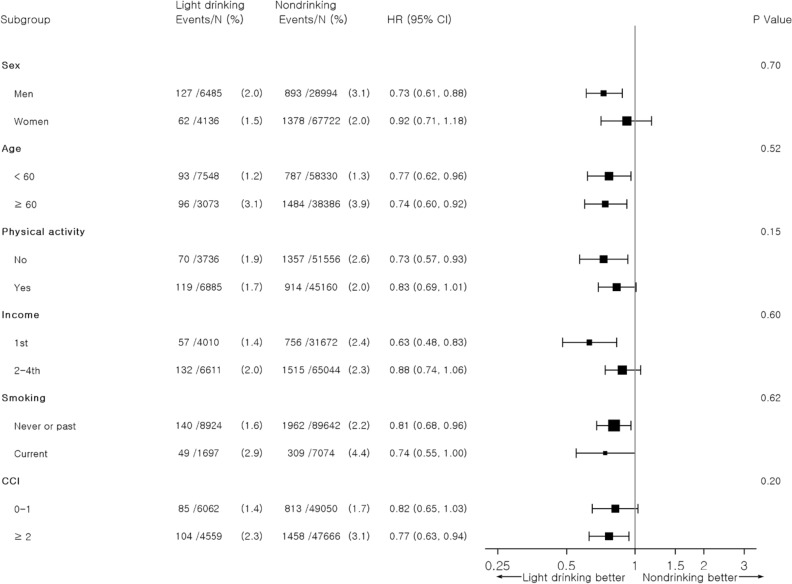
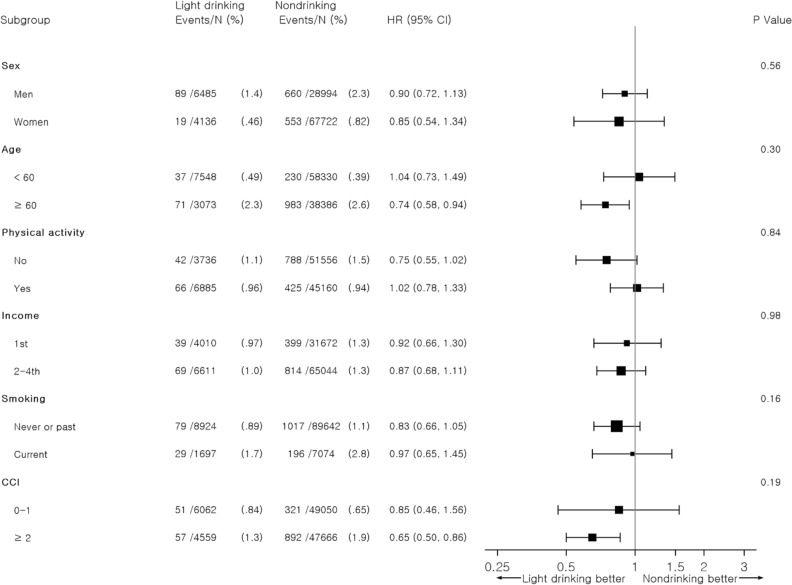
There is a paucity of studies on the influence of alcohol intake among non-drinkers. We evaluated the association between an increase in alcohol consumption and primary prevention of major adverse cardiovascular events (MACE) among non-drinkers. Data collected by the National Health Insurance Service in the Korea between 2007 and 2013 were analysed. A total of 112,403 subjects were included and followed up from 1 January 2011 to 31 December 2013. Increases in alcohol consumption, measured as glasses per day, at the second medical check-up, were categorized into maintenance of nondrinking (0), > 0- ≤ 1, > 1- ≤ 2, > 2- ≤ 4, and > 4. Hazard ratios (HRs) for MACE and all-cause mortality on increase in alcohol consumption were calculated. Compared to that in non-drinkers at the second check-up, the risk of MACE significantly decreased among the subjects with an increase in alcohol consumption to ≤ 1 glass per day (HR 0.79, 95% CI 0.68-0.92). However, a light increase in alcohol consumption did not reduce the risk of stroke or all-cause mortality (stroke, HR 0.83, 95% CI 0.68-1.02; all-cause mortality, HR 0.89, 95% CI 0.73-1.09). Compared to continual non-drinkers, those who drank > 2 glass per day had higher risk for death due to external causes (aHR 2.06, 95% CI 1.09-3.90). The beneficial effect of light increments in alcohol consumption on the occurrence of MACE may have resulted from the inappropriate inclusion of sick quitters, who maintained a nondrinking status, in the reference group.
关于非饮酒者饮酒量的影响,相关研究较少。我们评估了非饮酒者饮酒量增加与主要不良心血管事件(MACE)一级预防之间的关系。该研究数据来自韩国国家健康保险服务在 2007 年至 2013 年期间收集的数据。共纳入 112403 例患者,随访时间从 2011 年 1 月 1 日至 2013 年 12 月 31 日。在第二次体检时,根据每日饮酒量(杯)将饮酒量增加情况分为:维持不饮酒状态(0)、>0-≤1、>1-≤2、>2-≤4、>4。计算了 MACE 和全因死亡率随饮酒量增加的风险比(HR)。与第二次体检时不饮酒者相比,每日饮酒量增加至≤1 杯时,MACE 的发病风险显著降低(HR 0.79,95%CI 0.68-0.92)。然而,轻度增加饮酒量并不能降低中风或全因死亡率的风险(中风,HR 0.83,95%CI 0.68-1.02;全因死亡率,HR 0.89,95%CI 0.73-1.09)。与持续不饮酒者相比,每日饮酒量超过 2 杯者因外部原因导致死亡的风险更高(校正 HR 2.06,95%CI 1.09-3.90)。轻度增加饮酒量对 MACE 发生有益的影响可能是由于将维持不饮酒状态的病退者错误地纳入了参照组。