Knott Craig S, Coombs Ngaire, Stamatakis Emmanuel, Biddulph Jane P
Department of Epidemiology and Public Health, University College London, London, UK
Physical Activity Research Group, Department of Epidemiology and Public Health, University College London, London, UK Department of Social Statistics and Demography, University of Southampton, Southampton, UK.
BMJ. 2015 Feb 10;350:h384. doi: 10.1136/bmj.h384.
To examine the suitability of age specific limits for alcohol consumption and to explore the association between alcohol consumption and mortality in different age groups.
Population based data from Health Survey for England 1998-2008, linked to national mortality registration data and pooled for analysis using proportional hazards regression. Analyses were stratified by sex and age group (50-64 and ≥ 65 years).
Up to 10 waves of the Health Survey for England, which samples the non-institutionalised general population resident in England.
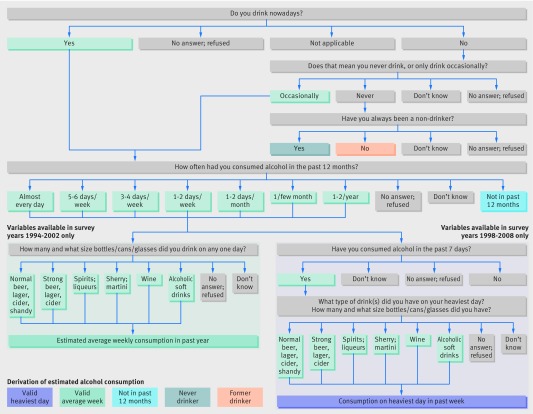
The derivation of two analytical samples was based on the availability of comparable alcohol consumption data, covariate data, and linked mortality data among adults aged 50 years or more. Two samples were used, each utilising a different variable for alcohol usage: self reported average weekly consumption over the past year and self reported consumption on the heaviest day in the past week. In fully adjusted analyses, the former sample comprised Health Survey for England years 1998-2002, 18,368 participants, and 4102 deaths over a median follow-up of 9.7 years, whereas the latter comprised Health Survey for England years 1999-2008, 34,523 participants, and 4220 deaths over a median follow-up of 6.5 years.
All cause mortality, defined as any death recorded between the date of interview and the end of data linkage on 31 March 2011.
In unadjusted models, protective effects were identified across a broad range of alcohol usage in all age-sex groups. These effects were attenuated across most use categories on adjustment for a range of personal, socioeconomic, and lifestyle factors. After the exclusion of former drinkers, these effects were further attenuated. Compared with self reported never drinkers, significant protective associations were limited to younger men (50-64 years) and older women (≥ 65 years). Among younger men, the range of protective effects was minimal, with a significant reduction in hazards present only among those who reported consuming 15.1-20.0 units/average week (hazard ratio 0.49, 95% confidence interval 0.26 to 0.91) or 0.1-1.5 units on the heaviest day (0.43, 0.21 to 0.87). The range of protective effects was broader but lower among older women, with significant reductions in hazards present ≤ 10.0 units/average week and across all levels of heaviest day use. Supplementary analyses found that most protective effects disappeared where calculated in comparison with various definitions of occasional drinkers.
Beneficial associations between low intensity alcohol consumption and all cause mortality may in part be attributable to inappropriate selection of a referent group and weak adjustment for confounders. Compared with never drinkers, age stratified analyses suggest that beneficial dose-response relations between alcohol consumption and all cause mortality may be largely specific to women drinkers aged 65 years or more, with little to no protection present in other age-sex groups. These protective associations may, however, be explained by the effect of selection biases across age-sex strata.
研究特定年龄的酒精消费限量是否合适,并探讨不同年龄组酒精消费与死亡率之间的关联。
基于1998 - 2008年英格兰健康调查的人群数据,与国家死亡率登记数据相链接,并使用比例风险回归进行汇总分析。分析按性别和年龄组(50 - 64岁和≥65岁)分层。
英格兰健康调查多达10轮,对居住在英格兰的非机构化普通人群进行抽样。
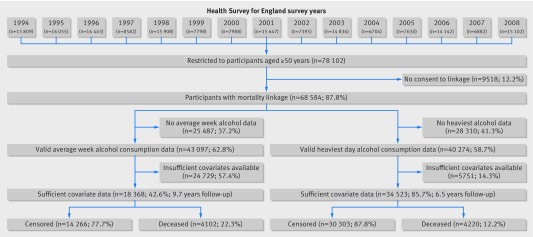
两个分析样本的推导基于50岁及以上成年人中可比的酒精消费数据、协变量数据和关联的死亡率数据的可用性。使用了两个样本,每个样本对酒精使用采用不同变量:过去一年自我报告的平均每周消费量和过去一周自我报告的最重饮酒日的消费量。在完全调整分析中,前一个样本包括1998 - 2002年的英格兰健康调查,18368名参与者,在中位随访9.7年期间有4102例死亡;而后一个样本包括1999 - 2008年的英格兰健康调查,34523名参与者,在中位随访6.5年期间有4220例死亡。
全因死亡率,定义为访谈日期至2011年3月31日数据链接结束之间记录的任何死亡。
在未调整模型中,所有年龄 - 性别组在广泛的酒精使用范围内均发现了保护作用。在对一系列个人、社会经济和生活方式因素进行调整后,这些作用在大多数使用类别中减弱。排除既往饮酒者后,这些作用进一步减弱。与自我报告从不饮酒者相比,显著的保护关联仅限于较年轻男性(50 - 64岁)和老年女性(≥65岁)。在较年轻男性中,保护作用范围最小,仅在报告平均每周消费15.1 - 20.0单位(风险比0.49,95%置信区间0.26至0.91)或最重饮酒日消费0.1 - 1.5单位(0.43,0.21至0.87)的人群中存在显著的风险降低。老年女性中保护作用范围更广但程度较低,平均每周≤10.0单位以及最重饮酒日所有水平的消费均存在显著的风险降低。补充分析发现,与偶尔饮酒者的各种定义进行比较计算时,大多数保护作用消失。
低强度酒精消费与全因死亡率之间的有益关联可能部分归因于参照组选择不当和对混杂因素调整不足。与从不饮酒者相比,年龄分层分析表明,酒精消费与全因死亡率之间的有益剂量 - 反应关系可能主要特定于65岁及以上的女性饮酒者,其他年龄 - 性别组几乎没有保护作用。然而,这些保护关联可能由年龄 - 性别层间的选择偏倚效应来解释。