Centre for Microbiology and Environmental Systems Science, University of Vienna, Althanstrasse 14, 1090, Vienna, Austria.
Joint Microbiome Facility of the Medical University of Vienna and the University of Vienna, Vienna, Austria.
ISME J. 2020 Dec;14(12):3038-3053. doi: 10.1038/s41396-020-00735-7. Epub 2020 Aug 7.
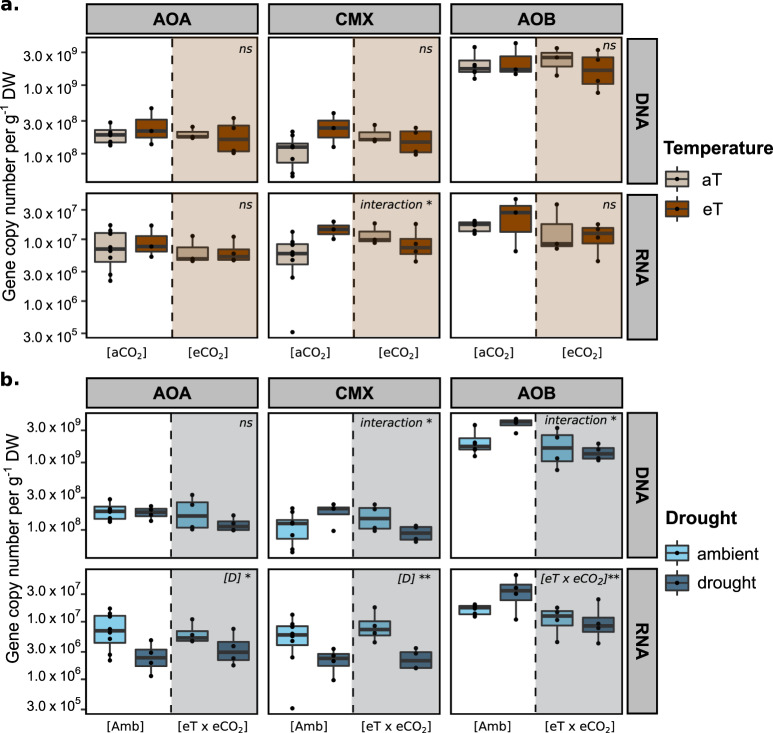
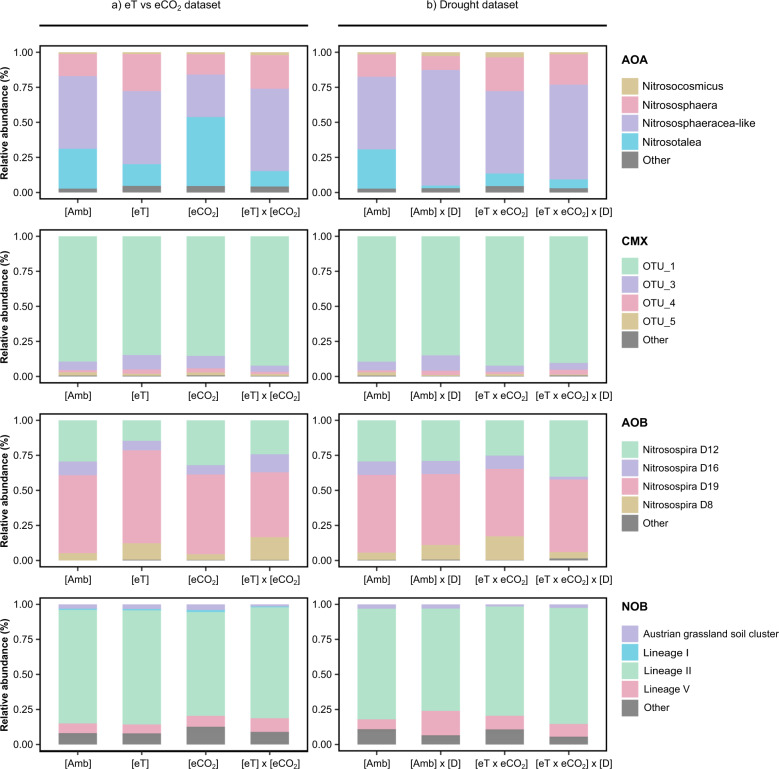
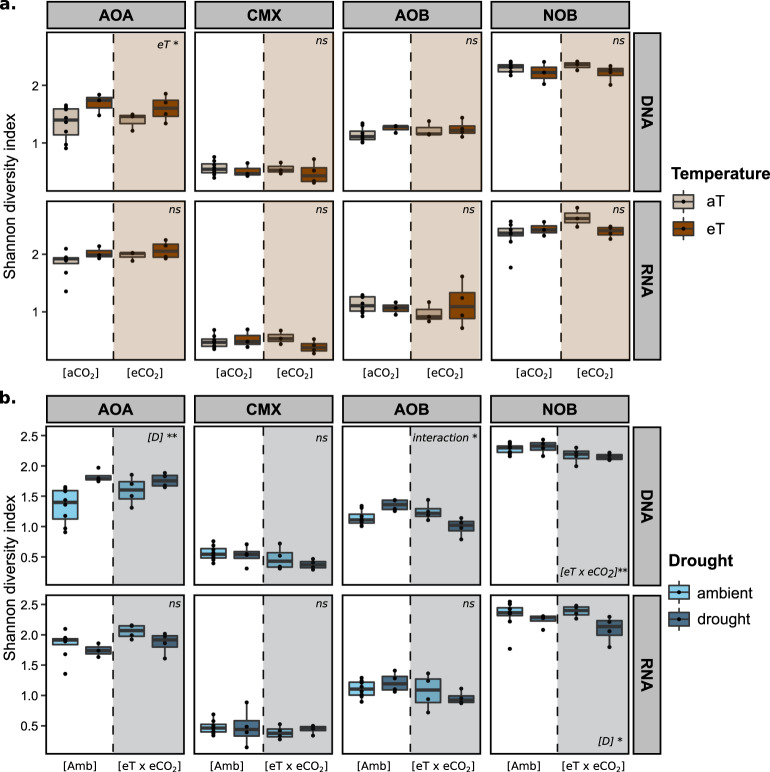
Nitrification is a fundamental process in terrestrial nitrogen cycling. However, detailed information on how climate change affects the structure of nitrifier communities is lacking, specifically from experiments in which multiple climate change factors are manipulated simultaneously. Consequently, our ability to predict how soil nitrogen (N) cycling will change in a future climate is limited. We conducted a field experiment in a managed grassland and simultaneously tested the effects of elevated atmospheric CO, temperature, and drought on the abundance of active ammonia-oxidizing bacteria (AOB) and archaea (AOA), comammox (CMX) Nitrospira, and nitrite-oxidizing bacteria (NOB), and on gross mineralization and nitrification rates. We found that N transformation processes, as well as gene and transcript abundances, and nitrifier community composition were remarkably resistant to individual and interactive effects of elevated CO and temperature. During drought however, process rates were increased or at least maintained. At the same time, the abundance of active AOB increased probably due to higher NH availability. Both, AOA and comammox Nitrospira decreased in response to drought and the active community composition of AOA and NOB was also significantly affected. In summary, our findings suggest that warming and elevated CO have only minor effects on nitrifier communities and soil biogeochemical variables in managed grasslands, whereas drought favors AOB and increases nitrification rates. This highlights the overriding importance of drought as a global change driver impacting on soil microbial community structure and its consequences for N cycling.
硝化作用是陆地氮循环的基本过程。然而,关于气候变化如何影响硝化生物群落结构的详细信息仍然缺乏,特别是在同时操纵多个气候变化因素的实验中。因此,我们预测土壤氮(N)循环在未来气候中如何变化的能力受到限制。我们在一个管理的草原上进行了一项现场实验,并同时测试了大气 CO2 升高、温度升高和干旱对活性氨氧化细菌(AOB)和古菌(AOA)、共氨氧化菌(CMX)Nitrospira 和亚硝酸盐氧化菌(NOB)的丰度以及总矿化和硝化速率的影响。我们发现,氮转化过程以及基因和转录物丰度和硝化生物群落组成对 CO2 升高和温度的单独和交互作用具有显著的抵抗力。然而,在干旱期间,过程速率增加或至少得到维持。与此同时,活性 AOB 的丰度增加,可能是由于 NH4+ 可用性更高。AOA 和共氨氧化菌 Nitrospira 都对干旱做出响应而减少,AOA 和 NOB 的活性群落组成也受到显著影响。总之,我们的研究结果表明,在管理的草原中,变暖增 CO2 对硝化生物群落和土壤生物地球化学变量的影响较小,而干旱有利于 AOB 并增加硝化速率。这突出表明干旱作为全球变化驱动因素的重要性,影响土壤微生物群落结构及其对 N 循环的影响。