Laboratory of Molecular and Cellular Biology, Faculty of Science and Engineering, Graduate School, University of Toyama, Toyama, Japan.
Graduate School of Science and Engineering for Education, University of Toyama, Toyama, Japan.
Cancer Sci. 2020 Oct;111(10):3516-3526. doi: 10.1111/cas.14602. Epub 2020 Aug 26.
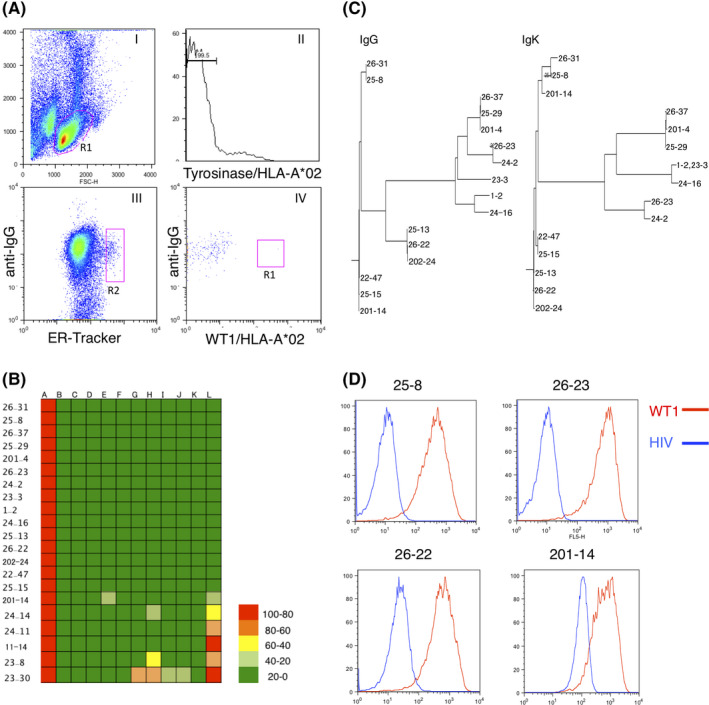
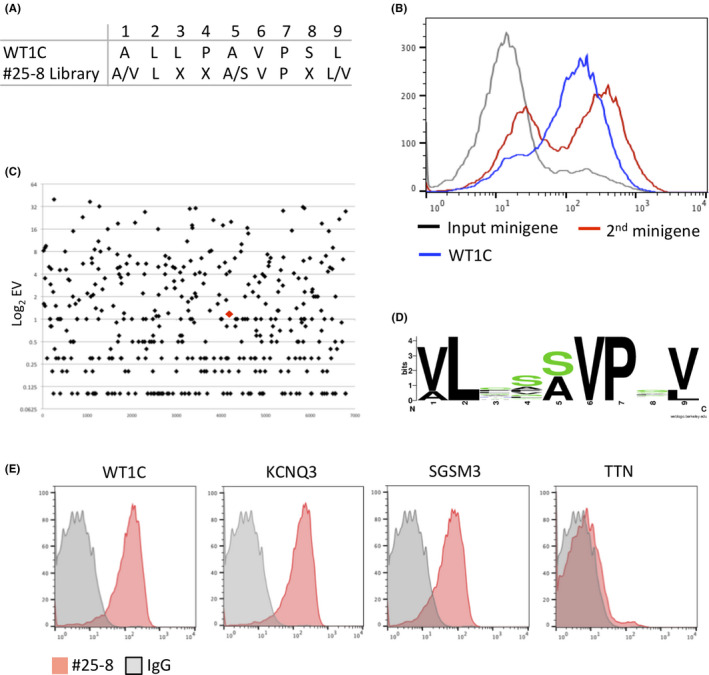
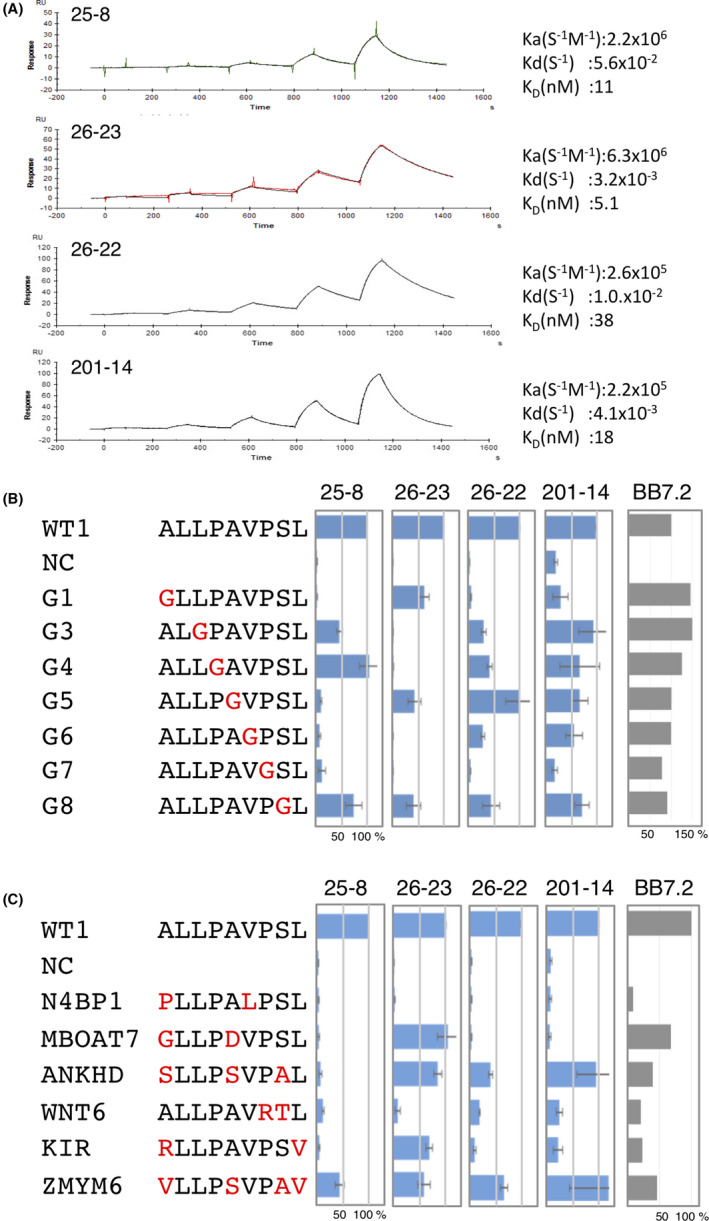
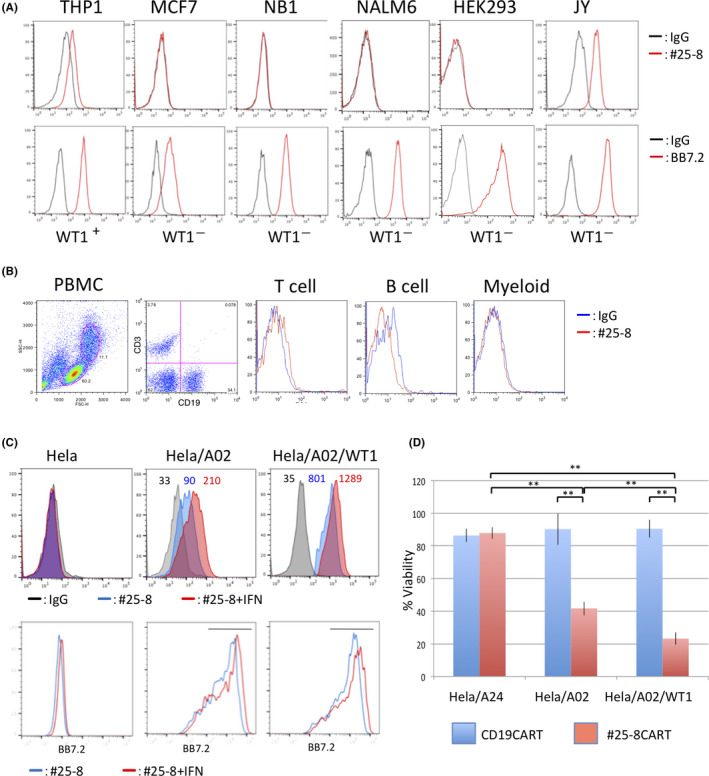
Wilms tumor 1 (WT1) is an intracellular tumor-associated antigen that remains inaccessible to antibodies. Recently, T-cell receptor (TCR) mimic antibodies (TCRm-Abs), which recognize peptides loaded on human leukocyte antigen (HLA) with higher specificity and affinity than TCR, have been developed as a new antibody class that can target intracellular antigens. To expand the therapeutic targets in tumors with WT1, we developed TCRm-Abs targeting a novel HLA-A02:01-restricted peptide, WT1C (ALLPAVPSL), and validated their specificity using multiple techniques. Screening of these antibodies by ELISA with a panel of peptide/HLA complexes and by glycine scanning of peptide-pulsed T2 cells identified one specific clone, #25-8. Despite the low risk for eliciting broad cross-reactivity of this TCRm-Ab, analysis of a panel of cell lines, in conjunction with exogenous expression of either or both the HLA-A02:01 and WT1 genes in HeLa cells, revealed that #25-8 reacts with WT1C but also with unknown peptides in the context of HLA-A*02:01. This potentially dangerous cross-reactivity was confirmed through analysis using chimeric antigen receptor T-cells carrying the single-chain variable fragment of #25-8, which targets WT1-negative HeLa/A02 cells. To determine the cross-reactive profiles of #25-8, we applied the PresentER antigen presentation platform with the #25-8-recognition motif, which enables the identification of potential off-target peptides expressed in the human proteome. Our results demonstrate the potential of TCRm-Abs to target a variety of peptides in the context of HLA but also depict the need for systematic validation to identify the cross-reactive peptides for the prediction of off-target toxicity in future clinical translation.
Wilms 肿瘤 1(WT1)是一种细胞内肿瘤相关抗原,抗体无法与之结合。最近,T 细胞受体(TCR)模拟抗体(TCRm-Abs)被开发出来,作为一种新的抗体类别,可以识别与人类白细胞抗原(HLA)结合的肽,具有比 TCR 更高的特异性和亲和力,这些肽可以靶向细胞内抗原。为了扩大 WT1 肿瘤中的治疗靶点,我们开发了靶向新型 HLA-A02:01 限制性肽 WT1C(ALLPAVPSL)的 TCRm-Abs,并使用多种技术验证了其特异性。通过 ELISA 用肽/HLA 复合物进行筛选,以及用甘氨酸扫描肽脉冲 T2 细胞,筛选出一个特异性克隆,#25-8。尽管这种 TCRm-Ab 引发广泛交叉反应的风险较低,但对一系列细胞系的分析,结合 HeLa 细胞中外源表达 HLA-A02:01 和 WT1 基因,表明#25-8 与 WT1C 反应,但也与 HLA-A*02:01 背景下的未知肽反应。通过分析携带靶向 WT1 阴性 HeLa/A02 细胞的#25-8 的单链可变片段的嵌合抗原受体 T 细胞,证实了这种潜在的危险交叉反应。为了确定#25-8 的交叉反应谱,我们应用了带有#25-8 识别基序的 PresentER 抗原呈递平台,该平台可识别人类蛋白质组中表达的潜在非靶标肽。我们的结果表明,TCRm-Abs 具有靶向 HLA 背景下多种肽的潜力,但也需要进行系统验证,以确定潜在的脱靶毒性的交叉反应肽,为未来临床转化中的脱靶毒性预测提供参考。