Institute of Nutritional Sciences, University of Hohenheim, Stuttgart, Germany.
Food Security Center, University of Hohenheim, Stuttgart, Germany.
BMC Public Health. 2020 Aug 8;20(1):1214. doi: 10.1186/s12889-020-09313-0.
Maternal undernutrition is a pervasive health problem among Ethiopian mothers. This study aims at identifying the level of maternal undernutrition and its associated factors in Kilte Awaleo-Health and Demographic Surveillance Site (KA-HDSS), Tigray region, Ethiopia.
Nutritional status of 2260 lactating mothers was evaluated using the mid-upper-arm circumference (MUAC). Data from the vital events and verbal autopsy databases were linked to the survey and baseline recensus data to investigate the association of adult mortality from chronic causes of death (CoD) on maternal undernutrition. We employed a generalized log-binomial model to estimate the independent effects of the fitted covariates.
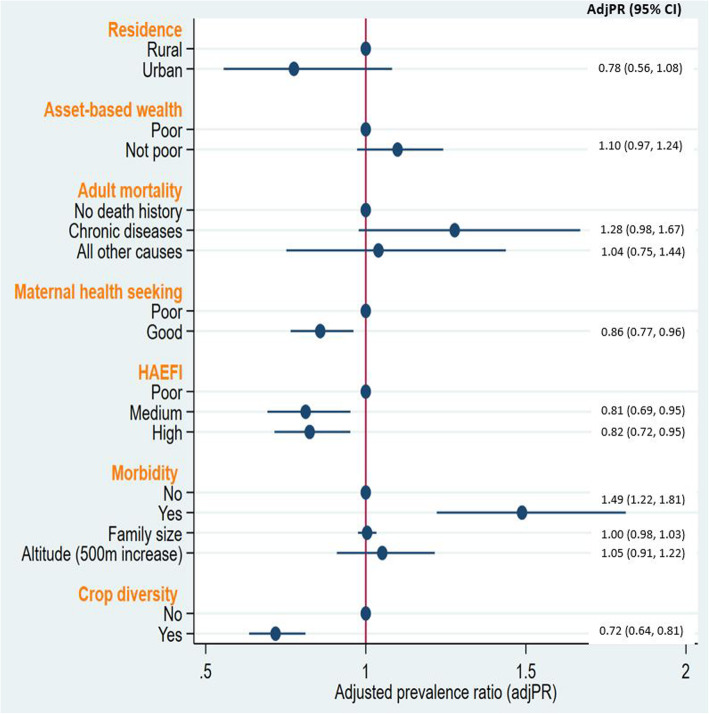
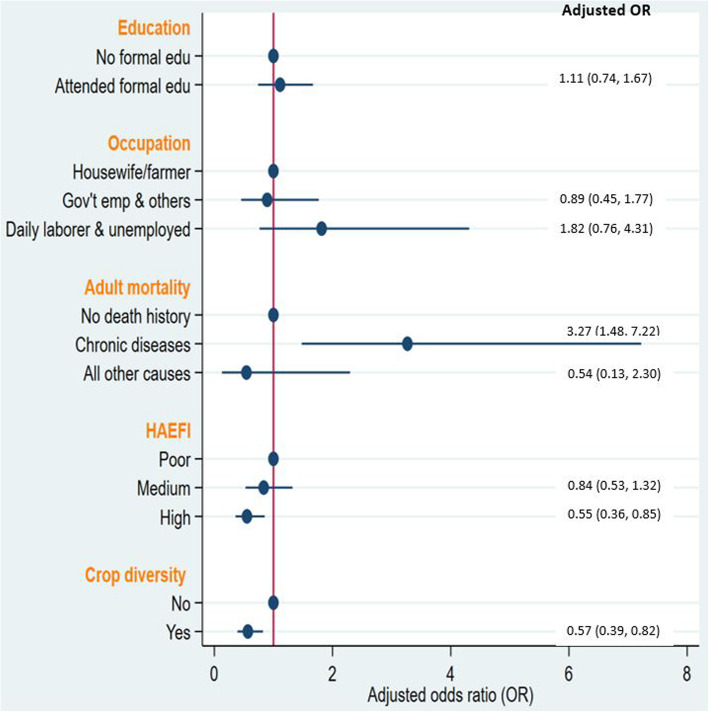
The overall prevalence of maternal undernutrition based on MUAC < 23 cm was 38% (95% CI: 36.1, 40.1%). Recent occurrence of household morbidity (adjusted prevalence ratio (adjPR) = 1.49; 95%CI: 1.22, 1.81) was associated with increased risk of maternal undernutrition. In addition, there was a 28% higher risk (adjPR = 1.28; 95%CI: 0.98, 1.67) of maternal undernutrition for those mothers who lived in households with history of adult mortality from chronic diseases. Especially, its association with severe maternal undernutrition was strong (adjusted OR = 3.27; 95%CI: 1.48, 7.22). In contrast, good maternal health-seeking practice (adjPR = 0.86; 95%CI: 0.77, 0.96) and production of diverse food crops (adjPR = 0.72; 95%CI: 0.64, 0.81) were associated with a lower risk of maternal undernutrition. Relative to mothers with low scores of housing and environmental factors index (HAEFI), those with medium and higher scores of HAEFI had 0.81 (adjPR = 0.81; 95%CI: 0.69, 0.95) and 0.82 (adjPR = 0.82; 95%CI: 0.72, 0.95) times lower risk of maternal undernutrition, respectively.
Efforts to ameliorate maternal undernutrition need to consider the influence of the rising epidemiology of adult mortality from chronic diseases. Our data clearly indicate the need for channeling the integrated intervention power of nutrition-sensitive development programs with that of nutrition-specific sectoral services.
孕产妇营养不良是埃塞俄比亚母亲普遍存在的健康问题。本研究旨在确定在提格雷地区基尔泰阿瓦莱奥-人口与健康监测点(KA-HDSS)孕产妇营养不良的程度及其相关因素。
采用上臂中部周长(MUAC)评估 2260 名哺乳期母亲的营养状况。从生命事件和死因推断数据库中提取数据,并与调查和基线重访数据相联系,以调查成人因慢性疾病死亡(CoD)导致的死亡率与孕产妇营养不良之间的关联。我们采用广义对数二项式模型来估计拟合协变量的独立影响。
根据 MUAC<23cm,总体上孕产妇营养不良的患病率为 38%(95%CI:36.1,40.1%)。近期家庭发病(调整后的患病率比(adjPR)=1.49;95%CI:1.22,1.81)与孕产妇营养不良的风险增加相关。此外,对于那些生活在有成人因慢性疾病死亡史的家庭中的母亲,她们发生孕产妇营养不良的风险增加了 28%(adjPR=1.28;95%CI:0.98,1.67)。特别是,它与严重孕产妇营养不良的关联很强(调整后的比值比(OR)=3.27;95%CI:1.48,7.22)。相比之下,良好的孕产妇寻求医疗保健行为(adjPR=0.86;95%CI:0.77,0.96)和生产多种粮食作物(adjPR=0.72;95%CI:0.64,0.81)与较低的孕产妇营养不良风险相关。与住房和环境因素指数(HAEFI)得分低的母亲相比,HAEFI 得分中等和较高的母亲发生孕产妇营养不良的风险分别降低了 0.81(adjPR=0.81;95%CI:0.69,0.95)和 0.82(adjPR=0.82;95%CI:0.72,0.95)倍。
改善孕产妇营养不良的努力需要考虑成人因慢性疾病死亡的流行病学上升的影响。我们的数据清楚地表明,需要将营养敏感型发展计划的综合干预力量与营养专门部门服务的力量结合起来。