Department of Molecular Toxicology, German Institute of Human Nutrition Potsdam-Rehbrücke, 14558 Nuthetal, Germany.
Division of Genetics, Brigham and Women's Hospital and Harvard Medical School, Boston, MA 02115, USA.
Oxid Med Cell Longev. 2020 Jul 24;2020:4908162. doi: 10.1155/2020/4908162. eCollection 2020.
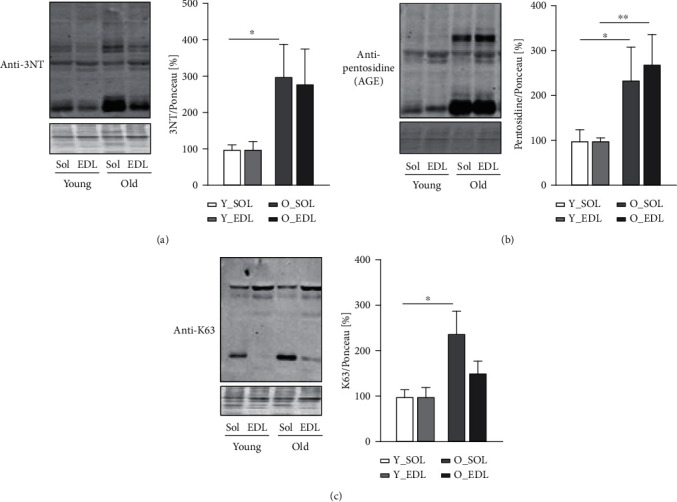
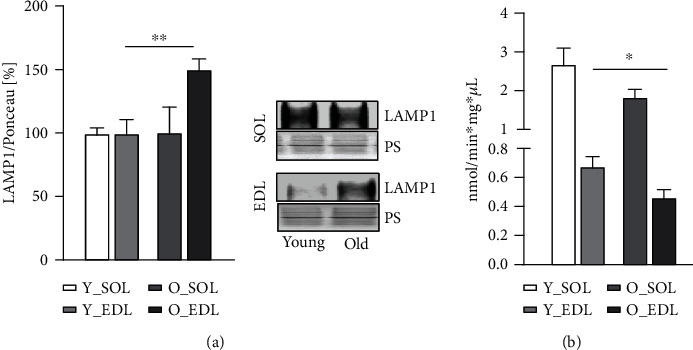
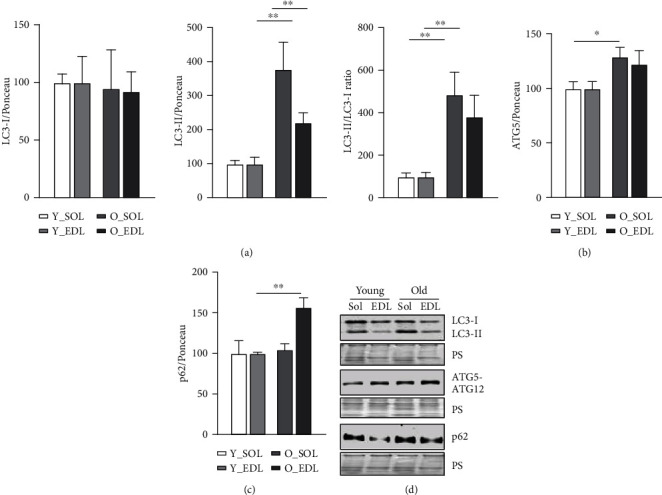
The skeletal muscle plays an important role in maintaining whole-body mechanics, metabolic homeostasis, and interorgan crosstalk. However, during aging, functional and structural changes such as fiber integrity loss and atrophy can occur across different species. A commonly observed hallmark of aged skeletal muscle is the accumulation of oxidatively modified proteins and protein aggregates which point to an imbalance in proteostasis systems such as degradation machineries. Recently, we showed that the ubiquitin-proteasomal system was impaired. Specifically, the proteasomal activity, which was declining in aged (SOL) and (EDL). Therefore, in order to understand whether another proteolytic system would compensate the decline in proteasomal activity, we aimed to investigate age-related changes in the autophagy-lysosomal system (ALS) in SOL, mostly consisting of slow-twitch fibers, and EDL, mainly composed of fast-twitch fibers, from young (4 months) and old (25 months) C57BL/6JRj mice. Here, we focused on changes in the content of modified proteins and the ALS. Our results show that aged SOL and EDL display high levels of protein modifications, particularly in old SOL. While autophagy machinery appears to be functional, lysosomal activity declines gradually in aged SOL. In contrast, in old EDL, the ALS seems to be affected, demonstrated by an increased level of key autophagy-related proteins, which are known to accumulate when their delivery or degradation is impaired. In fact, lysosomal activity was significantly decreased in old EDL. Results presented herein suggest that the ALS can compensate the high levels of modified proteins in the more oxidative muscle, SOL, while EDL seems to be more prone to ALS age-related alterations.
骨骼肌在维持全身力学、代谢稳态和器官间串扰方面发挥着重要作用。然而,在衰老过程中,不同物种的骨骼肌会发生功能和结构变化,如纤维完整性丧失和萎缩。衰老骨骼肌的一个常见特征是氧化修饰蛋白和蛋白聚集体的积累,这表明蛋白质稳态系统(如降解机制)失衡。最近,我们发现泛素-蛋白酶体系统受损。具体来说,蛋白酶体活性在衰老的比目鱼肌(SOL)和快肌(EDL)中下降。因此,为了了解另一种蛋白水解系统是否会代偿蛋白酶体活性的下降,我们旨在研究 SOL 和 EDL 中自噬溶酶体系统(ALS)的年龄相关变化,SOL 主要由慢肌纤维组成,EDL 主要由快肌纤维组成,来自年轻(4 个月)和年老(25 个月)C57BL/6JRj 小鼠。在这里,我们重点研究了修饰蛋白和 ALS 的变化。我们的结果表明,衰老的 SOL 和 EDL 显示出高水平的蛋白修饰,特别是在衰老的 SOL 中。虽然自噬机制似乎是功能性的,但溶酶体活性在衰老的 SOL 中逐渐下降。相比之下,在衰老的 EDL 中,ALS 似乎受到影响,这表现为关键自噬相关蛋白的水平增加,当它们的传递或降解受损时,这些蛋白会积累。事实上,衰老的 EDL 中的溶酶体活性显著降低。本研究结果表明,ALS 可以代偿更氧化的肌肉 SOL 中高水平的修饰蛋白,而 EDL 似乎更容易受到 ALS 年龄相关改变的影响。