Department of Internal Medicine, Kilimanjaro Christian Medical University College, Moshi, Tanzania.
Department of Internal Medicine, Kilimanjaro Christian Medical Centre, Moshi, Tanzania.
J Diabetes Res. 2020 Jul 20;2020:4376251. doi: 10.1155/2020/4376251. eCollection 2020.
Hypertension (HTN) can be present in up to two-thirds of patients living with diabetes mellitus (DM). It is a risk factor for the development of diabetes as well as complications like coronary artery disease (CAD), nephropathy, retinopathy, and neuropathy. Hypertension is treatable, and the degree to which it is controlled determines the risk of development of cardiovascular diseases and other complications in a given individual patient. Even though antihypertensive drugs are available and issued to hypertensive diabetic patients, the rate of control of HTN is often inadequate. The aim of this study was to assess the prevalence of suboptimal blood pressure (BP) control, its associated factors, and the choice of antihypertensive drugs among type 2 DM patients at Kilimanjaro Christian Medical Centre (KCMC).
A hospital-based cross-sectional study was conducted at the KCMC diabetes clinic from October 2018 to March 2019 among type 2 DM patients with HTN based on the inclusion criteria. Data were collected using structured questionnaires, and written informed consent was obtained. Suboptimal BP was defined as BP levels ≥ 140/90 mmHg according to the American Diabetes Association guideline published in 2018. Data analysis was done using the Statistical Package for the Social Sciences (SPSS) version 25. Chi-square analysis was done to identify the independent predictors of BP control, and a value of <0.05 was considered to be statistically significant.
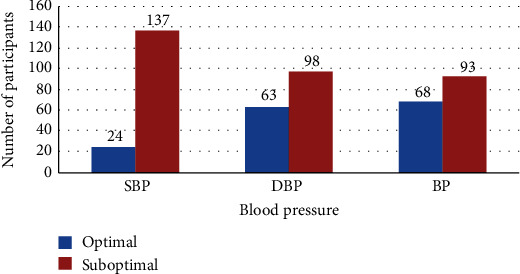
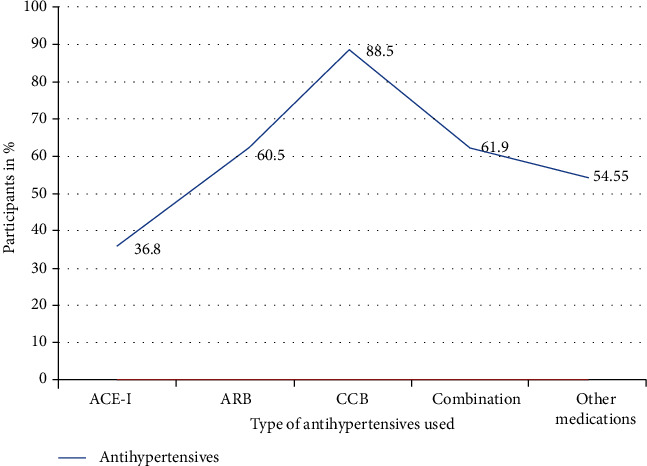
The data of 161 participants was analysed; the mean age was 63.9 ± 20.2 years, with the majority being females (67.1%). Despite all participants being on different classes of antihypertensives, 57.8% had suboptimal BP control. Among the participants with good BP control, 52.7% were on angiotensin-converting enzyme inhibitors (ACE-I). Poor diabetes control was observed in 50.1% participants as indicated by elevated glycated haemoglobin.
This study demonstrated that BP control in type 2 DM patients was suboptimal in more than half of the participants. The study showed that the use of ACE-I or angiotensin II receptor blockers (ARBs) in the majority of DM patients has a good impact in the control of blood pressure. The early initiation of ACE-I or ARBs among the diabetic patients will improve the optimal BP control.
高血压(HTN)可存在于多达三分之二的糖尿病(DM)患者中。它是糖尿病发展的一个危险因素,也是冠心病(CAD)、肾病、视网膜病变和神经病变等并发症的一个危险因素。高血压是可以治疗的,其控制程度决定了个体患者发生心血管疾病和其他并发症的风险。尽管有降压药物可用于治疗高血压糖尿病患者,但血压控制的达标率往往不足。本研究旨在评估坦桑尼亚基督教学医中心(KCMC) 2 型糖尿病患者中血压控制不佳的流行率、相关因素以及降压药物的选择。
2018 年 10 月至 2019 年 3 月,在 KCMC 糖尿病诊所进行了一项基于纳入标准的基于医院的横断面研究,研究对象为患有 HTN 的 2 型 DM 患者。使用结构化问卷收集数据,并获得书面知情同意。根据美国糖尿病协会 2018 年发布的指南,血压控制不佳定义为血压水平≥140/90mmHg。使用社会科学统计软件包(SPSS)第 25 版进行数据分析。卡方分析用于确定血压控制的独立预测因素, 值<0.05 被认为具有统计学意义。
分析了 161 名参与者的数据;平均年龄为 63.9±20.2 岁,大多数为女性(67.1%)。尽管所有参与者都服用不同类别的降压药,但仍有 57.8%的人血压控制不佳。在血压控制良好的参与者中,52.7%服用血管紧张素转换酶抑制剂(ACE-I)。根据糖化血红蛋白升高,50.1%的参与者存在糖尿病控制不良。
本研究表明,超过一半的 2 型 DM 患者血压控制不佳。研究表明,在大多数 DM 患者中使用 ACE-I 或血管紧张素 II 受体阻滞剂(ARB)对血压控制有良好的影响。在糖尿病患者中尽早开始使用 ACE-I 或 ARB 将改善血压的控制。