Departments of Pediatrics, Obstetrics & Gynecology, University of Alberta , Edmonton, AB, Canada.
Department of Agricultural, Food and Nutritional Science, University of Alberta , Edmonton, AB, Canada.
Gut Microbes. 2020 Nov 9;12(1):1799734. doi: 10.1080/19490976.2020.1799734.
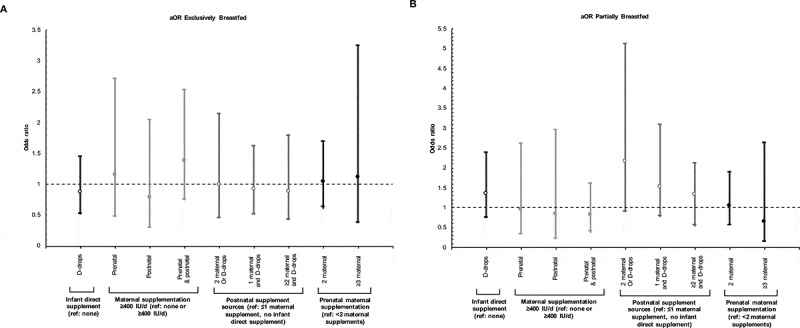
In Canada and the US, the infant diet is supplemented with vitamin D via supplement drops or formula. Pregnant and nursing mothers often take vitamin D supplements. Since little is known about the impact of this supplementation on infant gut microbiota, we undertook a study to determine the association between maternal and infant vitamin D supplementation, infant gut microbiota composition and colonization in 1,157 mother-infant pairs of the CHILD (Canadian Healthy Infant Longitudinal Development) Cohort Study over 2009-2012. Logistic and MaAsLin regression were employed to assess associations between vitamin D supplementation, and colonization, or other gut microbiota, respectively. Sixty-five percent of infants received a vitamin D supplement. Among all infants, infant vitamin D supplementation was associated with a lower abundance of genus (q = 0.01) in gut microbiota. Among those exclusively breastfed, maternal prenatal supplementation was associated with lower abundance of (q = 0.01) and of Lachnospiraceae (q = 0.02) but higher abundance of (q = 0.02). There were no differences in microbiota composition with vitamin D supplementation among partially and not breastfed infants. Neither infant nor maternal vitamin D supplementation were associated with colonization, after adjusting for breastfeeding status and other factors. However, maternal consumption of vitamin-D fortified milk reduced the likelihood of colonization in infants (adjustedOR: 0.40, 95% CI: 0.19-0.82). The impact of this compositional difference on later childhood health, especially defense against viral respiratory infection, may go beyond the expected effects of vitamin D supplements and remains to be ascertained.
在加拿大和美国,婴儿的饮食通过补充滴剂或配方来补充维生素 D。孕妇和哺乳期妇女经常服用维生素 D 补充剂。由于人们对这种补充对婴儿肠道微生物群的影响知之甚少,我们进行了一项研究,以确定 2009 年至 2012 年间在 CHILD(加拿大健康婴儿纵向发展)队列研究的 1157 对母婴对中,母亲和婴儿维生素 D 补充、婴儿肠道微生物群组成和定植之间的关联。使用逻辑回归和 MaAsLin 回归分别评估维生素 D 补充与定植或其他肠道微生物群之间的关联。65%的婴儿接受了维生素 D 补充。在所有婴儿中,婴儿补充维生素 D 与肠道微生物群中属的丰度降低有关(q=0.01)。在完全母乳喂养的婴儿中,母亲产前补充与属的丰度降低有关(q=0.01)和lachnospiraceae 的丰度降低有关(q=0.02),但与属的丰度增加有关(q=0.02)。在部分和非母乳喂养的婴儿中,维生素 D 补充与肠道微生物群组成没有差异。在调整母乳喂养状况和其他因素后,婴儿和母亲补充维生素 D 与定植无关。然而,母亲食用添加维生素 D 的牛奶会降低婴儿定植的可能性(调整后的 OR:0.40,95%CI:0.19-0.82)。这种组成差异对以后儿童健康的影响,特别是对病毒性呼吸道感染的防御作用,可能超出了维生素 D 补充剂的预期效果,还有待确定。