Department of Otolaryngology-Head and Neck Surgery, Indiana University, Indianapolis, Indiana, USA.
School of Medicine, Indiana University, Indianapolis, Indiana, USA.
Otolaryngol Head Neck Surg. 2021 Feb;164(2):433-442. doi: 10.1177/0194599820951169. Epub 2020 Aug 11.
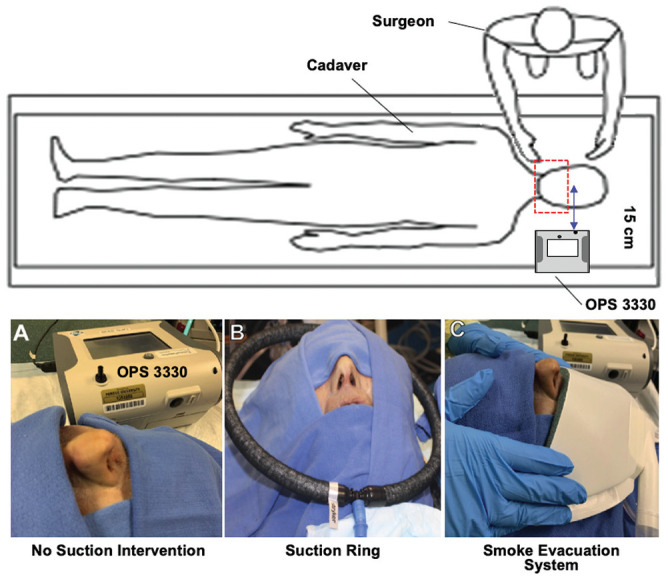
After significant restrictions initially due to the COVID-19 pandemic, otolaryngologists have begun resuming normal clinical practice. However, the risk of SARS-CoV-2 transmission to health care workers through aerosolization and airborne transmission during rhinologic surgery remains incompletely characterized. The objective of this study was to quantify the number concentrations of aerosols generated during rhinologic surgery with and without interventions involving 3 passive suction devices.
Cadaver simulation.
Dedicated surgical laboratory.
In a simulation of rhinologic procedures with and without different passive suction interventions, the concentrations of generated aerosols in the particle size range of 0.30 to 10.0 µm were quantified with an optical particle sizer.
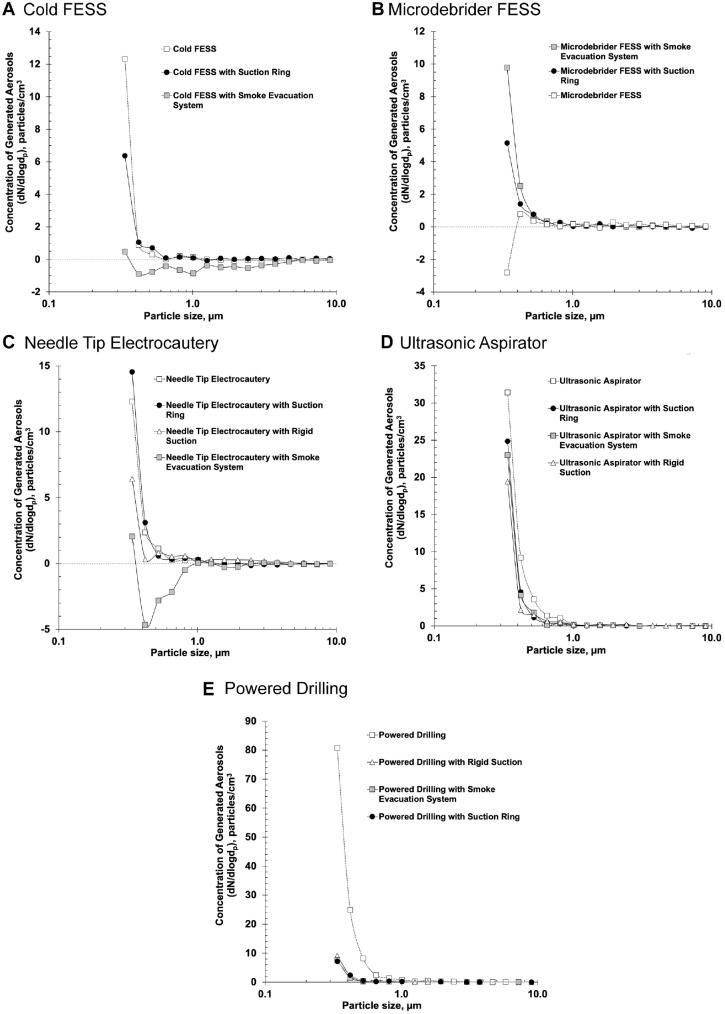
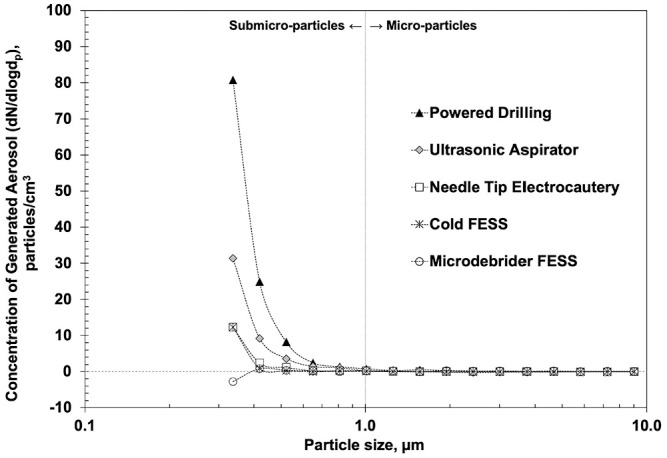
Functional endoscopic sinus surgery with and without microdebrider, high-speed powered drilling, use of an ultrasonic aspirator, and electrocautery all produced statistically significant increases in concentrations of aerosols of various sizes ( < .05). Powered drilling, ultrasonic aspirator, and electrocautery generated the highest concentration of aerosols, predominantly submicroparticles <1 µm. All interventions with a suction device were effective in reducing aerosols, though the surgical smoke evacuation system was the most effective passive suction method in 2 of the 5 surgical conditions with statistical significance ( < .05).
Significant aerosol concentrations were produced in the range of 0.30 to 10.0 µm during all rhinologic procedures in this cadaver simulation. Rhinologic surgery with a passive suction device results in significant mitigation of generated aerosols.
在 COVID-19 大流行初期受到重大限制之后,耳鼻喉科医生已开始恢复正常的临床实践。然而,在鼻科学手术过程中通过气溶胶化和空气传播将 SARS-CoV-2 传播给医护人员的风险仍未完全确定。本研究的目的是量化在鼻科学手术过程中产生的气溶胶的数量浓度,同时涉及 3 种被动抽吸设备的干预措施。
尸体模拟。
专用手术实验室。
在模拟的鼻科手术中,进行了不同的被动抽吸干预,使用光学粒子计数器对粒径在 0.30 至 10.0 µm 范围内产生的气溶胶浓度进行了量化。
功能性内窥镜鼻窦手术(无论是否使用微型磨钻)、高速动力钻、超声抽吸器的使用以及电灼都会导致各种大小的气溶胶浓度均产生统计学上的显著增加(<0.05)。动力钻、超声抽吸器和电灼产生的气溶胶浓度最高,主要是亚微米级<1 µm 的颗粒。带有抽吸装置的所有干预措施都能有效减少气溶胶,但在 5 种手术条件中的 2 种情况下,外科烟雾清除系统是最有效的被动抽吸方法,具有统计学意义(<0.05)。
在这项尸体模拟中的所有鼻科学手术中,都产生了 0.30 至 10.0 µm 范围内的显著气溶胶浓度。使用被动抽吸装置进行鼻科学手术可显著减轻产生的气溶胶。