Finn Richard S, Cristofanilli Massimo, Ettl Johannes, Gelmon Karen A, Colleoni Marco, Giorgetti Carla, Gauthier Eric, Liu Yuan, Lu Dongrui R, Zhang Zhe, Bartlett Cynthia Huang, Slamon Dennis J, Turner Nicholas C, Rugo Hope S
Division of Hematology/Oncology, David Geffen School of Medicine at UCLA, 2825 Santa Monica Blvd, Suite 200, Santa Monica, CA, USA.
Robert H. Lurie Comprehensive Cancer Center, Feinberg School of Medicine, 710 N Fairbanks Ct, Suite 8-250A, Chicago, IL, USA.
Breast Cancer Res Treat. 2020 Nov;184(1):23-35. doi: 10.1007/s10549-020-05782-4. Epub 2020 Aug 11.
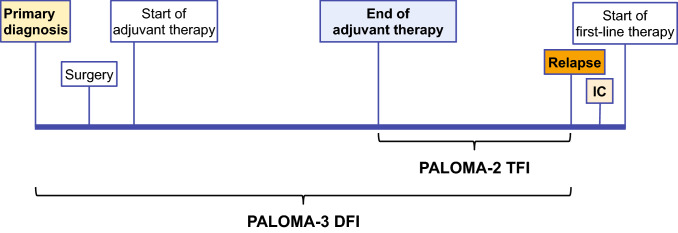
This analysis evaluated the relationship between treatment-free interval (TFI, in PALOMA-2)/disease-free interval (DFI, in PALOMA-3) and progression-free survival (PFS) and overall survival (OS, in PALOMA-3), treatment effect in patients with bone-only disease, and whether intrinsic subtype affects PFS in patients receiving palbociclib.
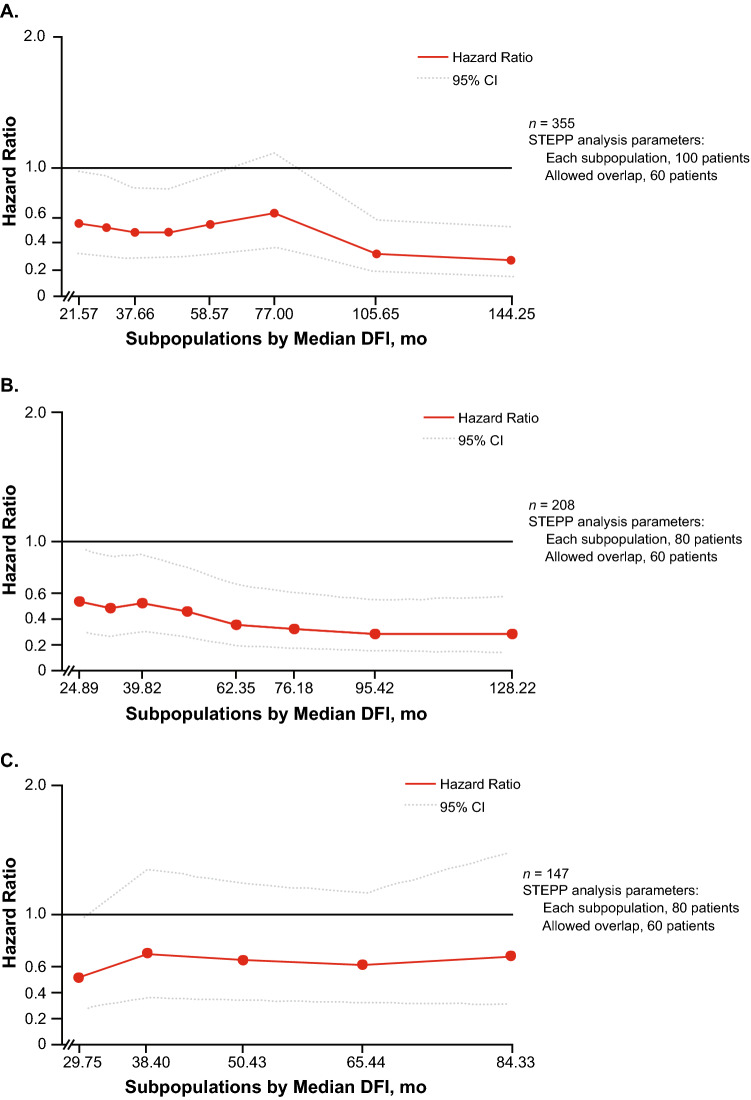
Data were from phase 3, randomized PALOMA-2 and PALOMA-3 clinical studies of hormone receptor‒positive/human epidermal growth factor receptor 2‒negative (HR+ /HER2-) advanced breast cancer (ABC) patients receiving endocrine therapy plus palbociclib or placebo. Subpopulation treatment effect pattern plot (STEPP) analysis evaluated the association between DFI and PFS and OS. PFS by luminal subtype and cyclin-dependent kinase (CDK) 4/6 or endocrine pathway gene expression levels were evaluated in patients with bone-only disease; median PFS and OS were estimated by the Kaplan-Meier method.
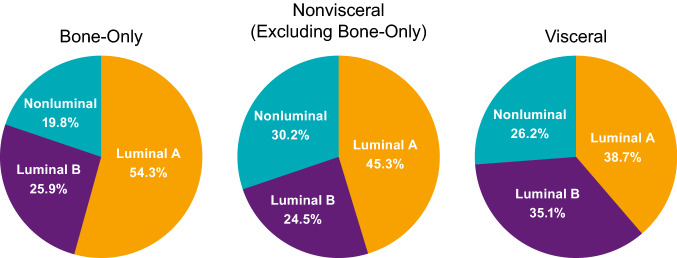
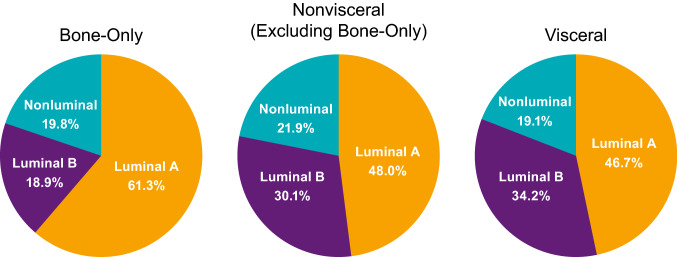
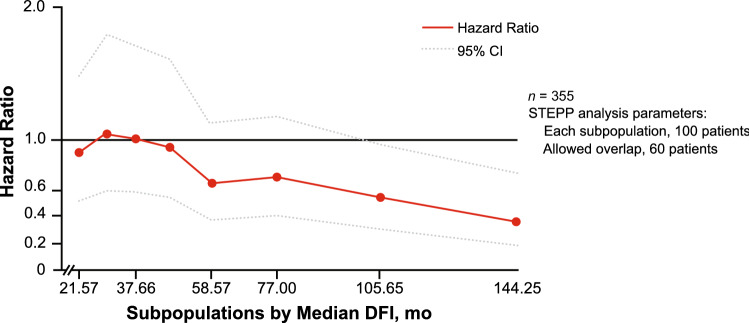
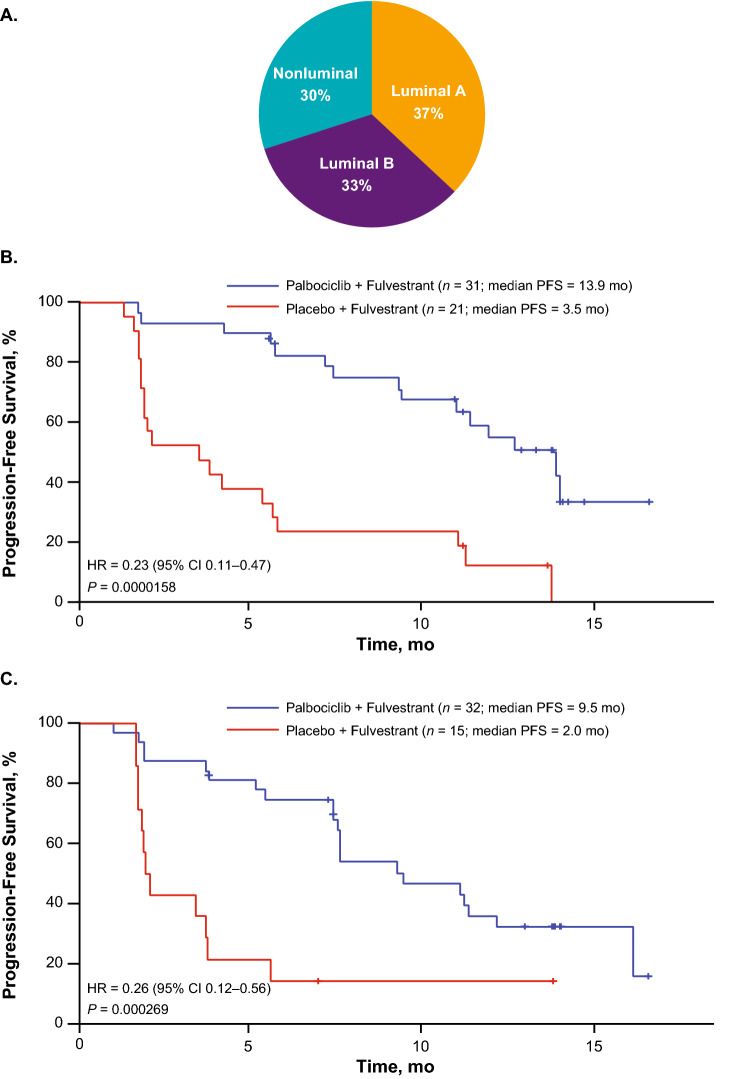
Median durations of TFI were 37.1 and 30.9 months (PALOMA-2) and DFI were 49.2 and 52.0 months (PALOMA-3) in the palbociclib and placebo groups, respectively. Among the PALOMA-2 biomarker population (n = 454), 23% had bone-only disease; median PFS was longer with palbociclib versus placebo (31.3 vs 11.2 months; hazard ratio, 0.41; 95% CI 0.25‒0.69). The interaction effect of bone-only versus visceral disease subgroups on median PFS with palbociclib was not significant (P = 0.262). Among the PALOMA-3 biomarker population (n = 302), 27% had bone-only disease. STEPP analyses showed that palbociclib PFS benefit was not affected by DFI, and that palbociclib OS effect may be smaller in patients with short DFIs. Among patients who provided metastatic tumor tissues (n = 142), regardless of luminal A (hazard ratio, 0.23; 95% CI 0.11‒0.47; P = 0.0000158) or luminal B (hazard ratio, 0.26; 95% CI 0.12‒0.56; P = 0.000269) subtype, palbociclib improved PFS versus placebo.
These findings support palbociclib plus endocrine therapy as standard of care for HR+ /HER2- ABC patients, regardless of baseline TFI/DFI or intrinsic molecular subtype, including patients with bone-only disease.
Pfizer (clinicaltrials.gov:NCT01740427, NCT01942135).
本分析评估了无治疗间期(在PALOMA - 2研究中为TFI)/无病间期(在PALOMA - 3研究中为DFI)与无进展生存期(PFS)及总生存期(在PALOMA - 3研究中为OS)之间的关系、仅骨转移疾病患者的治疗效果,以及内在亚型是否影响接受哌柏西利治疗患者的PFS。
数据来自3期随机PALOMA - 2和PALOMA - 3临床研究,研究对象为接受内分泌治疗加哌柏西利或安慰剂的激素受体阳性/人表皮生长因子受体2阴性(HR + /HER2 - )晚期乳腺癌(ABC)患者。亚组治疗效应模式图(STEPP)分析评估了DFI与PFS及OS之间的关联。在仅骨转移疾病患者中评估了管腔亚型及细胞周期蛋白依赖性激酶(CDK)4/6或内分泌途径基因表达水平对PFS的影响;采用Kaplan - Meier法估计中位PFS和OS。
在哌柏西利组和安慰剂组中,TFI的中位持续时间分别为37.1个月和30.9个月(PALOMA - 2研究),DFI的中位持续时间分别为49.2个月和52.0个月(PALOMA - 3研究)。在PALOMA - 2生物标志物人群(n = 454)中,23%为仅骨转移疾病;与安慰剂相比,哌柏西利组的中位PFS更长(31.3个月对11.2个月;风险比,0.41;95%置信区间0.25 - 0.69)。仅骨转移与内脏转移疾病亚组对哌柏西利治疗中位PFS的交互作用不显著(P = 0.262)。在PALOMA - 3生物标志物人群(n = 302)中,27%为仅骨转移疾病。STEPP分析显示,哌柏西利对PFS的获益不受DFI影响,且在DFI短的患者中,哌柏西利对OS的疗效可能较小。在提供转移瘤组织的患者(n = 142)中,无论管腔A型(风险比,0.23;95%置信区间0.11 - 0.47;P = 0.0000158)或管腔B型(风险比,0.26;95%置信区间0.12 - 0.56;P = 0.000269),与安慰剂相比,哌柏西利均改善了PFS。
这些发现支持哌柏西利加内分泌治疗作为HR + /HER2 - ABC患者的标准治疗方案,无论基线TFI/DFI或内在分子亚型如何,包括仅骨转移疾病患者。
辉瑞公司(clinicaltrials.gov:NCT01740427,NCT01942135)