Department of Health Care Policy Research, Korea Institute for Health and Social Affairs, Sejong 30147, Korea.
Big Data Department, National Health Insurance Service, Wonju 26464, Korea.
Int J Environ Res Public Health. 2020 Aug 10;17(16):5788. doi: 10.3390/ijerph17165788.
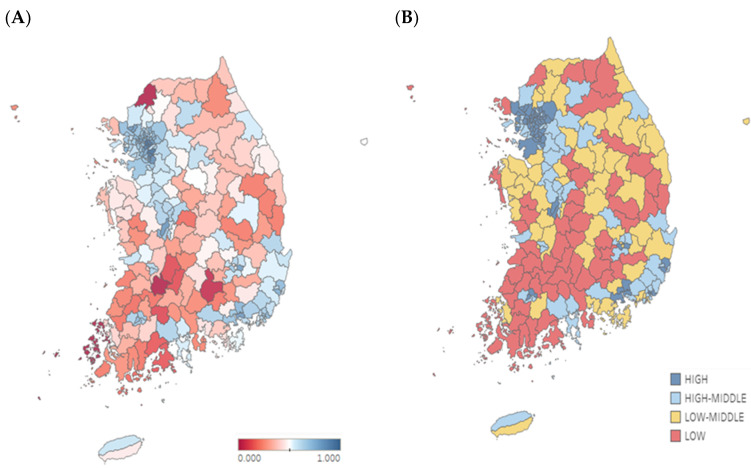
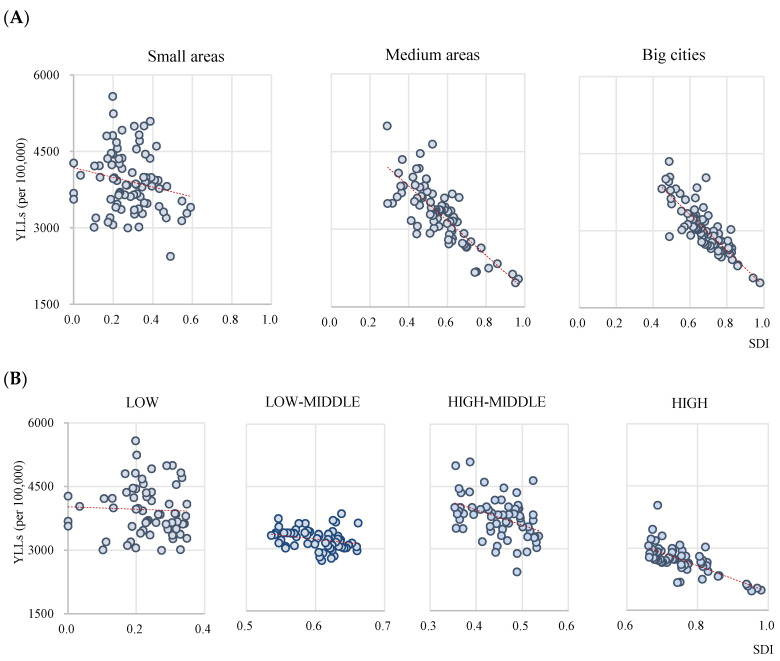
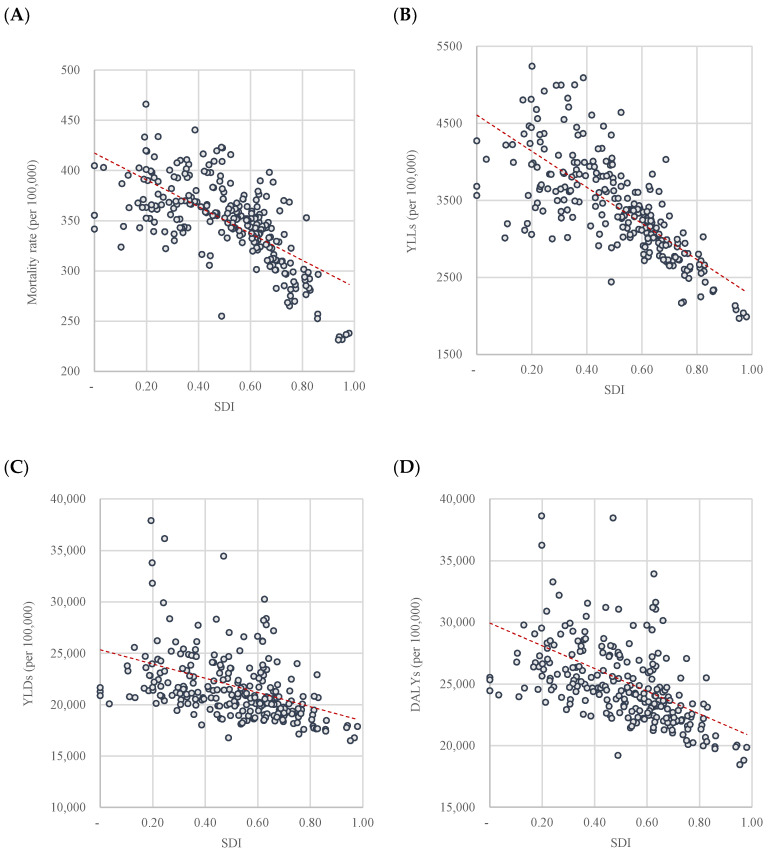
The sociodemographic index (SDI), a composite index per capita income, educational attainment, and total fertility rate in a country, can indicate whether the country's burden of disease varies depending upon its level of socioeconomic development. This study identified the subnational SDI and disease burden of South Korea based on the country's overall SDI, using national representative data. The burden of disease was measured using disability-adjusted life years (DALY) with an incidence-based approach. We used National Health Insurance Services claims data to estimate the years lived with disability (YLD) and cause-of-death statistics to estimate the years of life lost (YLL). Indicators of subnational SDI were also extracted. The Korean subnational SDIs for 250 regions were correlated with YLL, YLD, and DALY for the year 2016. The correlation between SDI and YLL was stronger in big cities than in medium areas and small areas. Moreover, the higher the SDI, the higher the coefficient. The SDI should be used as a standard for interpreting and comparing regions' disease burden at the subnational level.
社会人口指数(SDI)是一个人均收入、教育程度和总生育率的综合指数,可以反映一个国家的疾病负担是否因社会经济发展水平而异。本研究基于韩国的总体 SDI,利用全国代表性数据,确定了韩国的次国家级 SDI 和疾病负担。采用基于发病率的方法,使用伤残调整生命年(DALY)来衡量疾病负担。我们使用国民健康保险服务索赔数据来估计残疾生存年(YLD),并使用死因统计数据来估计生命损失年(YLL)。还提取了次国家级 SDI 的指标。2016 年,韩国 250 个地区的次国家级 SDI 与 YLL、YLD 和 DALY 相关。SDI 与 YLL 的相关性在大城市中比在中等地区和小地区更强。此外,SDI 越高,系数越高。SDI 应作为解释和比较次国家级区域疾病负担的标准。