Department of Entomology, Faculty of Agriculture, Kasetsart University, Bangkok, Thailand.
HydroSciences Montpellier (HSM), Institut de Recherche pour le Développement (IRD), CNRS, Université Montpellier, Montpellier, France.
PLoS One. 2020 Aug 12;15(8):e0237353. doi: 10.1371/journal.pone.0237353. eCollection 2020.
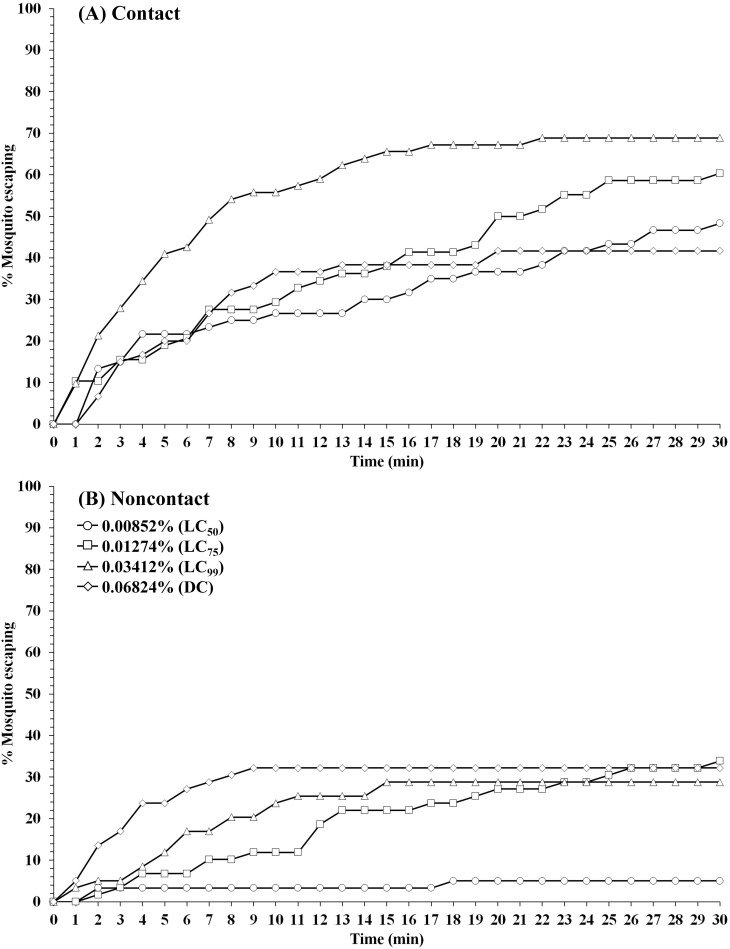
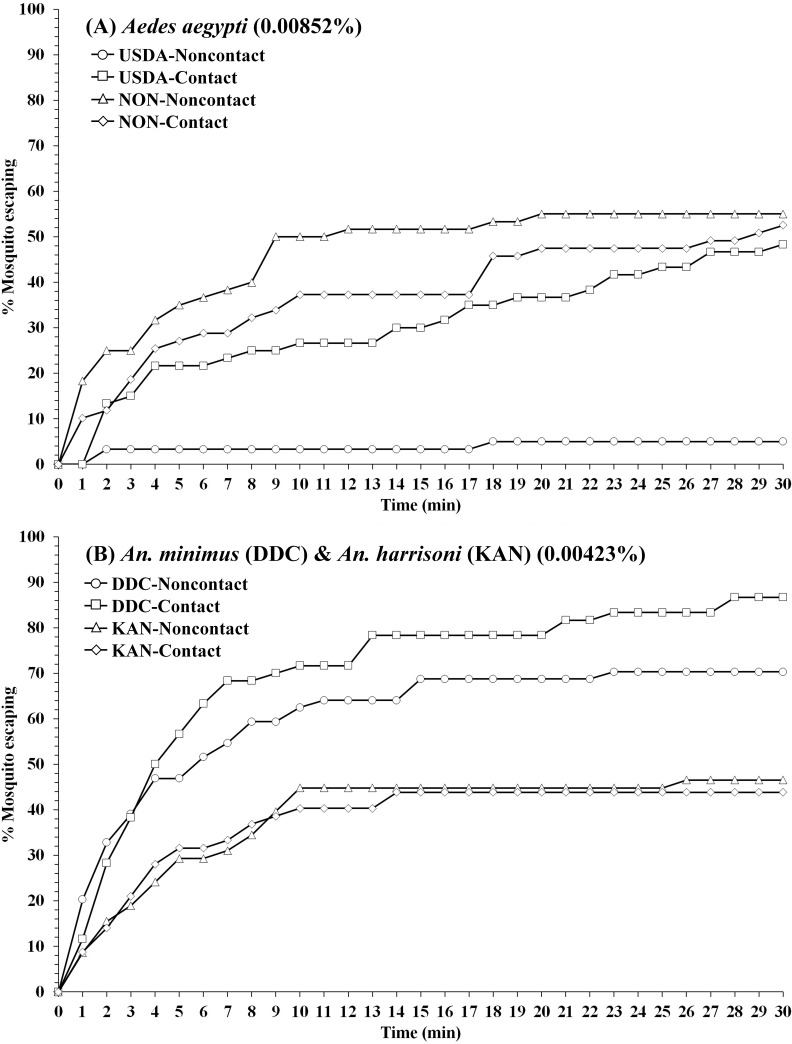
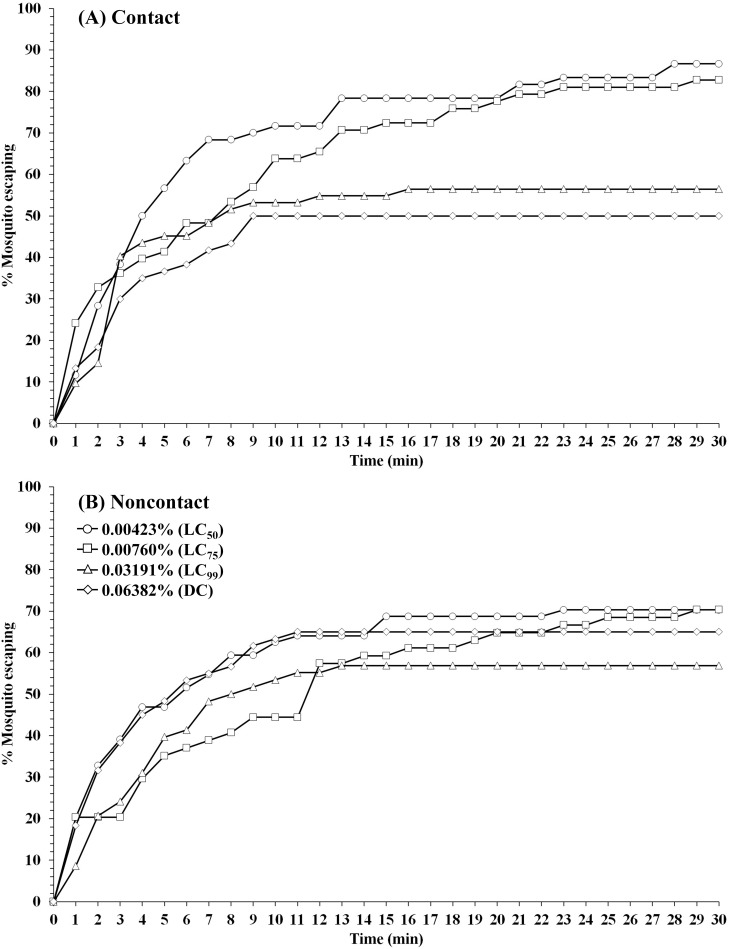
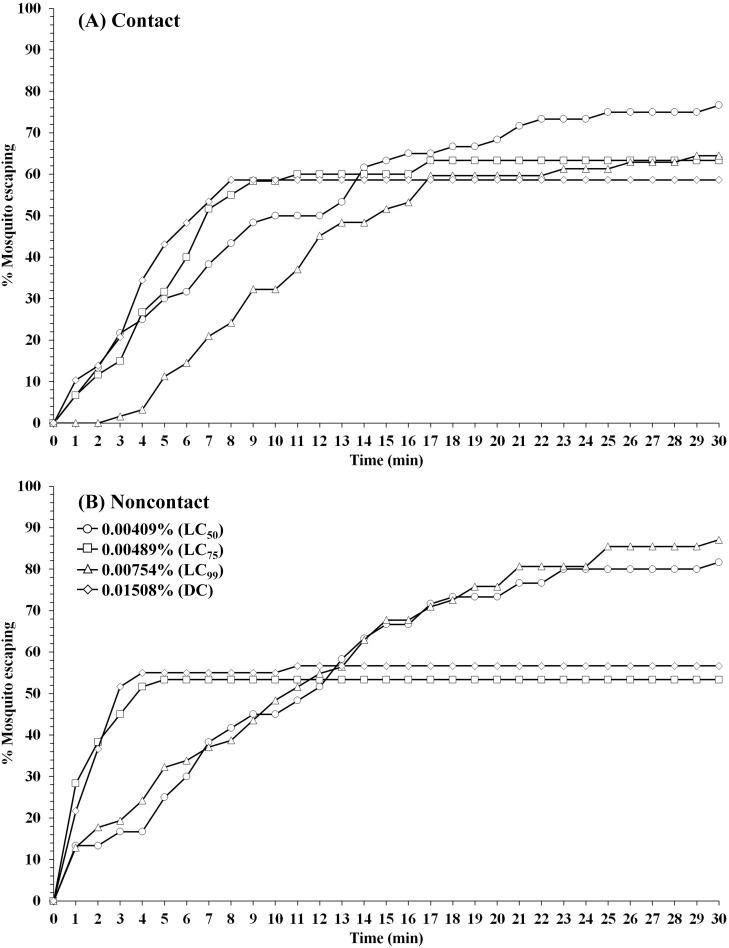
Airborne spatial repellency (SR) is characterized and distinguished from other chemical actions including contact locomotor excitation and toxicity. The use of volatile spatial repellents is a potential new intervention class for combatting mosquito-borne pathogen transmission; therefore, continuing investigations on the actions of these chemicals that modify mosquito host-seeking behavior (i.e., bite prevention) is needed. The objective of this study is to characterize the key behavioral avoidance actions of transfluthrin (TFT) to advance spatial repellent development into practical products. Behavioral avoidance responses were observed for adult laboratory strains of Aedes aegypti, Anopheles minimus and An. dirus, and two field populations of An. harrisoni and Ae. aegypti, respectively. Established TFT sublethal (LC50 and LC75), lethal concentrations (LC99) and discriminating concentrations (DCs) were selected corresponding to each mosquito test species. Spatial repellency and contact excitation ('irritancy') responses on adult mosquitoes to TFT were assessed using an excito-repellency assay system. At LC50, TFT exhibited strong avoidance with An. minimus (60.1% escape) and An. dirus (80% escape) laboratory strains, showing between 12 and 16x greater escape response than Ae. aegypti (5% escape). Repellency responses for field collected Ae. aegypti and An. harrisoni were 54.9 and 47.1% escape, respectively. After adjusting the initial contact escape response (a measure of combined irritancy and repellency) to estimate only escape due to contact, the LC50 and LC99 showed moderate escape irritancy with laboratory Ae. aegypti (41.4% escape) and no contact activity against the field population. Adjustment showed only weak contact activity (16.1% escape) in laboratory An. minimus at LC50. Spatial repellency is the predominant mode of action of TFT among colonized and field mosquitoes used in this study. Established baseline (susceptible) dose-response curves assist in optimizing SR products for mosquito control and pathogen transmission prevention.
空气传播空间驱避(SR)的特点和区别于其他化学作用,包括接触运动兴奋和毒性。挥发性空间驱避剂的使用是防治蚊媒病原体传播的一种潜在的新干预类别;因此,需要继续研究这些化学物质改变蚊虫宿主寻找行为(即防止叮咬)的作用。本研究的目的是描述 Transfluthrin(TFT)的关键行为回避作用,以推进空间驱避剂开发为实用产品。观察了实验室饲养的埃及伊蚊、微小按蚊和致倦库蚊、以及两种野外种群的 Harrisoni 按蚊和埃及伊蚊的成虫对 Transfluthrin 的回避反应。选择了与每种蚊子测试种对应的亚致死(LC50 和 LC75)、致死(LC99)和区分浓度(DC)浓度来进行实验。使用驱避-兴奋测定系统评估了 TFT 对成蚊的空间驱避和接触兴奋(“刺激性”)反应。在 LC50 浓度下,TFT 对实验室饲养的微小按蚊(60.1%的逃避)和致倦库蚊(80%的逃避)表现出强烈的回避作用,其逃避反应比埃及伊蚊(5%的逃避)高 12-16 倍。野外采集的埃及伊蚊和 Harrisoni 按蚊的驱避反应分别为 54.9%和 47.1%的逃避。在调整初始接触逃避反应(衡量刺激性和驱避性的综合作用)以仅估计接触引起的逃避后,LC50 和 LC99 对实验室埃及伊蚊显示出中度逃避刺激性(41.4%的逃避),对野外种群无接触活性。调整后仅在 LC50 时实验室微小按蚊表现出微弱的接触活性(16.1%的逃避)。在本研究中使用的已定居(敏感)剂量反应曲线有助于优化空间驱避产品以控制蚊虫和预防病原体传播。