Department of Cell Biology, Duke University School of Medicine, Durham, North Carolina, USA.
Department of Biochemistry, Duke University School of Medicine, Durham, North Carolina, USA.
Mol Cell Proteomics. 2020 Nov;19(11):1826-1849. doi: 10.1074/mcp.RA120.002228. Epub 2020 Aug 11.
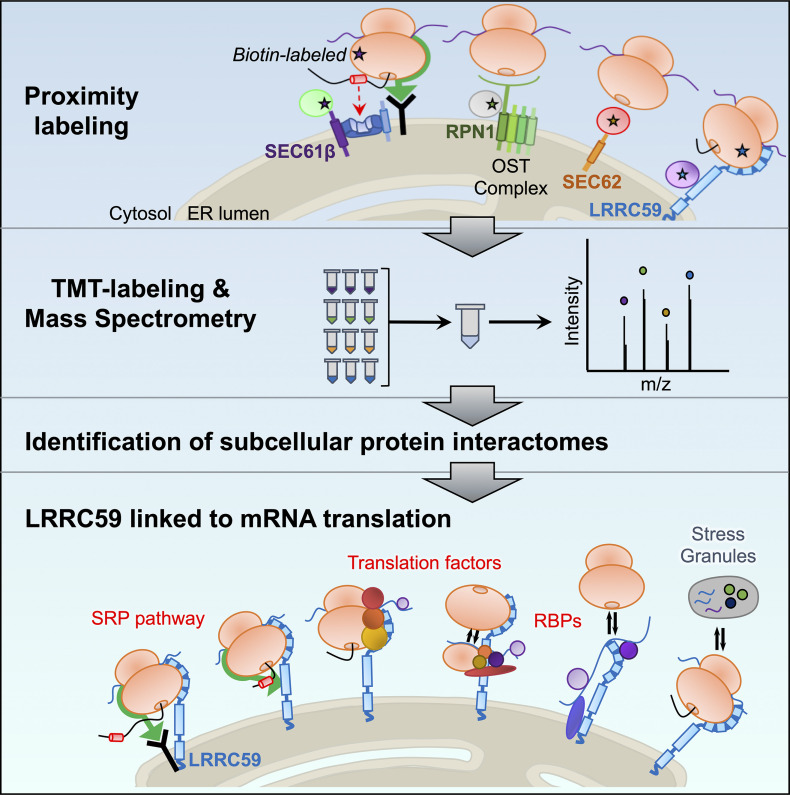
Protein synthesis on the endoplasmic reticulum (ER) requires the dynamic coordination of numerous cellular components. Together, resident ER membrane proteins, cytoplasmic translation factors, and both integral membrane and cytosolic RNA-binding proteins operate in concert with membrane-associated ribosomes to facilitate ER-localized translation. Little is known, however, regarding the spatial organization of ER-localized translation. This question is of growing significance as it is now known that ER-bound ribosomes contribute to secretory, integral membrane, and cytosolic protein synthesis alike. To explore this question, we utilized quantitative proximity proteomics to identify neighboring protein networks for the candidate ribosome interactors SEC61β (subunit of the protein translocase), RPN1 (oligosaccharyltransferase subunit), SEC62 (translocation integral membrane protein), and LRRC59 (ribosome binding integral membrane protein). Biotin labeling time course studies of the four BioID reporters revealed distinct labeling patterns that intensified but only modestly diversified as a function of labeling time, suggesting that the ER membrane is organized into discrete protein interaction domains. Whereas SEC61β and RPN1 reporters identified translocon-associated networks, SEC62 and LRRC59 reporters revealed divergent protein interactomes. Notably, the SEC62 interactome is enriched in redox-linked proteins and ER luminal chaperones, with the latter likely representing proximity to an ER luminal chaperone reflux pathway. In contrast, the LRRC59 interactome is highly enriched in SRP pathway components, translation factors, and ER-localized RNA-binding proteins, uncovering a functional link between LRRC59 and mRNA translation regulation. Importantly, analysis of the LRRC59 interactome by native immunoprecipitation identified similar protein and functional enrichments. Moreover, [S]-methionine incorporation assays revealed that siRNA silencing of LRRC59 expression reduced steady state translation levels on the ER by ca. 50%, and also impacted steady state translation levels in the cytosol compartment. Collectively, these data reveal a functional domain organization for the ER and identify a key role for LRRC59 in the organization and regulation of local translation.
内质网上的蛋白质合成需要众多细胞成分的动态协调。内质网膜蛋白、细胞质翻译因子、膜结合和胞质 RNA 结合蛋白共同作用,与膜结合核糖体协同,促进内质网定位的翻译。然而,内质网定位翻译的空间组织尚不清楚。由于现在已知 ER 结合核糖体有助于分泌、整合膜和胞质蛋白的合成,因此这个问题变得越来越重要。为了探讨这个问题,我们利用定量邻近蛋白质组学来鉴定候选核糖体相互作用蛋白 SEC61β(蛋白易位子的亚基)、RPN1(寡糖基转移酶亚基)、SEC62(易位子整合膜蛋白)和 LRRC59(核糖体结合整合膜蛋白)的邻近蛋白网络。四种 BioID 报告蛋白的生物素标记时间过程研究揭示了不同的标记模式,这些模式随着标记时间的延长而增强,但只是适度多样化,这表明内质网膜被组织成离散的蛋白质相互作用域。虽然 SEC61β和 RPN1 报告蛋白鉴定了易位子相关网络,但 SEC62 和 LRRC59 报告蛋白揭示了不同的蛋白质相互作用组。值得注意的是,SEC62 相互作用组富含与氧化还原相关的蛋白质和内质网腔伴侣,后者可能代表与内质网腔伴侣回流途径的接近。相比之下,LRRC59 相互作用组富含 SRP 途径成分、翻译因子和内质网定位的 RNA 结合蛋白,揭示了 LRRC59 与 mRNA 翻译调节之间的功能联系。重要的是,通过天然免疫沉淀分析 LRRC59 相互作用组发现了类似的蛋白质和功能富集。此外,[S]-甲硫氨酸掺入测定表明,LRRC59 表达的 siRNA 沉默降低了 ER 上的稳态翻译水平约 50%,并影响了胞质区室中的稳态翻译水平。总之,这些数据揭示了内质网的功能域组织,并确定了 LRRC59 在组织和调节局部翻译中的关键作用。