Jiao Yang, Liu Yu-Wan, Chen Wei-Gong, Liu Jing
Stem Cell Clinical Research Center, National Joint Engineering Laboratory, Regenerative Medicine Center, The First Affiliated Hospital of Dalian Medical University; Dalian Innovation Institute of Stem Cells and Precision Medicine, Dalian, Liaoning Province, China.
Stem Cell Clinical Research Center, National Joint Engineering Laboratory, Regenerative Medicine Center, The First Affiliated Hospital of Dalian Medical University, Dalian, Liaoning Province, China.
Neural Regen Res. 2021 Jan;16(1):80-92. doi: 10.4103/1673-5374.286955.
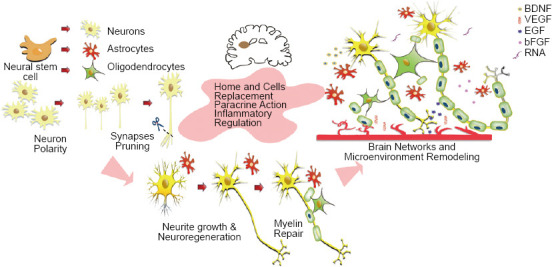
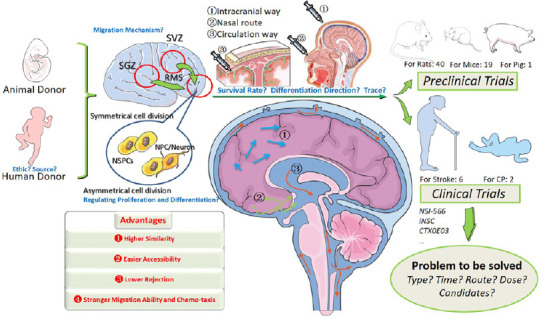
Stroke is a main cause of death and disability worldwide. The ability of the brain to self-repair in the acute and chronic phases after stroke is minimal; however, promising stem cell-based interventions are emerging that may give substantial and possibly complete recovery of brain function after stroke. Many animal models and clinical trials have demonstrated that neural stem cells (NSCs) in the central nervous system can orchestrate neurological repair through nerve regeneration, neuron polarization, axon pruning, neurite outgrowth, repair of myelin, and remodeling of the microenvironment and brain networks. Compared with other types of stem cells, NSCs have unique advantages in cell replacement, paracrine action, inflammatory regulation and neuroprotection. Our review summarizes NSC origins, characteristics, therapeutic mechanisms and repair processes, then highlights current research findings and clinical evidence for NSC therapy. These results may be helpful to inform the direction of future stroke research and to guide clinical decision-making.
中风是全球范围内死亡和残疾的主要原因。中风后急性和慢性阶段大脑的自我修复能力极小;然而,有前景的基于干细胞的干预措施正在出现,可能会使中风后大脑功能得到实质性甚至可能完全的恢复。许多动物模型和临床试验表明,中枢神经系统中的神经干细胞(NSCs)可以通过神经再生、神经元极化、轴突修剪、神经突生长、髓鞘修复以及微环境和脑网络重塑来协调神经修复。与其他类型的干细胞相比,神经干细胞在细胞替代、旁分泌作用、炎症调节和神经保护方面具有独特优势。我们的综述总结了神经干细胞的起源、特征、治疗机制和修复过程,然后重点介绍了神经干细胞治疗的当前研究结果和临床证据。这些结果可能有助于为未来中风研究的方向提供信息,并指导临床决策。