Research Center for Analytical Sciences in the College of Chemistry, Tianjin First Central Hospital, State Key Laboratory of Medicinal Chemical Biology, and Tianjin Key Laboratory of Molecular Recognition and Biosensing, Nankai University, Tianjin 300071, China.
Department of Radiology, The Third Xiangya Hospital, Central South University, Changsha, Hunan 410013, China.
Theranostics. 2020 Jul 23;10(20):9303-9314. doi: 10.7150/thno.46568. eCollection 2020.
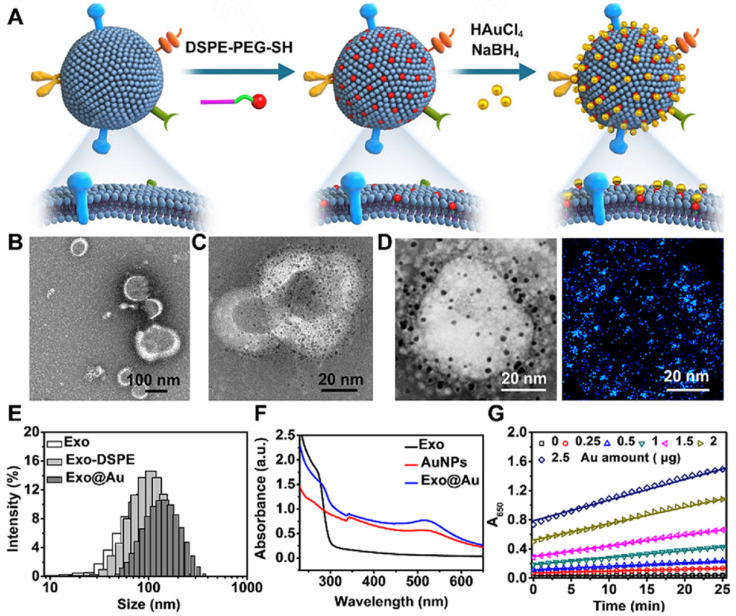
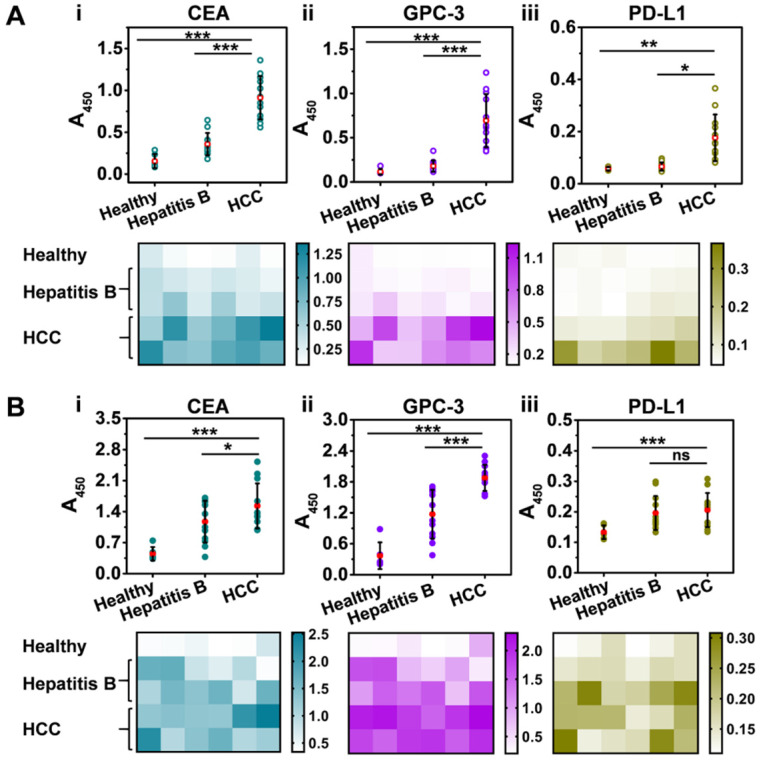
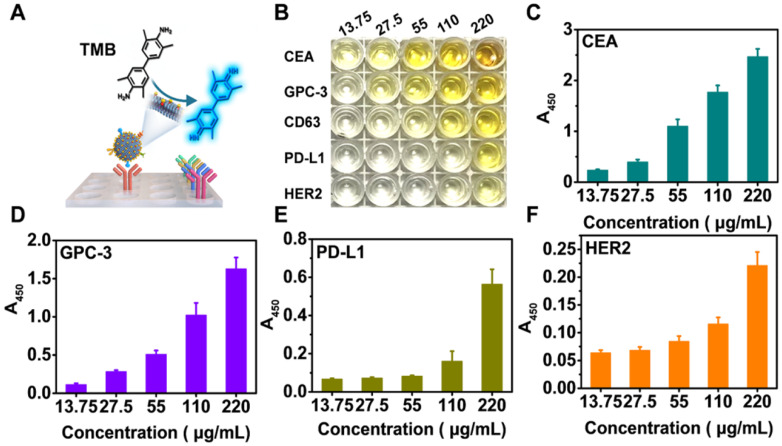
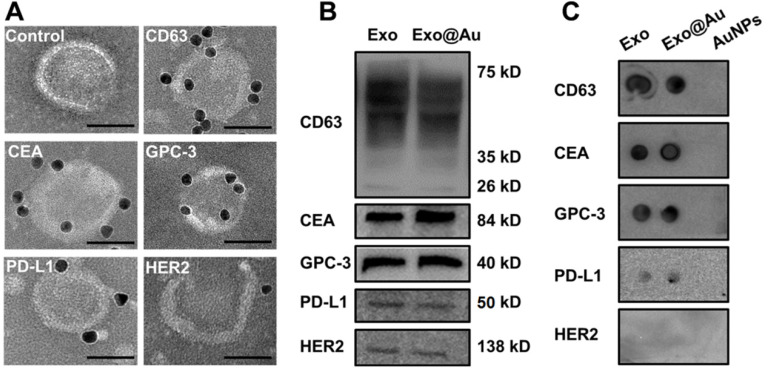
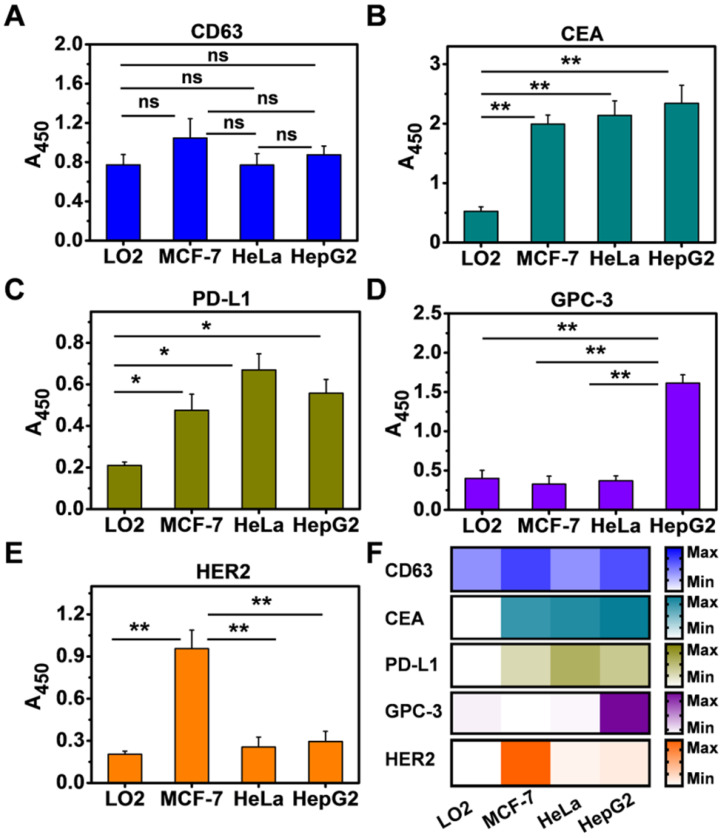
The proteins expressed on exosomes have emerged as promising liquid-biopsy biomarkers for cancer diagnosis. However, molecular profiling of exosomal proteins remains technically challenging. Herein, we report a nanozyme-assisted immunosorbent assay (NAISA) that enables sensitive and rapid multiplex profiling of exosomal proteins. This NAISA system is based on the installation of peroxidase-like nanozymes onto the phospholipid membranes of exosomes, thus avoiding the need for post-labelling detection antibodies. The exosomal proteins are determined by a sensitive nanozyme-catalyzed colorimetric assay less than 3 h, without the need for multi-step incubation and washing operations. Using NAISA to profile exosomal proteins from different cell lines and clinical samples, we reveal that tumor-associated exosomal proteins can serve as promising biomarkers for accurate cancer diagnosis in a cooperative detection pattern. Exosomes were engineered with DSPE-PEG-SH through hydrophobic interaction, and then were assembled with gold nanoparticles (2 nm) to produce Exo@Au nanozyme. The proteins on Exo@Au could be selectively captured by their specific antibodies seeded into a 96-well plate. The immobilized Exo@Au shows peroxidase-like activity to perform colorimetric assays by reaction with 3,3',5,5'-tetramethylbenzidine (TMB) and HO. The protein levels of exosomes were recorded on a microplate reader. The NAISA platform is capable of profiling multiple exosomal proteins from both cancer cell lines and clinical samples. The expression levels of exosomal proteins, such as CD63, CEA, GPC-3, PD-L1 and HER2, were used to classify different cancer cell lines. Moreover, the protein profiles have been applied to differentiate healthy donors, hepatitis B patients, and hepatic cell carcinoma (HCC) patients with high accuracy. The NAISA nanozyme was allowed to rapidly profile multiple exosomal proteins and could have great promise for early HCC diagnosis and identification of other cancer types.
外泌体表面表达的蛋白质已成为癌症诊断有前途的液体活检生物标志物。然而,外泌体蛋白的分子谱分析在技术上仍然具有挑战性。在此,我们报告了一种纳米酶辅助免疫吸附测定(NAISA),可实现对外泌体蛋白的灵敏和快速多重分析。该 NAISA 系统基于将过氧化物酶样纳米酶安装到外泌体的磷脂膜上,从而避免了对标记后检测抗体的需求。外泌体蛋白通过灵敏的纳米酶催化比色测定法在不到 3 小时内确定,无需进行多步孵育和洗涤操作。使用 NAISA 对外泌体蛋白进行分析从不同的细胞系和临床样本中,我们发现肿瘤相关的外泌体蛋白可以作为准确癌症诊断的有前途的生物标志物在协同检测模式下。 外泌体通过疏水相互作用与 DSPE-PEG-SH 工程化,然后与金纳米颗粒(2nm)组装,产生 Exo@Au 纳米酶。外泌体上的蛋白质可以通过接种到 96 孔板中的特异性抗体进行选择性捕获。固定的 Exo@Au 显示出过氧化物酶样活性,通过与 3,3',5,5'-四甲基联苯胺(TMB)和 HO 反应进行比色测定。外泌体的蛋白水平在微孔板读数器上记录。 该 NAISA 平台能够对外泌体中的多种蛋白质进行分析从癌细胞系和临床样本。外泌体蛋白的表达水平,如 CD63、CEA、GPC-3、PD-L1 和 HER2,用于对不同的癌细胞系进行分类。此外,该蛋白质图谱已成功应用于区分健康供体、乙型肝炎患者和肝细胞癌(HCC)患者,具有很高的准确性。 NAISA 纳米酶能够快速分析多种外泌体蛋白,有望用于早期 HCC 诊断和其他癌症类型的鉴定。