St James Sara, Bednarz Bryan, Benedict Stanley, Buchsbaum Jeffrey C, Dewaraja Yuni, Frey Eric, Hobbs Robert, Grudzinski Joseph, Roncali Emilie, Sgouros George, Capala Jacek, Xiao Ying
Department of Radiation Oncology, University of California San Francisco, San Francisco, California.
Department of Medical Physics and Human Oncology, University of Wisconsin School of Medicine and Public Health, Madison, Wisconsin.
Int J Radiat Oncol Biol Phys. 2021 Mar 15;109(4):891-901. doi: 10.1016/j.ijrobp.2020.08.035. Epub 2020 Aug 14.
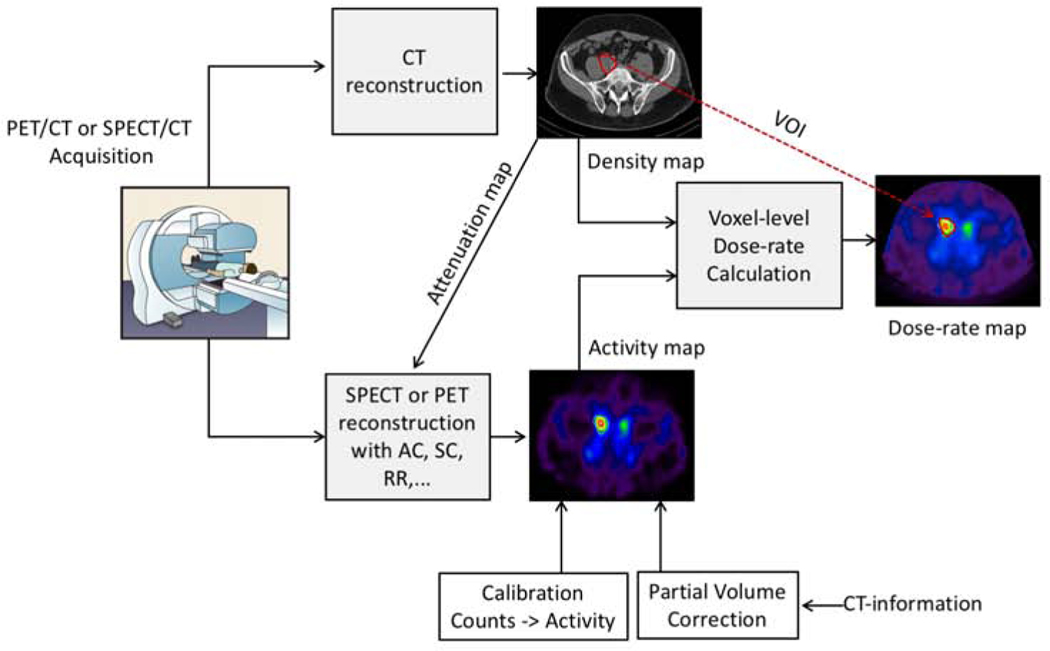
In radiopharmaceutical therapy (RPT), a radionuclide is systemically or locally delivered with the goal of targeting and delivering radiation to cancer cells while minimizing radiation exposure to untargeted cells. Examples of current RPTs include thyroid ablation with the administration of I, treatment of liver cancer with Y microspheres, the treatment of bony metastases with Ra, and the treatment of neuroendocrine tumors with Lu-DOTATATE. New RPTs are being developed where radionuclides are incorporated into systemic targeted therapies. To assure that RPT is appropriately implemented, advances in targeting need to be matched with advances in quantitative imaging and dosimetry methods. Currently, radiopharmaceutical therapy is administered by intravenous or locoregional injection, and the treatment planning has typically been implemented like chemotherapy, where the activity administered is either fixed or based on a patient's body weight or body surface area. RPT pharmacokinetics are measurable by quantitative imaging and are known to vary across patients, both in tumors and normal tissues. Therefore, fixed or weight-based activity prescriptions are not currently optimized to deliver a cytotoxic dose to targets while remaining within the tolerance dose of organs at risk. Methods that provide dose estimates to individual patients rather than to reference geometries are needed to assess and adjust the injected RPT dose. Accurate doses to targets and organs at risk will benefit the individual patients and decrease uncertainties in clinical trials. Imaging can be used to measure activity distribution in vivo, and this information can be used to determine patient-specific treatment plans where the dose to the targets and organs at risk can be calculated. The development and adoption of imaging-based dosimetry methods is particularly beneficial in early clinical trials. In this work we discuss dosimetric accuracy needs in modern radiation oncology, uncertainties in the dosimetry in RPT, and best approaches for imaging and dosimetry of internal radionuclide therapy.
在放射性药物治疗(RPT)中,放射性核素通过全身或局部给药,目的是靶向癌细胞并向其传递辐射,同时将对非靶向细胞的辐射暴露降至最低。当前RPT的例子包括用碘进行甲状腺消融、用钇微球治疗肝癌、用镭治疗骨转移以及用镥-奥曲肽治疗神经内分泌肿瘤。正在开发新的RPT,即将放射性核素纳入全身靶向治疗中。为确保RPT得到恰当实施,靶向方面的进展需要与定量成像和剂量测定方法的进展相匹配。目前,放射性药物治疗通过静脉注射或局部注射给药,治疗计划通常像化疗一样实施,即给药活度要么是固定的,要么基于患者的体重或体表面积。RPT的药代动力学可通过定量成像测量,并且已知在患者之间、肿瘤和正常组织中都会有所不同。因此,目前固定或基于体重的活度处方并未优化到既能向靶标递送细胞毒性剂量,又能保持在危及器官的耐受剂量范围内。需要提供针对个体患者而非参考几何结构的剂量估计方法,以评估和调整注射的RPT剂量。对靶标和危及器官的准确剂量将使个体患者受益,并减少临床试验中的不确定性。成像可用于测量体内的活度分布,该信息可用于确定患者特异性的治疗计划,其中可以计算出对靶标和危及器官的剂量。基于成像的剂量测定方法的开发和采用在早期临床试验中特别有益。在这项工作中,我们讨论了现代放射肿瘤学中剂量测定准确性的需求、RPT剂量测定中的不确定性以及内部放射性核素治疗的成像和剂量测定的最佳方法。