Department of Food Science, Purdue University, 745 Agriculture Mall Drive, West Lafayette, IN, 47907, USA.
Diversey Inc., Charlotte, NC, 28273, USA.
Antimicrob Resist Infect Control. 2020 Aug 17;9(1):134. doi: 10.1186/s13756-020-00792-9.
Bacterial biofilms persistent on dry environmental surfaces in healthcare facilities play an important role in the occurrence of healthcare associated infections (HAI). Compared to wet surface biofilms and planktonic bacteria, dry surface biofilms (DSB) are more tolerant to disinfection. However, there is no official method for developing DSB for in vitro disinfectant efficacy testing. The objectives of this study were to (i) develop an in vitro model of DSB of S. aureus and P. aeruginosa for disinfectant efficacy testing and (ii) investigate the effect of drying times and temperatures on DSB development. We hypothesized that a minimum six log density of DSB could be achieved on glass coupons by desiccating wet surface biofilms near room temperatures. We also hypothesized that a DSB produced by the model in this study will be encased in extracellular polymeric substances (EPS).
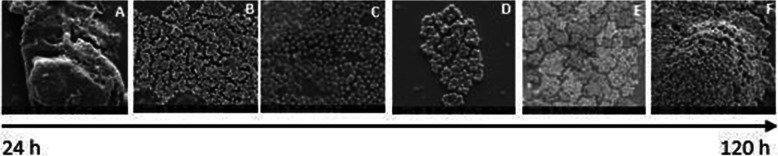
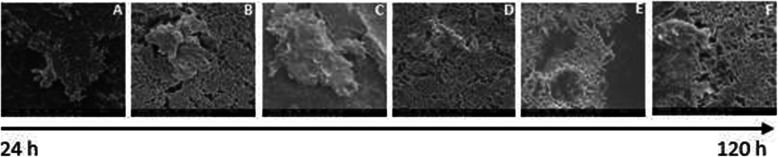
S. aureus ATCC-6538 and P. aeruginosa ATCC-15442 wet surface biofilms were grown on glass coupons following EPA MLB SOP MB-19. A DSB model was developed by drying coupons in an incubator and viable bacteria were recovered following a modified version of EPA MLB SOP MB-20. Scanning electron microscopy was used to confirm the EPS presence on DSB.
Overall, a minimum of six mean log densities of DSB for disinfectant efficacy were recovered per coupon after drying at different temperatures and drying times. Regardless of strain, temperature and dry time, 86% of coupons with DSB were confirmed to have EPS.
A rapid model for developing DSB with characteristic EPS was developed for disinfectant efficacy testing against DSB.
医疗机构干燥环境表面上持续存在的细菌生物膜在发生医院相关感染(HAI)方面起着重要作用。与湿表面生物膜和浮游细菌相比,干燥表面生物膜(DSB)对消毒更具耐受性。然而,目前还没有用于体外消毒剂功效测试的开发 DSB 的官方方法。本研究的目的是:(i)开发用于消毒剂功效测试的金黄色葡萄球菌和铜绿假单胞菌的 DSB 体外模型,(ii)研究干燥时间和温度对 DSB 形成的影响。我们假设通过在室温附近干燥湿表面生物膜,可以在玻璃小条上实现至少 6 个对数密度的 DSB。我们还假设本研究中模型产生的 DSB 将被细胞外聚合物质(EPS)包裹。
按照 EPA MLB SOP MB-19,在玻璃小条上培养金黄色葡萄球菌 ATCC-6538 和铜绿假单胞菌 ATCC-15442 的湿表面生物膜。通过在培养箱中干燥小条来开发 DSB 模型,并按照 EPA MLB SOP MB-20 的修改版回收活细菌。使用扫描电子显微镜确认 DSB 上存在 EPS。
总体而言,在不同温度和干燥时间下干燥后,每个小条至少回收了 6 个平均对数密度的 DSB 用于消毒剂功效测试。无论菌株如何,温度和干燥时间,86%的 DSB 小条被证实具有 EPS。
开发了一种具有特征性 EPS 的 DSB 快速模型,用于针对 DSB 的消毒剂功效测试。