Department of Bioscience and Biotechnology, Konkuk University, Seoul 05029, Republic of Korea.
J Microbiol Biotechnol. 2020 Oct 28;30(10):1560-1567. doi: 10.4014/jmb.2007.07003.
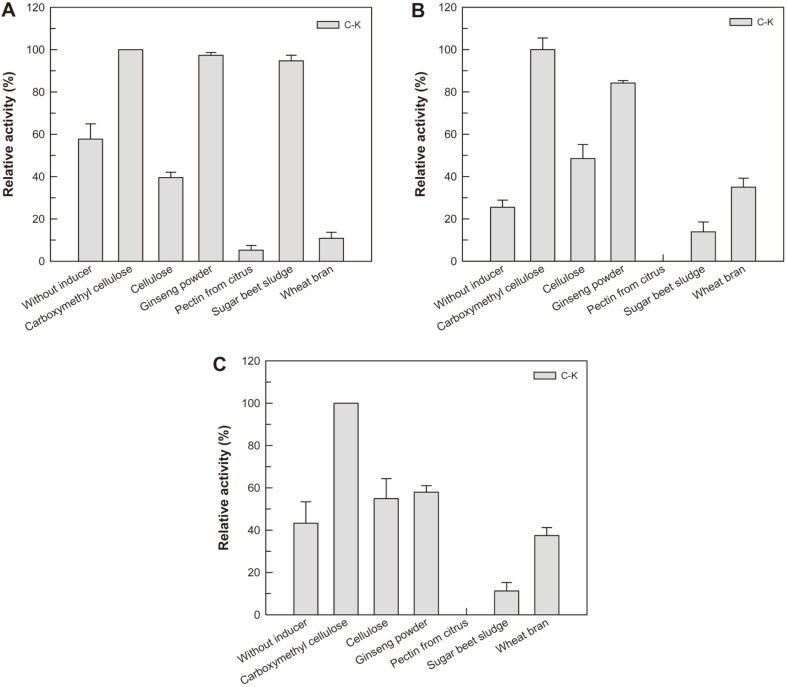
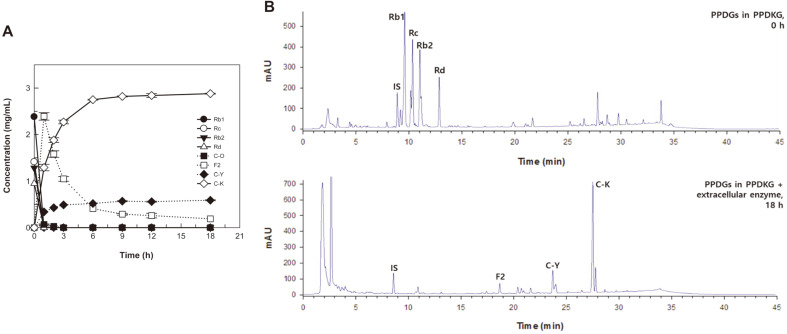
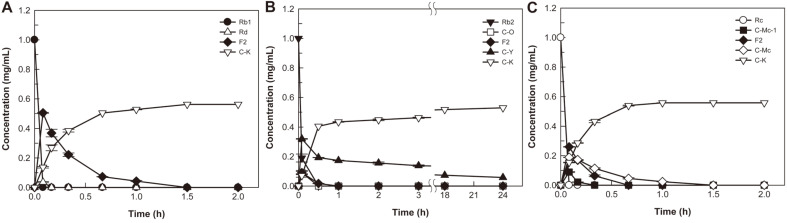
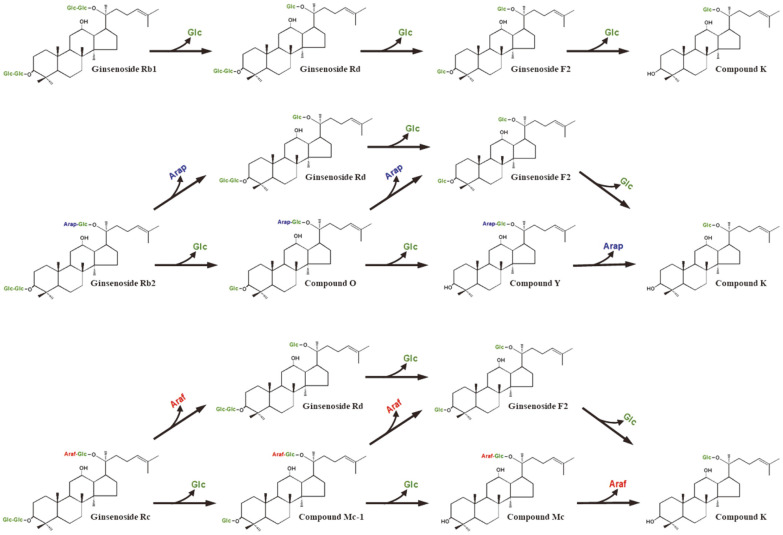
Compound K (C-K) is one of the most pharmaceutically effective ginsenosides, but it is absent in natural ginseng. However, C-K can be obtained through the hydrolysis of protopanaxadiol-type ginsenosides (PPDGs) in natural ginseng. The aim of this study was to obtain the high concentration of food-available C-K using PPDGs in Korean ginseng extract by an extracellular enzyme from KACC 46495. was cultivated in the culture medium containing the inducer carboxymethyl cellulose (CMC) for 6 days. The extracellular enzyme extracted from was prepared from the culture broth by filtration, ammonium sulfate, and dialysis. The extracellular enzyme was used for C-K production using PPDGs. The glycoside-hydrolyzing pathways for converting PPDGs into C-K by the extracellular enzyme were Rb1 → Rd → F2 → C-K, Rb2 → Rd or compound O → F2 or compound Y → C-K, and Rc → Rd or compound Mc1 → F2 or compound Mc → C-K. The extracellular enzyme from at 8.0 mg/ml, which was obtained by the induction of CMC during the cultivation, converted 6.0 mg/ml (5.6 mM) PPDGs in Korean ginseng extract into 2.8 mg/ml (4.5 mM) food-available C-K in 9 h, with a productivity of 313 mg/l/h and a molar conversion of 80%. To the best of our knowledge, the productivity and concentration of C-K of the extracellular enzyme are the highest among those by crude enzymes from wild-type microorganisms.
化合物 K(C-K)是最具药用功效的人参皂苷之一,但它在天然人参中并不存在。然而,C-K 可以通过天然人参中原参二醇型人参皂苷(PPDG)的水解获得。本研究旨在通过 KACC 46495 的胞外酶从高丽参提取物中的 PPDG 获得高浓度的可食用 C-K。在含有诱导剂羧甲基纤维素(CMC)的培养基中培养 6 天。从发酵液中通过过滤、硫酸铵沉淀和透析制备来自 的胞外酶。利用 PPDG 用胞外酶生产 C-K。该胞外酶通过糖苷水解途径将 PPDG 转化为 C-K,具体为 Rb1→Rd→F2→C-K、Rb2→Rd 或化合物 O→F2 或化合物 Y→C-K 以及 Rc→Rd 或化合物 Mc1→F2 或化合物 Mc→C-K。在培养过程中通过 CMC 诱导获得的浓度为 8.0mg/ml 的胞外酶,在 9 小时内将 6.0mg/ml(5.6mM)高丽参提取物中的 PPDG 转化为 2.8mg/ml(4.5mM)可食用的 C-K,产率为 313mg/l/h,摩尔转化率为 80%。据我们所知,该胞外酶的 C-K 产率和浓度在野生型微生物粗酶中的最高。