Department of Internal Medicine, Seoul National University College of Medicine, Seoul, Korea.
Department of Internal Medicine, Seoul Metropolitan Government-Seoul National University Boramae Medical Center, Seoul, Korea.
J Korean Med Sci. 2020 Aug 17;35(32):e297. doi: 10.3346/jkms.2020.35.e297.
There is limited information describing the presenting characteristics and dynamic clinical changes in severe acute respiratory syndrome coronavirus 2 (SARS-CoV-2) infection diagnosed in the early phase of illness. This study is a case series of patients with coronavirus disease 2019 (COVID-19) admitted to 11 hospitals in Korea.
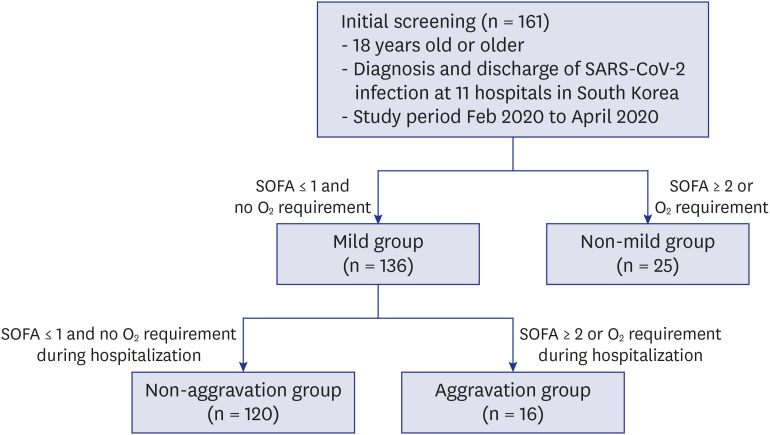
Patients with confirmed SARS-CoV-2 infection by positive polymerase chain reaction (PCR) testing of respiratory specimens by active surveillance that were finally discharged between February 20 and April 30, 2020 were included. Patients were classified into mild and non-mild groups on initial admission according to oxygen demand and Sequential Organ Failure Assessment score, and the mild group was followed up and subgrouped into non-aggravation and aggravation groups.
A total of 161 patients with SARS-CoV2 infection were enrolled. Among the mild group of 136 patients, 11.7% of patients experienced clinical aggravation during hospitalization, but there was no initial clinical parameter on admission predicting their aggravation. Fever (odds ratio [OR], 4.56), thrombocytopenia (OR, 12.87), fever (OR, 27.22) and lactate dehydrogenase (LDH) > 300 U/L (OR, 18.35), and CRP > 1 mg/dL (OR, 11.31) significantly indicated aggravation in the 1st, 2nd, 3rd, and 4th 5-day periods, respectively. PCR positivity lasted for a median of 22 days and 32 days after the onset of illness in the non-aggravation and aggravation groups, respectively.
Old age was associated with early severe presentation. Clinical aggravation among asymptomatic or mild patients could not be predicted initially but was heralded by fever and several laboratory markers during the clinical course.
目前关于在疾病早期诊断的严重急性呼吸综合征冠状病毒 2 型(SARS-CoV-2)感染的临床表现和动态临床变化的信息有限。本研究是对韩国 11 家医院的 2019 年冠状病毒病(COVID-19)患者的病例系列研究。
纳入 2020 年 2 月 20 日至 4 月 30 日期间通过主动监测,对呼吸道标本进行的 SARS-CoV-2 感染的阳性聚合酶链反应(PCR)检测而最终出院的确诊 SARS-CoV-2 感染患者。根据入院时的氧气需求和序贯器官衰竭评估评分,患者被分为轻症和非轻症两组,轻症组在入院时进行随访,并分为非恶化和恶化亚组。
共纳入 161 例 SARS-CoV2 感染患者。在 136 例轻症患者中,11.7%的患者在住院期间出现临床恶化,但入院时无初始临床参数可预测其恶化。发热(优势比[OR],4.56)、血小板减少(OR,12.87)、发热(OR,27.22)和乳酸脱氢酶(LDH)>300 U/L(OR,18.35),以及 C 反应蛋白(CRP)>1mg/dL(OR,11.31)在第 1、2、3 和 4 个 5 天期间分别显著提示恶化。非恶化和恶化组的 PCR 阳性持续时间分别为发病后 22 天和 32 天中位数。
高龄与早期严重表现相关。无症状或轻症患者的临床恶化最初无法预测,但在病程中发热和几个实验室标志物预示着病情恶化。