• 文献检索
  • 文档翻译
  • 深度研究
  • 学术资讯
  • Suppr Zotero 插件Zotero 插件
  • 邀请有礼
  • 套餐&价格
  • 历史记录
应用&插件
Suppr Zotero 插件Zotero 插件浏览器插件Mac 客户端Windows 客户端微信小程序
定价
高级版会员购买积分包购买API积分包
服务
文献检索文档翻译深度研究API 文档MCP 服务
关于我们
关于 Suppr公司介绍联系我们用户协议隐私条款
关注我们

Suppr 超能文献

核心技术专利:CN118964589B侵权必究
粤ICP备2023148730 号-1Suppr @ 2026

文献检索

告别复杂PubMed语法,用中文像聊天一样搜索,搜遍4000万医学文献。AI智能推荐,让科研检索更轻松。

立即免费搜索

文件翻译

保留排版,准确专业,支持PDF/Word/PPT等文件格式,支持 12+语言互译。

免费翻译文档

深度研究

AI帮你快速写综述,25分钟生成高质量综述,智能提取关键信息,辅助科研写作。

立即免费体验

开发和验证一种用于 COVID-19 确诊患者早期分诊的预后模型。

Development and validation of a prognostic model for early triage of patients diagnosed with COVID-19.

机构信息

Research Institute, National Health Insurance Service Ilsan Hospital, Goyang, Korea.

Department of Radiology, National Health Insurance Service Ilsan Hospital, Goyang, Korea.

出版信息

Sci Rep. 2021 Nov 9;11(1):21923. doi: 10.1038/s41598-021-01452-7.

DOI:10.1038/s41598-021-01452-7
PMID:34754036
原文链接:https://pmc.ncbi.nlm.nih.gov/articles/PMC8578640/
Abstract

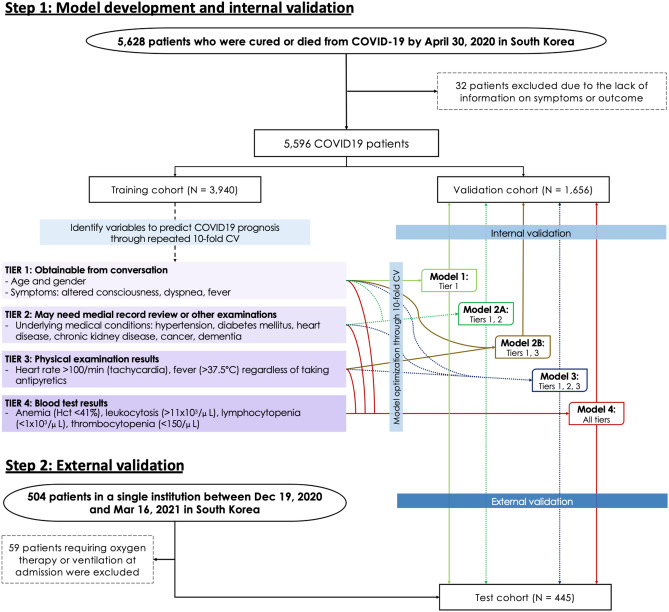
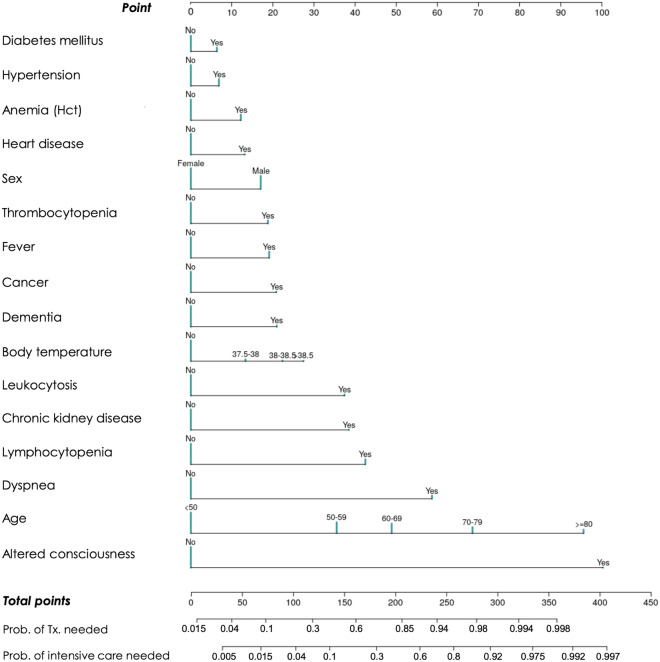
We developed a tool to guide decision-making for early triage of COVID-19 patients based on a predicted prognosis, using a Korean national cohort of 5,596 patients, and validated the developed tool with an external cohort of 445 patients treated in a single institution. Predictors chosen for our model were older age, male sex, subjective fever, dyspnea, altered consciousness, temperature ≥ 37.5 °C, heart rate ≥ 100 bpm, systolic blood pressure ≥ 160 mmHg, diabetes mellitus, heart disease, chronic kidney disease, cancer, dementia, anemia, leukocytosis, lymphocytopenia, and thrombocytopenia. In the external validation, when age, sex, symptoms, and underlying disease were used as predictors, the AUC used as an evaluation metric for our model's performance was 0.850 in predicting whether a patient will require at least oxygen therapy and 0.833 in predicting whether a patient will need critical care or die from COVID-19. The AUCs improved to 0.871 and 0.864, respectively, when additional information on vital signs and blood test results were also used. In contrast, the protocols currently recommended in Korea showed AUCs less than 0.75. An application for calculating the prognostic score in COVID-19 patients based on the results of this study is presented on our website ( https://nhimc.shinyapps.io/ih-psc/ ), where the results of the validation ongoing in our institution are periodically updated.

摘要

我们开发了一种工具,通过对 5596 名韩国患者的全国队列进行预测预后,来指导 COVID-19 患者的早期分诊决策,并使用单机构治疗的 445 名患者的外部队列对开发的工具进行验证。我们的模型选择的预测因素为年龄较大、男性、主观发热、呼吸困难、意识改变、体温≥37.5°C、心率≥100 bpm、收缩压≥160mmHg、糖尿病、心脏病、慢性肾脏病、癌症、痴呆、贫血、白细胞增多、淋巴细胞减少和血小板减少。在外部验证中,当使用年龄、性别、症状和基础疾病作为预测因素时,我们模型性能的评估指标 AUC 用于预测患者是否需要至少吸氧的 AUC 为 0.850,用于预测患者是否需要重症监护或死于 COVID-19 的 AUC 为 0.833。当还使用生命体征和血液检查结果的其他信息时,AUC 分别提高到 0.871 和 0.864。相比之下,目前在韩国推荐的方案显示 AUC 小于 0.75。本研究结果的 COVID-19 患者预后评分计算器应用程序已在我们的网站(https://nhimc.shinyapps.io/ih-psc/)上发布,我们机构正在进行的验证结果将定期更新。

https://cdn.ncbi.nlm.nih.gov/pmc/blobs/d485/8578640/2867c83f9968/41598_2021_1452_Fig4_HTML.jpg
https://cdn.ncbi.nlm.nih.gov/pmc/blobs/d485/8578640/762669b2acfb/41598_2021_1452_Fig1_HTML.jpg
https://cdn.ncbi.nlm.nih.gov/pmc/blobs/d485/8578640/da546de5f185/41598_2021_1452_Fig2_HTML.jpg
https://cdn.ncbi.nlm.nih.gov/pmc/blobs/d485/8578640/95f00b3a4525/41598_2021_1452_Fig3_HTML.jpg
https://cdn.ncbi.nlm.nih.gov/pmc/blobs/d485/8578640/2867c83f9968/41598_2021_1452_Fig4_HTML.jpg
https://cdn.ncbi.nlm.nih.gov/pmc/blobs/d485/8578640/762669b2acfb/41598_2021_1452_Fig1_HTML.jpg
https://cdn.ncbi.nlm.nih.gov/pmc/blobs/d485/8578640/da546de5f185/41598_2021_1452_Fig2_HTML.jpg
https://cdn.ncbi.nlm.nih.gov/pmc/blobs/d485/8578640/95f00b3a4525/41598_2021_1452_Fig3_HTML.jpg
https://cdn.ncbi.nlm.nih.gov/pmc/blobs/d485/8578640/2867c83f9968/41598_2021_1452_Fig4_HTML.jpg

相似文献

1
Development and validation of a prognostic model for early triage of patients diagnosed with COVID-19.开发和验证一种用于 COVID-19 确诊患者早期分诊的预后模型。
Sci Rep. 2021 Nov 9;11(1):21923. doi: 10.1038/s41598-021-01452-7.
2
A novel deterioration prediction system for mild COVID-19 patients in Korea: a retrospective study.韩国一种新型的轻症 COVID-19 患者恶化预测系统:一项回顾性研究。
Sci Rep. 2024 Aug 30;14(1):20171. doi: 10.1038/s41598-024-71033-x.
3
Development of a severity of disease score and classification model by machine learning for hospitalized COVID-19 patients.基于机器学习的住院 COVID-19 患者疾病严重程度评分和分类模型的建立。
PLoS One. 2021 Apr 21;16(4):e0240200. doi: 10.1371/journal.pone.0240200. eCollection 2021.
4
Development and Validation of a Robust and Interpretable Early Triaging Support System for Patients Hospitalized With COVID-19: Predictive Algorithm Modeling and Interpretation Study.开发和验证用于 COVID-19 住院患者的强大且可解释的早期分诊支持系统:预测算法建模和解释研究。
J Med Internet Res. 2024 Jan 11;26:e52134. doi: 10.2196/52134.
5
A Clinical Risk Score to Predict In-hospital Mortality from COVID-19 in South Korea.韩国用于预测 COVID-19 住院患者死亡率的临床风险评分
J Korean Med Sci. 2021 Apr 19;36(15):e108. doi: 10.3346/jkms.2021.36.e108.
6
Prognosis Score System to Predict Survival for COVID-19 Cases: a Korean Nationwide Cohort Study.用于预测 COVID-19 病例生存的预后评分系统:一项韩国全国队列研究。
J Med Internet Res. 2021 Feb 22;23(2):e26257. doi: 10.2196/26257.
7
Prediction Models for the Clinical Severity of Patients With COVID-19 in Korea: Retrospective Multicenter Cohort Study.韩国 COVID-19 患者临床严重程度预测模型:回顾性多中心队列研究。
J Med Internet Res. 2021 Apr 16;23(4):e25852. doi: 10.2196/25852.
8
Derivation and validation of a clinical severity score for acutely ill adults with suspected COVID-19: The PRIEST observational cohort study.一项针对疑似 COVID-19 的急性病成年人的临床严重程度评分的推导和验证:PRIEST 观察性队列研究。
PLoS One. 2021 Jan 22;16(1):e0245840. doi: 10.1371/journal.pone.0245840. eCollection 2021.
9
A novel artificial intelligence-assisted triage tool to aid in the diagnosis of suspected COVID-19 pneumonia cases in fever clinics.一种新型人工智能辅助分诊工具,用于协助发热门诊诊断疑似新型冠状病毒肺炎病例。
Ann Transl Med. 2021 Feb;9(3):201. doi: 10.21037/atm-20-3073.
10
Prognostic accuracy of emergency department triage tools for adults with suspected COVID-19: the PRIEST observational cohort study.成人疑似 COVID-19 患者的急诊科分诊工具的预后准确性:PRIEST 观察性队列研究。
Emerg Med J. 2021 Aug;38(8):587-593. doi: 10.1136/emermed-2020-210783. Epub 2021 Jun 3.

引用本文的文献

1
The gut microbiota as an early predictor of COVID-19 severity.肠道微生物群作为 COVID-19 严重程度的早期预测指标。
mSphere. 2024 Oct 29;9(10):e0018124. doi: 10.1128/msphere.00181-24. Epub 2024 Sep 19.
2
Accuracy of routine laboratory tests to predict mortality and deterioration to severe or critical COVID-19 in people with SARS-CoV-2.常规实验室检测对预测 SARS-CoV-2 感染者死亡和病情恶化为重症或危重症 COVID-19 的准确性。
Cochrane Database Syst Rev. 2024 Aug 6;8(8):CD015050. doi: 10.1002/14651858.CD015050.pub2.
3
Triage body temperature and its influence on patients with acute myocardial infarction.

本文引用的文献

1
A Clinical Risk Score to Predict In-hospital Mortality from COVID-19 in South Korea.韩国用于预测 COVID-19 住院患者死亡率的临床风险评分
J Korean Med Sci. 2021 Apr 19;36(15):e108. doi: 10.3346/jkms.2021.36.e108.
2
CANPT Score: A Tool to Predict Severe COVID-19 on Admission.CANPT评分:一种预测入院时重症COVID-19的工具。
Front Med (Lausanne). 2021 Feb 18;8:608107. doi: 10.3389/fmed.2021.608107. eCollection 2021.
3
Development and validation of the ISARIC 4C Deterioration model for adults hospitalised with COVID-19: a prospective cohort study.
对体温进行分类,并观察其对急性心肌梗死患者的影响。
BMC Cardiovasc Disord. 2023 Aug 4;23(1):388. doi: 10.1186/s12872-023-03372-y.
4
Prediction of COVID-19 Patients' Survival by Deep Learning Approaches.通过深度学习方法预测COVID-19患者的生存率
Med J Islam Repub Iran. 2022 Nov 29;36:144. doi: 10.47176/mjiri.36.144. eCollection 2022.
ISARIC 4C 成人 COVID-19 恶化模型的开发和验证:一项前瞻性队列研究。
Lancet Respir Med. 2021 Apr;9(4):349-359. doi: 10.1016/S2213-2600(20)30559-2. Epub 2021 Jan 11.
4
Machine learning prediction for mortality of patients diagnosed with COVID-19: a nationwide Korean cohort study.基于全国韩国队列研究的 COVID-19 患者死亡率的机器学习预测。
Sci Rep. 2020 Oct 30;10(1):18716. doi: 10.1038/s41598-020-75767-2.
5
Development and Validation of the Quick COVID-19 Severity Index: A Prognostic Tool for Early Clinical Decompensation.快速 COVID-19 严重程度指数的制定与验证:一种用于早期临床失代偿的预后工具。
Ann Emerg Med. 2020 Oct;76(4):442-453. doi: 10.1016/j.annemergmed.2020.07.022. Epub 2020 Jul 21.
6
Early prediction of disease progression in COVID-19 pneumonia patients with chest CT and clinical characteristics.基于胸部 CT 与临床特征的 COVID-19 肺炎患者疾病进展的早期预测。
Nat Commun. 2020 Oct 2;11(1):4968. doi: 10.1038/s41467-020-18786-x.
7
Developing a COVID-19 mortality risk prediction model when individual-level data are not available.在无法获得个体层面数据时开发 COVID-19 死亡率风险预测模型。
Nat Commun. 2020 Sep 7;11(1):4439. doi: 10.1038/s41467-020-18297-9.
8
Disease progression patterns and risk factors associated with mortality in deceased patients with COVID-19 in Hubei Province, China.中国湖北省 COVID-19 死亡患者疾病进展模式和与死亡率相关的因素。
Immun Inflamm Dis. 2020 Dec;8(4):584-594. doi: 10.1002/iid3.343. Epub 2020 Aug 28.
9
Risk factors for developing into critical COVID-19 patients in Wuhan, China: A multicenter, retrospective, cohort study.中国武汉新冠肺炎重症患者的危险因素:一项多中心、回顾性队列研究。
EClinicalMedicine. 2020 Aug;25:100471. doi: 10.1016/j.eclinm.2020.100471. Epub 2020 Jul 30.
10
Clinical Characteristics of COVID-19: Clinical Dynamics of Mild Severe Acute Respiratory Syndrome Coronavirus 2 Infection Detected by Early Active Surveillance.新型冠状病毒肺炎的临床特征:通过早期主动监测检测到的轻度至重度严重急性呼吸综合征冠状病毒 2 感染的临床动态。
J Korean Med Sci. 2020 Aug 17;35(32):e297. doi: 10.3346/jkms.2020.35.e297.