International Livestock Research Institute (ILRI), Hanoi, Vietnam.
Department of Health Management, Atlantic Veterinary College, University of Prince Edward Island, Charlottetown, PEI, Canada.
Transbound Emerg Dis. 2021 May;68(3):1384-1391. doi: 10.1111/tbed.13802. Epub 2020 Aug 29.
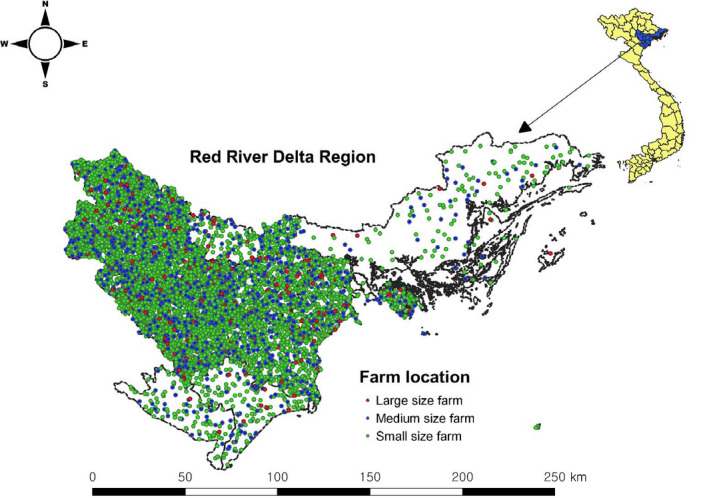
The main objectives of this study were to model various scenarios of African swine fever (ASF) virus transmission among farms in Vietnam and to evaluate the impact of control strategies using North American Animal Disease Spread Model (NAADSM). A total of 7,882 pig farms in the Red River Delta (RRD) region were obtained from the General Statistics Office, and then, random points corresponding to the number of farms in each province were generated as exact farm locations were not available. A total of 10 models were developed, including movement control scenarios. In addition, we conducted sensitivity analysis to assess the impact of indirect contact transmission probability (TP). Overall, the indirect contact exhibited an important role in transmitting the ASF virus. In order to minimize ASF transmission between farms, we found that movement restriction needed to reach a certain level (approximately between 50% and 75%) and that the restriction had to be applied in a timely manner. This study offers valuable insight into how ASF virus can be transmitted via direct and indirect contact and controlled among farms under the various simulation scenarios. Our results suggest that the enforcement of movement restriction was an effective control measure as soon as the outbreaks were reported. In addition, this study provided evidence that high standards of biosecurity can contribute to the reduction of disease spread.
本研究的主要目的是在越南农场之间模拟各种非洲猪瘟(ASF)病毒传播情景,并利用北美动物疾病传播模型(NAADSM)评估控制策略的影响。从统计局获得了红河三角洲(RRD)地区的 7882 个养猪场,然后,根据各省的农场数量生成相应的随机点,因为无法获得确切的农场位置。共开发了 10 个模型,包括移动控制情景。此外,我们还进行了敏感性分析,以评估间接接触传播概率(TP)的影响。总体而言,间接接触在 ASF 病毒传播中起着重要作用。为了最大程度地减少农场之间的 ASF 传播,我们发现移动限制需要达到一定水平(约为 50%至 75%),并且必须及时实施限制。本研究深入了解了 ASF 病毒如何通过直接和间接接触传播以及在各种模拟情景下在农场之间进行控制。我们的结果表明,一旦报告暴发,实施移动限制是一种有效的控制措施。此外,本研究还提供了证据表明,高标准的生物安全措施有助于减少疾病传播。