State Key Laboratory of Materials-Oriented Chemical Engineering, College of Biotechnology and Pharmaceutical Engineering, Jiangsu National Synergetic Innovation Center for Advanced Materials (SICAM), Nanjing Tech University, Nanjing, 211816, People's Republic of China.
Microb Cell Fact. 2020 Aug 18;19(1):165. doi: 10.1186/s12934-020-01422-0.
L-malate is one of the most important platform chemicals widely used in food, metal cleaning, textile finishing, pharmaceuticals, and synthesis of various fine chemicals. Recently, the development of biotechnological routes to produce L-malate from renewable resources has attracted significant attention.
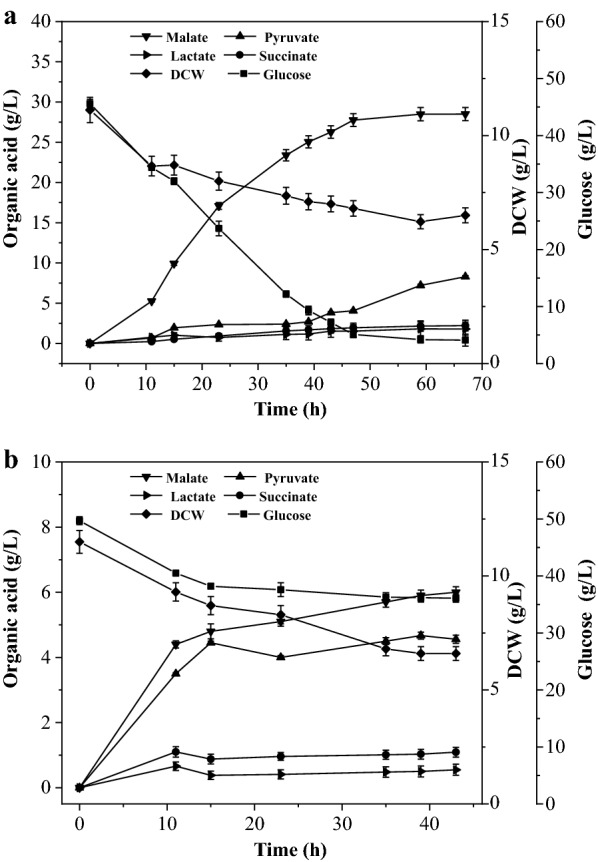
A potential L-malate producing strain E. coli BA040 was obtained by inactivating the genes of fumB, frdABCD, ldhA and pflB. After co-overexpression of mdh and pck, BA063 achieved 18 g/L glucose consumption, leading to an increase in L-malate titer and yield of 13.14 g/L and 0.73 g/g, respectively. Meantime, NADH/NAD ratio decreased to 0.72 with the total NAD(H) of 38.85 µmol/g DCW, and ATP concentration reached 715.79 nmol/g DCW. During fermentation in 5L fermentor with BA063, 41.50 g/L glucose was consumed within 67 h with the final L-malate concentration and yield of 28.50 g/L, 0.69 g/g when heterologous CO source was supplied.
The availability of NAD(H) was correlated positively with the glucose utilization rate and cellular metabolism capacities, and lower NADH/NAD ratio was beneficial for the accumulation of L-malate under anaerobic conditions. Enhanced ATP level could significantly enlarge the intracellular NAD(H) pool under anaerobic condition. Moreover, there might be an inflection point, that is, the increase of NAD(H) pool before the inflection point is followed by the improvement of metabolic performance, while the increase of NAD(H) pool after the inflection point has no significant impacts and NADH/NAD ratio would dominate the metabolic flux. This study is a typical case of anaerobic organic acid fermentation, and demonstrated that ATP level, NAD(H) pool and NADH/NAD ratio are three important regulatory parameters during the anaerobic production of L-malate.
L-苹果酸是一种最重要的平台化学品之一,广泛应用于食品、金属清洗、纺织品整理、制药和各种精细化学品的合成。最近,利用可再生资源通过生物技术途径生产 L-苹果酸的发展引起了人们的极大关注。
通过失活 fumB、frdABCD、ldhA 和 pflB 基因,获得了一株潜在的 L-苹果酸生产菌株 E. coli BA040。在共过表达 mdh 和 pck 后,BA063 实现了 18g/L 葡萄糖消耗,导致 L-苹果酸的产量和产率分别提高了 13.14g/L 和 0.73g/g。同时,NADH/NAD 比降低至 0.72,总 NAD(H)为 38.85µmol/g DCW,ATP 浓度达到 715.79nmol/g DCW。在 5L 发酵罐中用 BA063 发酵时,41.50g/L 葡萄糖在 67h 内被消耗,当提供异源 CO 源时,最终 L-苹果酸浓度和产率分别为 28.50g/L 和 0.69g/g。
NAD(H)的可用性与葡萄糖利用率和细胞代谢能力呈正相关,较低的 NADH/NAD 比有利于在厌氧条件下积累 L-苹果酸。增强的 ATP 水平可在厌氧条件下显著扩大细胞内 NAD(H)库。此外,可能存在一个转折点,即在转折点之前,NAD(H)库的增加伴随着代谢性能的提高,而在转折点之后,NAD(H)库的增加没有显著影响,NADH/NAD 比将主导代谢通量。本研究是厌氧有机酸发酵的典型案例,证明了 ATP 水平、NAD(H)库和 NADH/NAD 比是 L-苹果酸厌氧生产过程中三个重要的调控参数。