Autonomous University of Nuevo Leon, Faculty of Public Health and Nutrition, Calle Eduardo Aguirre Pequeño y Yuriria, s/n Col. Mitras Centro, C.P. 64460, Monterrey, Nuevo León, Mexico.
Int Breastfeed J. 2020 Aug 19;15(1):73. doi: 10.1186/s13006-020-00316-6.
Exclusive breastfeeding (EBF) has multiple benefits for both the child and the mother; however, there is little data regarding the reason why Mexican mothers with a high socio-economic level abandon EBF before 6 months, and there is limited information about the practice of breastfeeding in private hospitals. The objective was to identify the factors associated with the cessation of exclusive breastfeeding in Mexican mothers at two private hospitals.
A cross-sectional study was conducted with 218 upper-class mothers selected according to their place of residence by geographic location, socio-economic level, and pediatric consultations cost. They were over 18 years old and with children aged 6 to 24 months. Data were collected between July and November 2016 by face to face interview using a structured questionnaire while the mothers waited for the pediatric postnatal care consultation in two private hospitals in northeastern Mexico. Exclusive breastfeeding was measured according to World Health Organization (WHO) recommendations, which consist of providing only breast milk for the first 6 months of life. Chi-squared tests and multivariate logistic regression were performed.
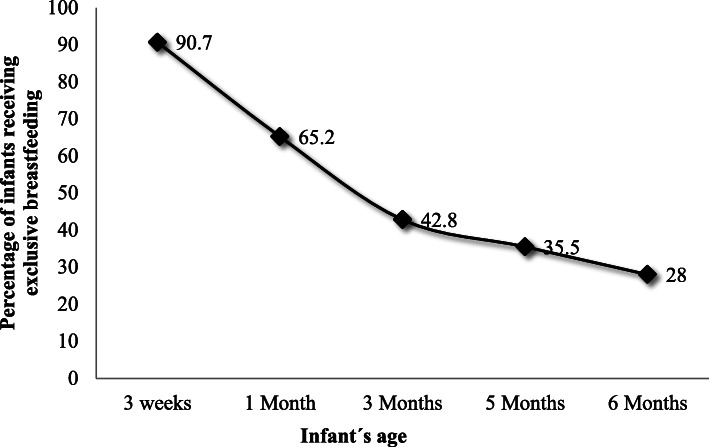
Mean maternal age was 31.4 years (SD of 4.4) and most of the participants had an undergraduate education, were married, and worked outside the home. The prevalence of exclusive breastfeeding at 6 months was 28%. Upper-class working mothers are less likely to continue breastfeeding. There was a negative association with employment (AOR 13.69; 95% CI 1.59, 111.11), bottle use in the first 6 months (AOR 7.93; 95% CI 3.07, 20.48), and a low level of knowledge (AOR 2.18; 95% CI 1.04, 4.56). After 6 months, only 61 mothers (28%) maintained exclusive breastfeeding.
Knowledge level, bottle use, and employment are associated with premature cessation of EBF in Mexican upper-class mothers, attending two private hospitals. There was a high percentage of breastfeeding cessation in the sample. It is necessary to reinforce a strategy that coordinates the action of the different laws, regulations and programs affecting the exclusive breastfeeding practice, in order to adequately promote breastfeeding and support mothers in both public and private sectors.
纯母乳喂养(EBF)对儿童和母亲都有多种益处;然而,对于墨西哥高社会经济水平的母亲为何在 6 个月前放弃纯母乳喂养,以及私立医院母乳喂养的实践情况,数据很少。目的是确定与两家私立医院的墨西哥母亲停止纯母乳喂养相关的因素。
这是一项横断面研究,根据地理位置、社会经济水平和儿科就诊费用,选择了 218 名居住在不同地区的上层社会母亲作为研究对象。这些母亲年龄均在 18 岁以上,且子女年龄在 6 至 24 个月之间。2016 年 7 月至 11 月期间,在墨西哥东北部的两家私立医院,通过面对面访谈,使用结构化问卷收集数据,当时母亲正在等待儿科产后护理咨询。根据世界卫生组织(WHO)的建议,通过纯母乳喂养来衡量,即仅在生命的前 6 个月提供母乳。采用卡方检验和多变量逻辑回归进行分析。
母亲平均年龄为 31.4 岁(标准差为 4.4),大多数参与者拥有本科教育背景、已婚且外出工作。6 个月时纯母乳喂养的流行率为 28%。有工作的上层社会母亲更不可能继续母乳喂养。就业(AOR 13.69;95%CI 1.59,111.11)、前 6 个月使用奶瓶(AOR 7.93;95%CI 3.07,20.48)和知识水平低(AOR 2.18;95%CI 1.04,4.56)与纯母乳喂养的过早停止呈负相关。6 个月后,仅有 61 名母亲(28%)坚持纯母乳喂养。
在参加两家私立医院的墨西哥上层社会母亲中,知识水平、奶瓶使用和就业与过早停止纯母乳喂养有关。样本中母乳喂养的中断率很高。有必要加强协调影响纯母乳喂养实践的不同法律、法规和计划的行动策略,以便在公共和私营部门都能充分促进母乳喂养并为母亲提供支持。