Division of Genetics and Genomics, Department of Pediatrics, Boston Children's Hospital, Boston, MA, 02115, USA.
Divisions of Newborn Medicine and Manton Center for Orphan Disease Research, Department of Pediatrics, Boston Children's Hospital, Boston, MA, 02115, USA.
Sci Rep. 2020 Aug 20;10(1):14045. doi: 10.1038/s41598-020-70656-0.
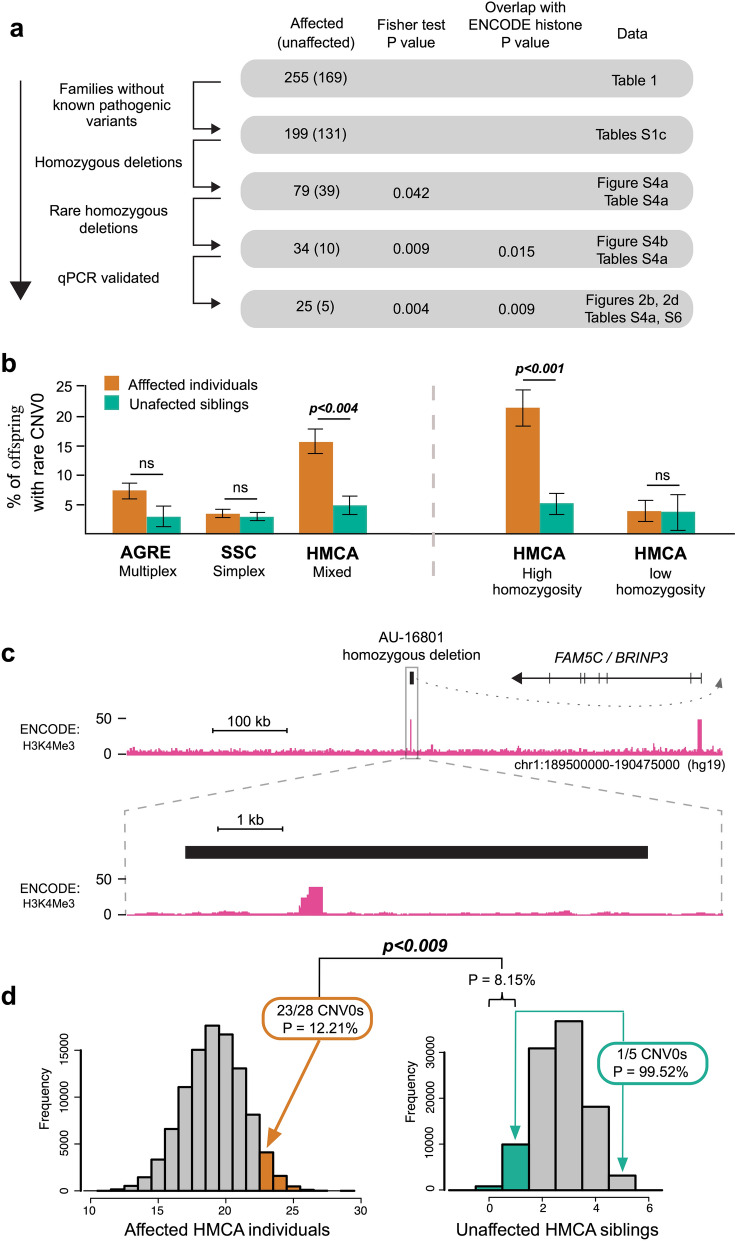
More than 98% of the human genome is made up of non-coding DNA, but techniques to ascertain its contribution to human disease have lagged far behind our understanding of protein coding variations. Autism spectrum disorder (ASD) has been mostly associated with coding variations via de novo single nucleotide variants (SNVs), recessive/homozygous SNVs, or de novo copy number variants (CNVs); however, most ASD cases continue to lack a genetic diagnosis. We analyzed 187 consanguineous ASD families for biallelic CNVs. Recessive deletions were significantly enriched in affected individuals relative to their unaffected siblings (17% versus 4%, p < 0.001). Only a small subset of biallelic deletions were predicted to result in coding exon disruption. In contrast, biallelic deletions in individuals with ASD were enriched for overlap with regulatory regions, with 23/28 CNVs disrupting histone peaks in ENCODE (p < 0.009). Overlap with regulatory regions was further demonstrated by comparisons to the 127-epigenome dataset released by the Roadmap Epigenomics project, with enrichment for enhancers found in primary brain tissue and neuronal progenitor cells. Our results suggest a novel noncoding mechanism of ASD, describe a powerful method to identify important noncoding regions in the human genome, and emphasize the potential significance of gene activation and regulation in cognitive and social function.
人类基因组的 98%以上由非编码 DNA 组成,但确定其对人类疾病的贡献的技术远远落后于我们对蛋白质编码变异的理解。自闭症谱系障碍 (ASD) 主要通过从头单核苷酸变异 (SNV)、隐性/纯合 SNV 或从头拷贝数变异 (CNV) 与编码变异相关联;然而,大多数 ASD 病例仍然缺乏遗传诊断。我们分析了 187 个近亲 ASD 家庭的双等位基因 CNV。与未受影响的兄弟姐妹相比,受影响个体中的隐性缺失明显丰富(17%比 4%,p<0.001)。只有一小部分双等位基因缺失被预测会导致编码外显子破坏。相比之下,ASD 个体中的双等位基因缺失富集与调控区域重叠,在 ENCODE 中 28 个 CNV 中有 23 个破坏了组蛋白峰(p<0.009)。通过与 Roadmap Epigenomics 项目发布的 127-表观基因组数据集进行比较,进一步证明了与调控区域的重叠,在原代脑组织和神经元祖细胞中发现了增强子的富集。我们的结果表明了 ASD 的一种新的非编码机制,描述了一种识别人类基因组中重要非编码区域的有效方法,并强调了基因激活和调控在认知和社会功能中的潜在意义。