Department of Safety Research on Blood and Biological Products, National Institute of Infectious Diseases, Tokyo, Japan.
Research and Development Division, Fujirebio Inc., Tokyo, Japan.
Retrovirology. 2020 Aug 24;17(1):26. doi: 10.1186/s12977-020-00534-0.
The reliable diagnosis of human T-cell leukemia virus type 1 (HTLV-1) infection is important, particularly as it can be vertically transmitted by breast feeding mothers to their infants. However, current diagnosis in Japan requires a confirmatory western blot (WB) test after screening/primary testing for HTLV-1 antibodies, but this test often gives indeterminate results. Thus, this collaborative study evaluated the reliability of diagnostic assays for HTLV-1 infection, including a WB-based one, along with line immunoassay (LIA) as an alternative to WB for confirmatory testing.
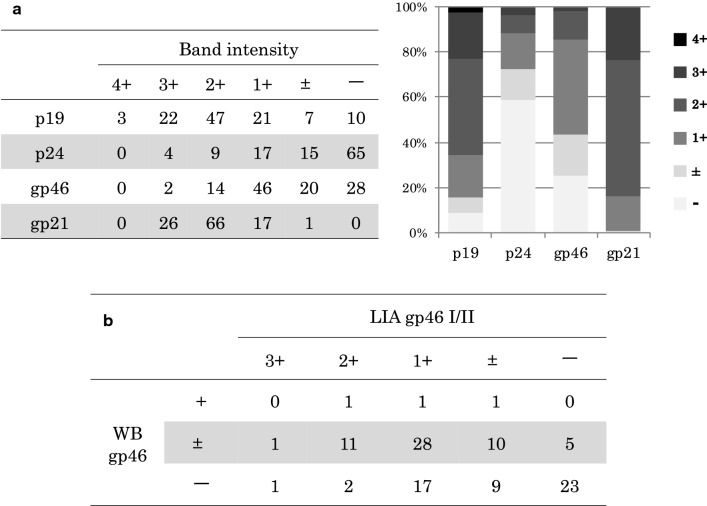
Using peripheral blood samples from blood donors and pregnant women previously serologically screened and subjected to WB analysis, we analyzed the performances of 10 HTLV-1 antibody assay kits commercially available in Japan. No marked differences in the performances of eight of the screening kits were apparent. However, LIA determined most of the WB-indeterminate samples to be conclusively positive or negative (an 88.0% detection rate). When we also compared the sensitivity to HTLV-1 envelope gp21 with that of other antigens by LIA, the sensitivity to gp21 was the strongest. When we also compared the sensitivity to envelope gp46 by LIA with that of WB, LIA showed stronger sensitivity to gp46 than WB did. These findings indicate that LIA is an alternative confirmatory test to WB analysis without gp21. Therefore, we established a novel diagnostic test algorithm for HTLV-1 infection in Japan, including both the performance of a confirmatory test where LIA replaced WB on primary test-reactive samples and an additional decision based on a standardized nucleic acid detection step (polymerase chain reaction, PCR) on the confirmatory test-indeterminate samples. The final assessment of the clinical usefulness of this algorithm involved performing WB analysis, LIA, and/or PCR in parallel for confirmatory testing of known reactive samples serologically screened at clinical laboratories. Consequently, LIA followed by PCR (LIA/PCR), but neither WB/PCR nor PCR/LIA, was found to be the most reliable diagnostic algorithm.
Because the above results show that our novel algorithm is clinically useful, we propose that it is recommended for solving the aforementioned WB-associated reliability issues and for providing a more rapid and precise diagnosis of HTLV-1 infection.
人类 T 细胞白血病病毒 1 型(HTLV-1)感染的可靠诊断非常重要,特别是因为它可以通过母乳喂养的母亲垂直传播给婴儿。然而,目前在日本,在对 HTLV-1 抗体进行筛查/初步检测后,需要进行确证性 Western blot(WB)检测,但该检测常常给出不确定结果。因此,这项合作研究评估了包括基于 WB 的检测在内的用于 HTLV-1 感染的诊断检测的可靠性,以及线免疫分析(LIA)作为 WB 确证检测的替代方法。
使用先前经血清学筛查并进行 WB 分析的献血者和孕妇的外周血样本,我们分析了日本市售的 10 种 HTLV-1 抗体检测试剂盒的性能。八种筛查试剂盒的性能没有明显差异。然而,LIA 确定大多数 WB 不确定样本为明确阳性或阴性(检出率为 88.0%)。当我们通过 LIA 比较 HTLV-1 包膜 gp21 与其他抗原的灵敏度时,gp21 的灵敏度最强。当我们通过 LIA 比较包膜 gp46 的灵敏度与 WB 时,LIA 对 gp46 的灵敏度强于 WB。这些发现表明,LIA 是 WB 分析的替代确证检测方法,不包括 gp21。因此,我们在日本建立了一种新的 HTLV-1 感染诊断测试算法,包括在初级测试阳性反应样本中用 LIA 替代 WB 进行确证测试的性能,以及在确证测试不确定样本中基于标准化核酸检测步骤(聚合酶链反应,PCR)的附加决策。该算法临床实用性的最终评估涉及在临床实验室对已知血清学筛查阳性反应样本进行并行的 WB 分析、LIA 和/或 PCR 确证检测。结果表明,LIA 后紧跟 PCR(LIA/PCR),而不是 WB/PCR 或 PCR/LIA,是最可靠的诊断算法。
由于上述结果表明我们的新算法具有临床实用性,因此我们建议推荐该算法用于解决上述与 WB 相关的可靠性问题,并提供更快速和准确的 HTLV-1 感染诊断。