Vliegenthart Gerard A, Ravichandran Arvind, Ripoll Marisol, Auth Thorsten, Gompper Gerhard
Theoretical Soft Matter and Biophysics, Institute of Complex Systems and Institute for Advanced Simulation, Forschungszentrum Jülich, 52425 Jülich, Germany.
Sci Adv. 2020 Jul 22;6(30):eaaw9975. doi: 10.1126/sciadv.aaw9975. eCollection 2020 Jul.
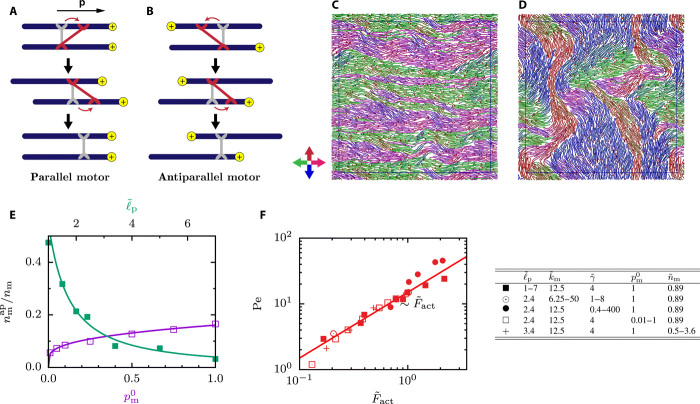
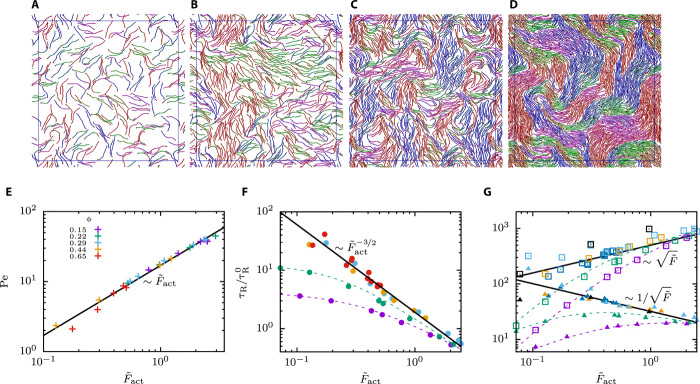
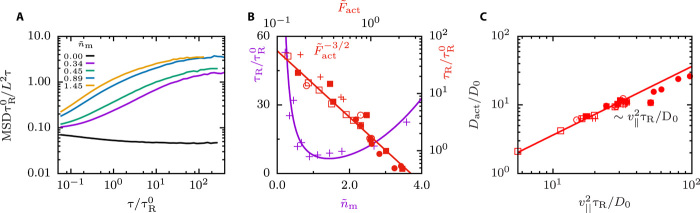
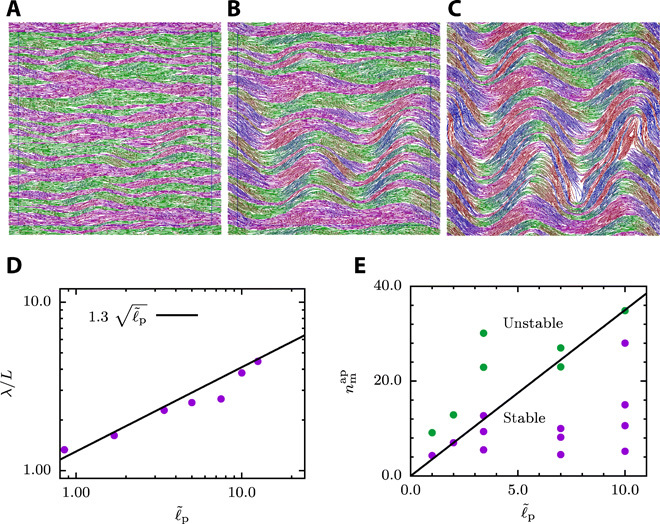
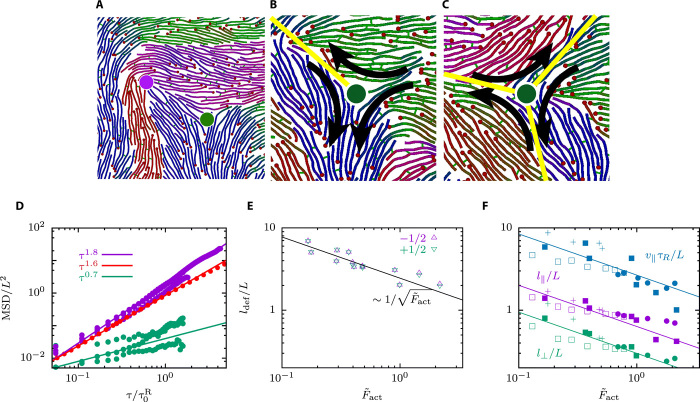
Motor proteins drive persistent motion and self-organization of cytoskeletal filaments. However, state-of-the-art microscopy techniques and continuum modeling approaches focus on large length and time scales. Here, we perform component-based computer simulations of polar filaments and molecular motors linking microscopic interactions and activity to self-organization and dynamics from the filament level up to the mesoscopic domain level. Dynamic filament cross-linking and sliding and excluded-volume interactions promote formation of bundles at small densities and of active polar nematics at high densities. A buckling-type instability sets the size of polar domains and the density of topological defects. We predict a universal scaling of the active diffusion coefficient and the domain size with activity, and its dependence on parameters like motor concentration and filament persistence length. Our results provide a microscopic understanding of cytoplasmic streaming in cells and help to develop design strategies for novel engineered active materials.
马达蛋白驱动细胞骨架丝的持续运动和自组织。然而,最先进的显微镜技术和连续介质建模方法关注的是大长度和时间尺度。在这里,我们对极性丝和分子马达进行基于组件的计算机模拟,将微观相互作用和活性与从丝水平到介观域水平的自组织和动力学联系起来。动态丝交联、滑动和排除体积相互作用促进了低密度下束的形成以及高密度下活性极性向列相的形成。一种屈曲型不稳定性决定了极性域的大小和拓扑缺陷的密度。我们预测了活性扩散系数和域大小随活性的普遍标度,以及其对诸如马达浓度和丝持久长度等参数的依赖性。我们的结果为细胞中的细胞质流动提供了微观理解,并有助于开发新型工程活性材料的设计策略。