Reilly Lauren M, von Schaumburg Patrick C, Hoke Jolene M, Davenport Gary M, Utterback Pamela L, Parsons Carl M, de Godoy Maria R C
Department of Animal Sciences, University of Illinois, Urbana, IL.
Archer Daniels Midland Company, Decatur, IL.
Transl Anim Sci. 2020 Jul 21;4(3):txaa133. doi: 10.1093/tas/txaa133. eCollection 2020 Jul.
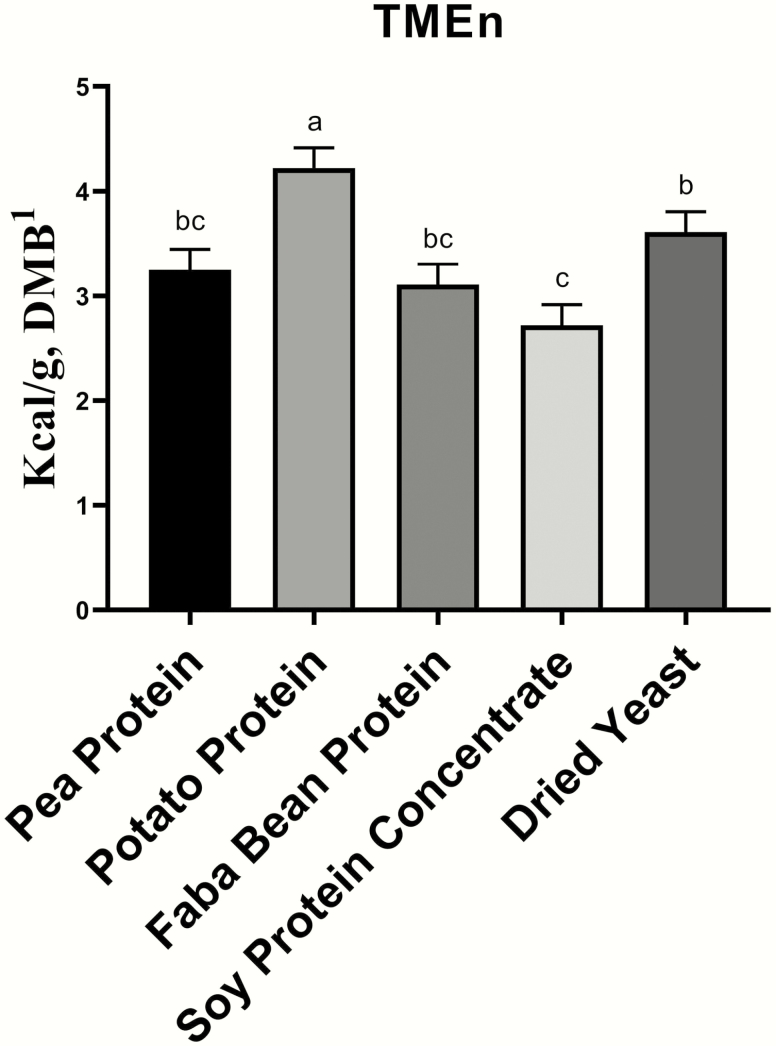
Increased consumer interest in high-quality and novel protein sources has driven the demand for the inclusion of protein-rich ingredients in companion animal diets. Novel protein concentrates, with protein contents of at least 50%, have been used to satisfy these consumer demands. However, minimal information is available regarding the macronutrient composition and protein quality of these ingredients that is needed for proper formulation of pet foods. Therefore, the objectives of this study were to determine the macronutrient and amino acid compositions, standardized amino acid digestibility according to the precision-fed rooster assay, and protein quality using digestible indispensable amino acid score (DIAAS like) of pea protein (PP), potato protein (POP), faba bean protein (FBP), soy protein concentrate (SPC), and dried yeast (DY). Precision-fed rooster assays were conducted using cecectomized roosters to calculate standardized amino acid digestibility and true metabolizable energy corrected for nitrogen (TMEn). For all five protein concentrates, all essential amino acids were highly digestible (88.0% to 96.3%, dry matter basis) with differences ( < 0.05) in only lysine, methionine, and tryptophan digestibilities. The TMEn values were highest for POP (4.22 kcal/g) and DY (3.61 kcal/g). The DIAAS-like values for adult dogs indicated that methionine was the first-limiting amino acid in all protein concentrates except POP, where the first-limiting amino acid was tryptophan. Using Association of American Feed Control Officials (AAFCO)-recommended values for adult cats, DIAAS-like values for methionine were lowest ( < 0.05) for FBP at 81.5%, with all other amino acids for all protein concentrates over 100%. The National Research Council (NRC)-recommended allowances for adult cats indicated that DIAAS-like methionine values for PP (92.7%) and FBP (73.8%) were significantly lower ( < 0.05) with these being the first-limiting amino acids, with the remaining amino acids above 100% for the other protein concentrates. The protein quality and high essential amino acid digestibility of these protein concentrates indicate that they would be viable protein sources in canine and feline diets. However, additional complementary protein sources should be included to meet the requirements of all essential amino acids.
消费者对优质和新型蛋白质来源的兴趣增加,推动了伴侣动物日粮中富含蛋白质成分的需求。蛋白质含量至少为50%的新型蛋白质浓缩物已被用于满足这些消费者需求。然而,关于这些成分的常量营养素组成和蛋白质质量的信息极少,而这些信息对于宠物食品的正确配方是必需的。因此,本研究的目的是测定豌豆蛋白(PP)、马铃薯蛋白(POP)、蚕豆蛋白(FBP)、大豆浓缩蛋白(SPC)和干酵母(DY)的常量营养素和氨基酸组成、根据精确饲喂公鸡法测定的标准化氨基酸消化率以及使用可消化必需氨基酸评分(类DIAAS)评估的蛋白质质量。使用去盲肠公鸡进行精确饲喂试验,以计算标准化氨基酸消化率和氮校正真代谢能(TMEn)。对于所有五种蛋白质浓缩物,所有必需氨基酸的消化率都很高(以干物质计为88.0%至96.3%),仅赖氨酸、蛋氨酸和色氨酸的消化率存在差异(<0.05)。POP的TMEn值最高(4.22千卡/克),DY的TMEn值为3.61千卡/克。成年犬的类DIAAS值表明,除POP外,所有蛋白质浓缩物中的蛋氨酸都是第一限制性氨基酸,在POP中第一限制性氨基酸是色氨酸。使用美国饲料管理官员协会(AAFCO)推荐的成年猫的数值,FBP的蛋氨酸类DIAAS值最低(<0.05),为81.5%,所有其他蛋白质浓缩物的所有其他氨基酸均超过100%。美国国家研究委员会(NRC)推荐的成年猫的摄入量表明,PP(92.7%)和FBP(73.8%)的类DIAAS蛋氨酸值显著较低(<0.05),这两种氨基酸是第一限制性氨基酸,其他蛋白质浓缩物的其余氨基酸均高于100%。这些蛋白质浓缩物的蛋白质质量和较高的必需氨基酸消化率表明,它们将是犬猫日粮中可行的蛋白质来源。然而,应添加其他互补蛋白质来源以满足所有必需氨基酸的需求。