Centers for Disease Control and Prevention, Atlanta, Georgia (E.J.C., M.A.R., A.O., C.R., S.G.).
Emory University School of Medicine and Atlanta Veterans Affairs Medical Center, Atlanta, Georgia (E.J.A.).
Ann Intern Med. 2020 Oct 20;173(8):605-613. doi: 10.7326/M20-1509. Epub 2020 Aug 25.
Influenza may contribute to the burden of acute cardiovascular events during annual influenza epidemics.
To examine acute cardiovascular events and determine risk factors for acute heart failure (aHF) and acute ischemic heart disease (aIHD) in adults with a hospitalization associated with laboratory-confirmed influenza.
Cross-sectional study.
U.S. Influenza Hospitalization Surveillance Network during the 2010-to-2011 through 2017-to-2018 influenza seasons.
Adults hospitalized with laboratory-confirmed influenza and identified through influenza testing ordered by a practitioner.
Acute cardiovascular events were ascertained using discharge codes from the International Classification of Diseases (ICD), Ninth Revision, Clinical Modification, and ICD, 10th Revision. Age, sex, race/ethnicity, tobacco use, chronic conditions, influenza vaccination, influenza antiviral medication, and influenza type or subtype were included as exposures in logistic regression models, and marginal adjusted risk ratios and 95% CIs were estimated to describe factors associated with aHF or aIHD.
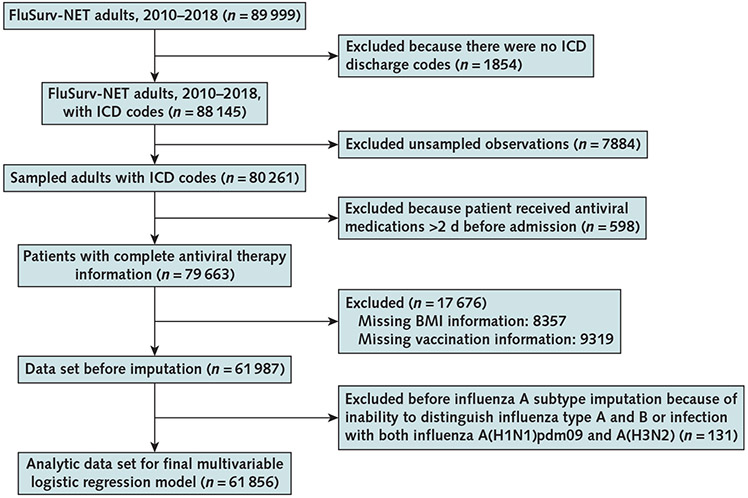
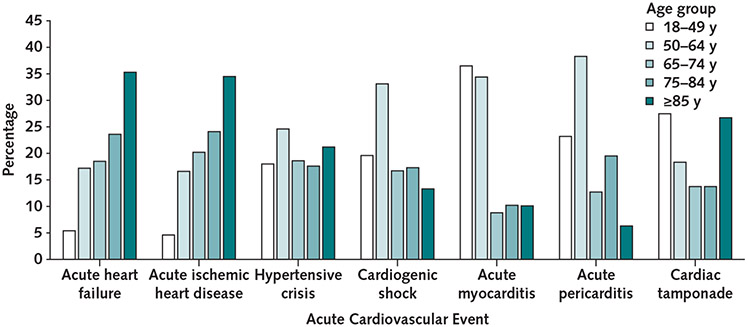
Among 89 999 adults with laboratory-confirmed influenza, 80 261 had complete medical record abstractions and available ICD codes (median age, 69 years [interquartile range, 54 to 81 years]) and 11.7% had an acute cardiovascular event. The most common such events (non-mutually exclusive) were aHF (6.2%) and aIHD (5.7%). Older age, tobacco use, underlying cardiovascular disease, diabetes, and renal disease were significantly associated with higher risk for aHF and aIHD in adults hospitalized with laboratory-confirmed influenza.
Underdetection of cases was likely because influenza testing was based on practitioner orders. Acute cardiovascular events were identified by ICD discharge codes and may be subject to misclassification bias.
In this population-based study of adults hospitalized with influenza, almost 12% of patients had an acute cardiovascular event. Clinicians should ensure high rates of influenza vaccination, especially in those with underlying chronic conditions, to protect against acute cardiovascular events associated with influenza.
Centers for Disease Control and Prevention.
流感可能导致年度流感流行期间急性心血管事件负担加重。
研究急性心血管事件,并确定与实验室确诊流感相关住院成人发生急性心力衰竭(aHF)和急性缺血性心脏病(aIHD)的危险因素。
横断面研究。
2010-2011 年至 2017-2018 年流感季节期间,美国流感住院监测网络。
通过从业者开具的流感检测确诊住院且通过流感检测识别的成年人。
急性心血管事件通过国际疾病分类(ICD)第九修订版临床修正版和 ICD-10 版的出院代码确定。年龄、性别、种族/民族、吸烟、慢性疾病、流感疫苗接种、流感抗病毒药物以及流感类型或亚型被纳入逻辑回归模型作为暴露因素,估计边缘调整风险比和 95%置信区间以描述与 aHF 或 aIHD 相关的因素。
在 89999 例实验室确诊流感的成年人中,有 80261 例有完整的病历摘录和可用的 ICD 代码(中位数年龄为 69 岁[四分位距为 54 岁至 81 岁]),有 11.7%发生了急性心血管事件。最常见的此类事件(非互斥)是 aHF(6.2%)和 aIHD(5.7%)。在因实验室确诊流感住院的成年人中,年龄较大、吸烟、心血管疾病、糖尿病和肾脏疾病与 aHF 和 aIHD 风险增加显著相关。
病例漏报可能是因为流感检测基于从业者的医嘱。急性心血管事件通过 ICD 出院代码确定,可能存在误诊偏倚。
在这项基于人群的成年人因流感住院的研究中,近 12%的患者发生了急性心血管事件。临床医生应确保高比例的流感疫苗接种,尤其是在有潜在慢性疾病的患者中,以预防与流感相关的急性心血管事件。
疾病控制与预防中心。