Epidemic Intelligence Service, Center for Surveillance, Epidemiology and Laboratory Services, Centers for Disease Control and Prevention, Atlanta, Georgia.
Influenza Division, National Center for Immunization and Respiratory Diseases, Centers for Disease Control and Prevention, Atlanta, Georgia.
JAMA Netw Open. 2020 Mar 2;3(3):e201323. doi: 10.1001/jamanetworkopen.2020.1323.
Seasonal influenza virus infection is a major cause of morbidity and mortality and may be associated with respiratory and nonrespiratory diagnoses.
To examine the respiratory and nonrespiratory diagnoses reported for adults hospitalized with laboratory-confirmed influenza between 2010 and 2018 in the United States.
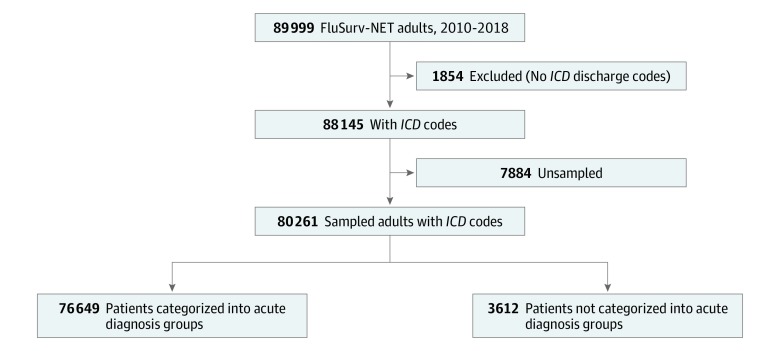
DESIGN, SETTING, AND PARTICIPANTS: This cross-sectional study used data from the US Influenza Hospitalization Surveillance Network (FluSurv-NET) from October 1 through April 30 of the 2010-2011 through 2017-2018 influenza seasons. FluSurv-NET is a population-based, multicenter surveillance network with a catchment area that represents approximately 9% of the US population. Patients are identified by practitioner-ordered influenza testing. Adults (aged ≥18 years) hospitalized with laboratory-confirmed influenza were included in the study.
FluSurv-NET defines laboratory-confirmed influenza as a positive influenza test result by rapid antigen assay, reverse transcription-polymerase chain reaction, direct or indirect fluorescent staining, or viral culture.
Acute respiratory or nonrespiratory diagnoses were defined using International Classification of Diseases, Ninth Revision, Clinical Modification (ICD-9-CM) and International Statistical Classification of Diseases and Related Health Problems, 10th Revision (ICD-10) discharge diagnosis codes. The analysis included calculation of the frequency of acute respiratory and nonrespiratory diagnoses with a descriptive analysis of patient demographic characteristics, underlying medical conditions, and in-hospital outcomes by respiratory and nonrespiratory diagnoses.
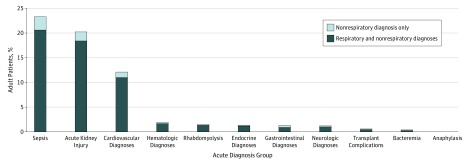
Of 89 999 adult patients hospitalized with laboratory-confirmed influenza, 76 649 (median age, 69 years; interquartile range, 55-82 years; 55% female) had full medical record abstraction and at least 1 ICD code for an acute diagnosis. In this study, 94.9% of patients had a respiratory diagnosis and 46.5% had a nonrespiratory diagnosis, including 5.1% with only nonrespiratory diagnoses. Pneumonia (36.3%), sepsis (23.3%), and acute kidney injury (20.2%) were the most common acute diagnoses. Fewer patients with only nonrespiratory diagnoses received antiviral therapy for influenza compared with those with respiratory diagnoses (81.4% vs 88.9%; P < .001).
Nonrespiratory diagnoses occurred frequently among adults hospitalized with influenza, further contributing to the burden of infection in the United States. The findings suggest that during the influenza season, practitioners should consider influenza in their differential diagnosis for patients who present to the hospital with less frequently recognized manifestations and initiate early antiviral treatment for patients with suspected or confirmed infection.
季节性流感病毒感染是发病率和死亡率的主要原因,可能与呼吸道和非呼吸道诊断有关。
在美国,检查 2010 年至 2018 年期间实验室确诊流感住院患者报告的呼吸道和非呼吸道诊断。
设计、地点和参与者:本横断面研究使用了美国流感住院监测网络(FluSurv-NET)的数据,该网络于 2010-2011 年至 2017-2018 年流感季节的 10 月 1 日至 4 月 30 日进行。FluSurv-NET 是一个基于人群的多中心监测网络,其集水区代表了美国约 9%的人口。患者通过医生开具的流感检测进行识别。患有实验室确诊流感的成年(年龄≥18 岁)患者被纳入研究。
FluSurv-NET 将实验室确诊的流感定义为通过快速抗原检测、逆转录聚合酶链反应、直接或间接荧光染色或病毒培养检测到的阳性流感检测结果。
急性呼吸道或非呼吸道诊断使用国际疾病分类,第九修订版(ICD-9-CM)和国际疾病分类和相关健康问题,第十版(ICD-10)出院诊断代码进行定义。该分析包括计算急性呼吸道和非呼吸道诊断的频率,并对呼吸和非呼吸道诊断患者的人口统计学特征、潜在医疗状况和院内结局进行描述性分析。
在 89999 名患有实验室确诊流感的成年患者中,76649 名(中位年龄 69 岁;四分位间距 55-82 岁;55%为女性)进行了完整的病历提取,并至少有 1 个用于急性诊断的 ICD 代码。在这项研究中,94.9%的患者有呼吸道诊断,46.5%的患者有非呼吸道诊断,其中 5.1%的患者只有非呼吸道诊断。最常见的急性诊断是肺炎(36.3%)、败血症(23.3%)和急性肾损伤(20.2%)。与有呼吸道诊断的患者相比,只有非呼吸道诊断的患者接受流感抗病毒治疗的比例较低(81.4%对 88.9%;P < .001)。
非呼吸道诊断在因流感住院的成年人中经常发生,这进一步增加了美国感染的负担。研究结果表明,在流感季节,医生在对以不太常见的症状就诊的患者进行鉴别诊断时,应考虑流感的可能性,并对疑似或确诊感染的患者尽早开始抗病毒治疗。