Yarmarkovich Mark, Warrington John M, Farrel Alvin, Maris John M
Division of Oncology and Center for Childhood Cancer Research, Children's Hospital of Philadelphia, Philadelphia, PA 19104, USA.
Department of Biomedical and Health Informatics, Children's Hospital of Philadelphia, Philadelphia, PA 19104, USA.
Cell Rep Med. 2020 Jun 23;1(3):100036. doi: 10.1016/j.xcrm.2020.100036. Epub 2020 Jun 8.
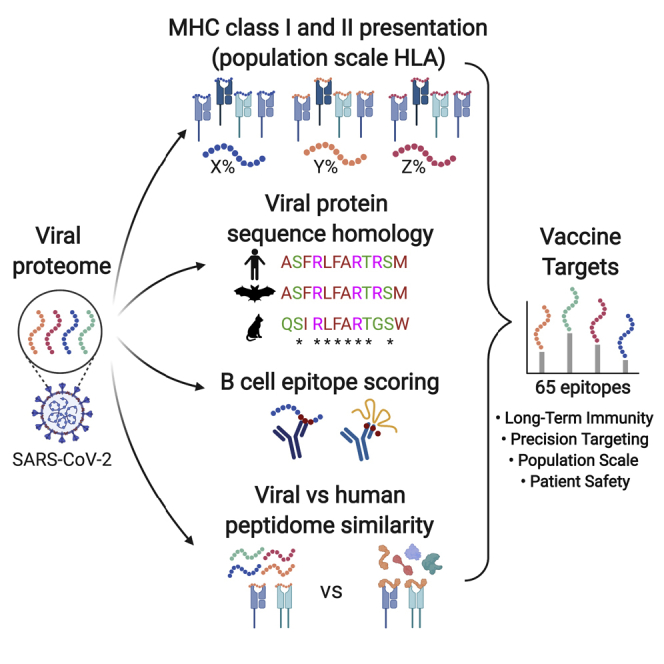
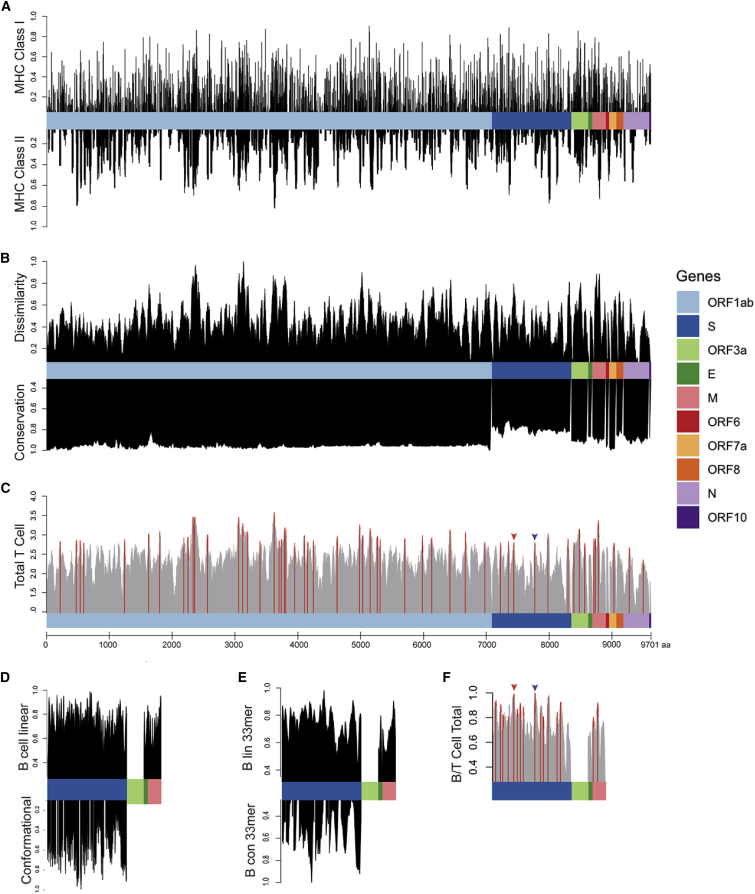
Here we propose a SARS-CoV-2 vaccine design concept based on identification of highly conserved regions of the viral genome and newly acquired adaptations, both predicted to generate epitopes presented on major histocompatibility complex (MHC) class I and II across the vast majority of the population. We further prioritize genomic regions that generate highly dissimilar peptides from the human proteome and are also predicted to produce B cell epitopes. We propose sixty-five 33-mer peptide sequences, a subset of which can be tested using DNA or mRNA delivery strategies. These include peptides that are contained within evolutionarily divergent regions of the spike protein reported to increase infectivity through increased binding to the ACE2 receptor and within a newly evolved furin cleavage site thought to increase membrane fusion. Validation and implementation of this vaccine concept could specifically target specific vulnerabilities of SARS-CoV-2 and should engage a robust adaptive immune response in the vast majority of the population.
在此,我们提出一种基于鉴定病毒基因组高度保守区域和新获得适应性的新型冠状病毒疫苗设计概念,预计这两者均可产生在绝大多数人群的主要组织相容性复合体(MHC)I类和II类上呈递的表位。我们进一步对那些与人类蛋白质组产生高度不同肽段且预计还会产生B细胞表位的基因组区域进行优先级排序。我们提出了65个33肽序列,其中一部分可以通过DNA或mRNA递送策略进行测试。这些肽段包括存在于刺突蛋白进化上不同区域内的肽段,据报道这些区域通过增加与ACE2受体的结合来提高感染性,以及存在于一个新进化的弗林蛋白酶切割位点内的肽段,该位点被认为可增加膜融合。这一疫苗概念的验证和实施可以特异性地针对新型冠状病毒的特定弱点,并应在绝大多数人群中引发强大的适应性免疫反应。