Michigan State University College of Osteopathic Medicine, East Lansing, MI, USA.
Omni International Inc, Kennesaw, GA, USA.
Virol J. 2020 Aug 25;17(1):129. doi: 10.1186/s12985-020-01405-y.
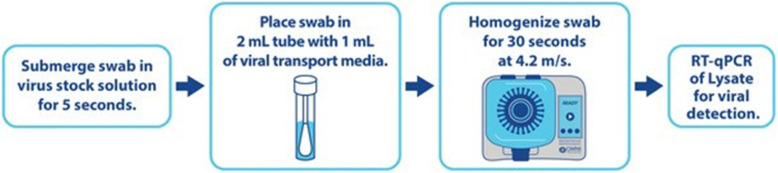
Currently, one of the most reliable methods for viral infection detection are polymerase chain reaction (PCR) based assays. This process is time and resource heavy, requiring multiple steps of lysis, extraction, purification, and amplification procedures. Herein, we have developed a method to detect virus off swabs using solely shaker-mill based mechanical lysis and the transfer of the viral lysate directly to a PCR assay for virus detection, bypassing the substantial reagent and time investments required for extraction and purification steps.
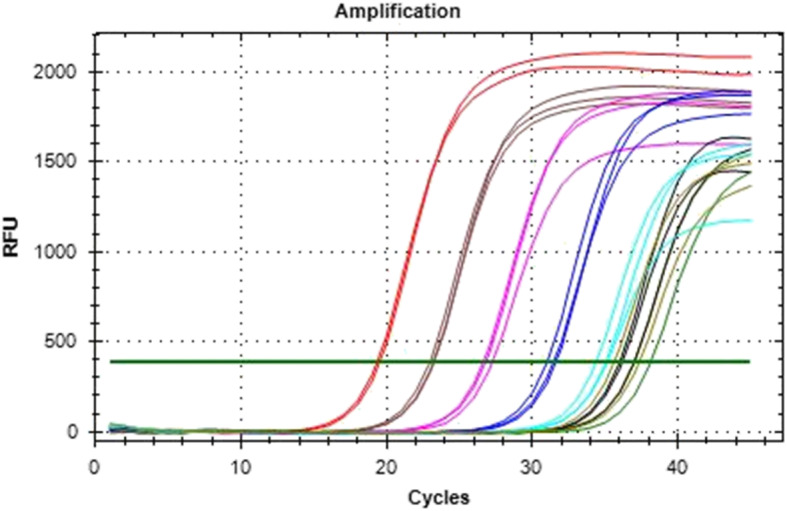
Using Human Coronavirus 229E (HCoV-229E) as a model system, we spiked swabs in vitro for proof-of-concept testing. Swabs were spiked in serial dilutions from 1.2 × 10 to 1.2 × 10 copies/mL and then placed in 2 mL tubes with viral transport media (VTM) to mimic the specimen collection procedures in the clinic prior to processing via shaker-mill homogenization. After homogenization, 1 μL of lysate was processed using RT-qPCR for amplification of the nucleocapsid (N) gene, qualifying viral detection.
HCoV-229E in vitro spiked swabs were processed in a novel two-step, direct-to-PCR methodology for viral detection. After running 54 swabs, we confidently determined our limit of detection to be 1.2 × 10 viral copies/mL with 96.30% sensitivity.
We have proven that the shaker-mill homogenization-based two-step, direct-to-PCR procedures provides sufficient viral lysis off swabs, where the resulting lysate can be used directly in PCR for the detection of HCoV-229E. This finding allows for reductions in the time and resources required for PCR based virus detection in comparison to the traditional extraction-to-PCR methodology.
目前,最可靠的病毒感染检测方法之一是基于聚合酶链反应(PCR)的检测。这个过程既费时又费资源,需要多个裂解、提取、纯化和扩增步骤。在此,我们开发了一种仅通过摇床研磨机械裂解来检测拭子上病毒的方法,并直接将病毒裂解液转移到 PCR 检测中以检测病毒,从而绕过了提取和纯化步骤所需的大量试剂和时间投入。
我们使用人类冠状病毒 229E(HCoV-229E)作为模型系统,进行了体外加标拭子进行概念验证测试。将拭子以 1.2×10 到 1.2×10 拷贝/ml 的系列稀释度进行加标,然后将其置于含有病毒运输介质(VTM)的 2ml 管中,以模拟临床标本采集程序,然后通过摇床研磨匀浆进行处理。匀浆后,使用 RT-qPCR 对 1μL 的裂解液进行处理,以扩增核衣壳(N)基因,从而鉴定病毒的存在。
使用新型两步法,即直接进行 PCR 的方法,对体外加标 HCoV-229E 的拭子进行了处理。对 54 个拭子进行处理后,我们有信心确定我们的检测限为 1.2×10 拷贝/ml,灵敏度为 96.30%。
我们已经证明,基于摇床研磨匀浆的两步法,直接进行 PCR 的程序可以充分裂解拭子上的病毒,所得的裂解液可直接用于 PCR 检测 HCoV-229E。与传统的提取到 PCR 方法相比,这一发现减少了 PCR 检测病毒所需的时间和资源。