Roet Milaine, Boonstra Jackson, Sahin Erdi, Mulders Anne E P, Leentjens Albert F G, Jahanshahi Ali
Department of Neurosurgery, Maastricht University Medical Center, P. Debyelaan 25, 6202 AZ Maastricht, The Netherlands.
European Graduate School of Neuroscience (EURON); 6229 ER Maastricht, The Netherlands.
J Clin Med. 2020 Aug 24;9(9):2729. doi: 10.3390/jcm9092729.
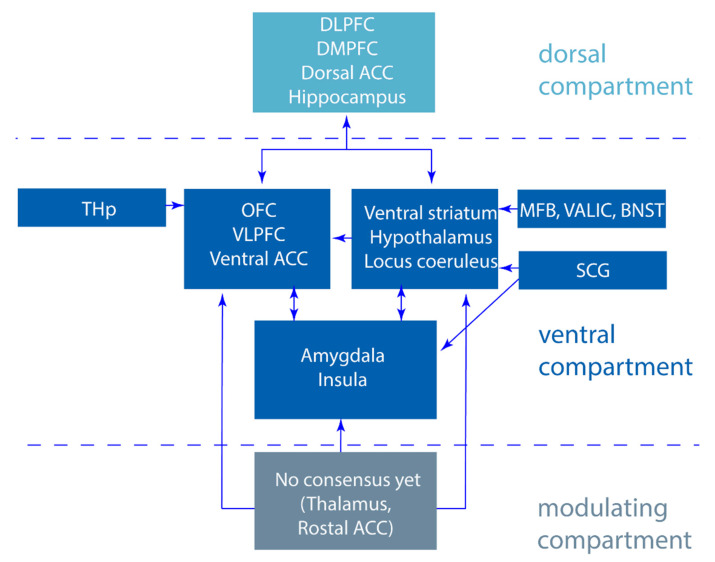
Major depressive disorder (MDD) affects approximately 4.4% of the world's population. One third of MDD patients do not respond to routine psychotherapeutic and pharmacotherapeutic treatment and are said to suffer from treatment-resistant depression (TRD). Deep brain stimulation (DBS) is increasingly being investigated as a treatment modality for TRD. Although early case studies showed promising results of DBS, open-label trials and placebo-controlled studies have reported inconsistent outcomes. This has raised discussion about the correct interpretation of trial results as well as the criteria for patient selection, the choice of stimulation target, and the optimal stimulation parameters. In this narrative review, we summarize recent studies of the effectiveness of DBS in TRD and address the relation between the targeted brain structures and clinical outcomes. Elaborating upon that, we hypothesize that the effectiveness of DBS in TRD can be increased by a more personalized and symptom-based approach. This may be achieved by using resting-state connectivity mapping for neurophysiological subtyping of TRD, by using individualized tractography to help decisions about stimulation target and electrode placement, and by using a more detailed registration of symptomatic improvements during DBS, for instance by using 'experience sampling' methods.
重度抑郁症(MDD)影响着全球约4.4%的人口。三分之一的MDD患者对常规心理治疗和药物治疗无反应,被称为难治性抑郁症(TRD)。深部脑刺激(DBS)作为TRD的一种治疗方式正越来越多地被研究。尽管早期的病例研究显示DBS有令人鼓舞的结果,但开放标签试验和安慰剂对照研究报告的结果并不一致。这引发了关于试验结果的正确解读以及患者选择标准、刺激靶点的选择和最佳刺激参数的讨论。在这篇叙述性综述中,我们总结了DBS治疗TRD有效性的近期研究,并探讨了靶向脑结构与临床结果之间的关系。在此基础上,我们假设通过更个性化和基于症状的方法可以提高DBS治疗TRD的有效性。这可以通过使用静息态连接图谱对TRD进行神经生理学亚型分类、使用个体化纤维束成像来辅助刺激靶点和电极放置的决策,以及通过在DBS期间更详细地记录症状改善情况来实现,例如使用“经验抽样”方法。