Department of Public Health Sciences, Medical University of South Carolina, Charleston, SC 29425, USA.
PepsiCo R&D, PepsiCo, Inc., Purchase, NY 10577, USA.
Nutrients. 2020 Aug 24;12(9):2566. doi: 10.3390/nu12092566.
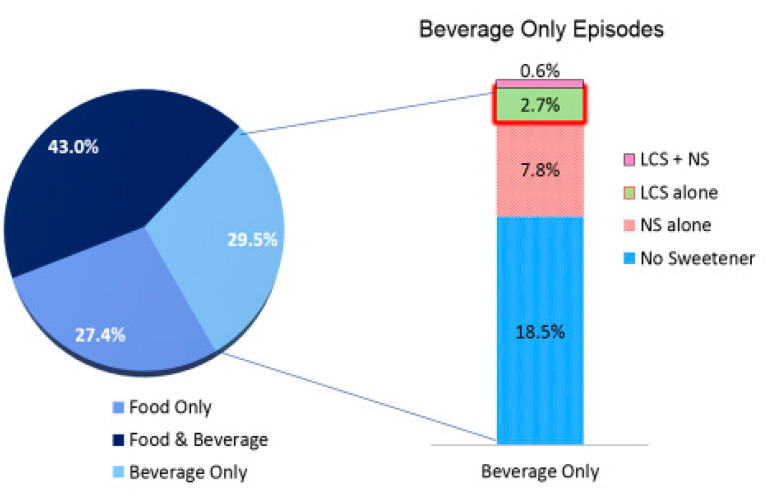
Studies of relationships between eating frequency and/or timing and energy intake have not examined associations with low-calorie sweeteners (LCS). We assessed the frequency of eating behavior related to LCS consumption emphasizing timing, calorie intake, and body mass index (BMI) among United States (US) adults aged ≥19 years. Using the National Health and Nutrition Examination Survey (NHANES) 2007-2016, we defined eating episodes as food and/or beverage intake within 15 min of one another over the first 24-h dietary recall. We coded items ingested during episodes ( = 136,938) and assessed LCS presence using US Department of Agriculture (USDA) food files. Episode analysis found intakes of foods only (27.4%), beverages only (29.5%), and foods with beverages (43.0%). LCS items were consumed without concurrent calories from other sources in fewer than 2.7% of all episodes. Within participants having normal weight (29.4%), overweight (33.6%) and obese (37.1%) BMIs, LCS consumers (35.2% overall) evidenced: more episodes/day; and fewer: calories, carbohydrates, fats, and protein per episode. Per person, those consuming LCS had lower total calories and higher fiber intake per day. LCS consumption was associated with higher BMI. Number of eating episodes/day and longer hours when eating episodes occurred were also consistently associated with higher BMI. Consuming LCS did not modify these relationships. These results did not show that LCS consumption was associated with increased caloric intake from other dietary sources.
研究进食频率和/或时间与能量摄入之间的关系并未考察与低热量甜味剂 (LCS) 的关联。我们评估了与 LCS 消费相关的进食行为的频率,重点关注美国 (US) 19 岁及以上成年人的时间、卡路里摄入量和体重指数 (BMI)。我们使用国家健康和营养检查调查 (NHANES) 2007-2016 年的数据,将进食事件定义为在首次 24 小时饮食回忆中彼此相隔 15 分钟内摄入的食物和/或饮料。我们对摄入的食物进行编码(共 136938 种),并使用美国农业部 (USDA) 的食品档案评估 LCS 的存在情况。进食事件分析发现,仅摄入食物(27.4%)、仅摄入饮料(29.5%)和同时摄入食物和饮料(43.0%)。LCS 物品的摄入没有同时来自其他来源的卡路里,在所有事件中不到 2.7%。在体重正常(29.4%)、超重(33.6%)和肥胖(37.1%)BMI 的参与者中,LCS 消费者(总体 35.2%)表现出:每天更多的进食事件;以及更少的:每一次进食的卡路里、碳水化合物、脂肪和蛋白质。就每个人而言,那些食用 LCS 的人每天的总卡路里和纤维摄入量更高。LCS 的消耗与更高的 BMI 相关。每天进食的次数和进食的时间也与更高的 BMI 有关。LCS 的消耗并没有改变这些关系。这些结果表明,LCS 的消耗与来自其他饮食来源的卡路里摄入增加无关。