Drewnowski Adam, Rehm Colin D
Center for Public Health Nutrition, University of Washington, Box 353410.
Nutrients. 2014 Oct 17;6(10):4389-403. doi: 10.3390/nu6104389.
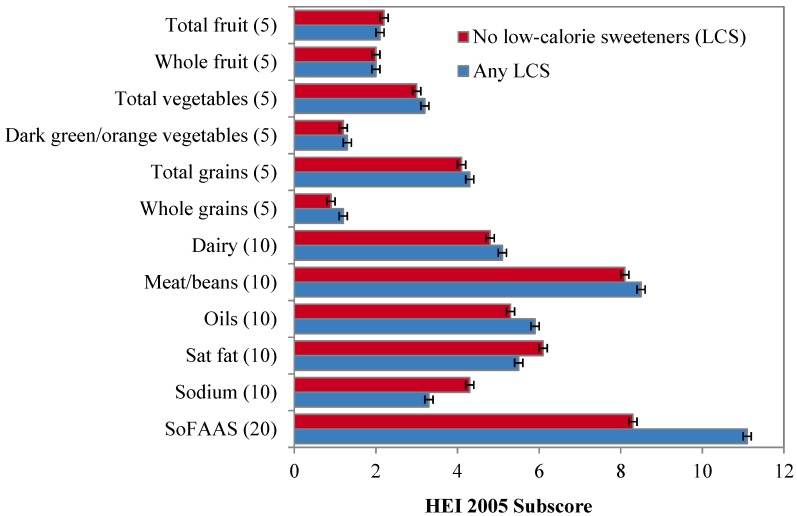
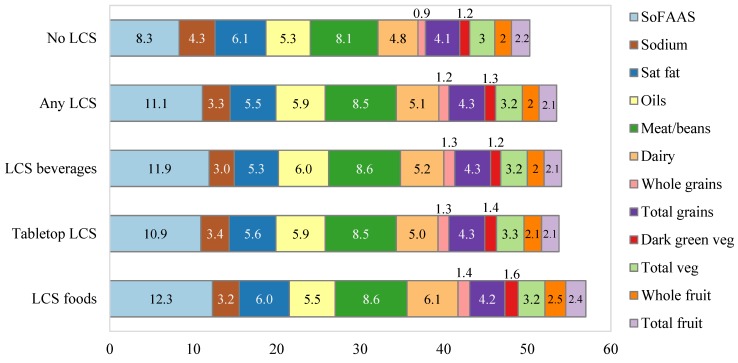
The possibility that low-calorie sweeteners (LCS) promote lower quality diets and, therefore, weight gain has been noted as a cause for concern. Data from a representative sample of 22,231 adults were obtained from five cycles of the National Health and Nutrition Examination Survey (1999-2008 NHANES). A single 24-hour recall was used to identify consumers of LCS beverages, foods and tabletop sweeteners. Diet quality was assessed using the Healthy Eating Index 2005 (HEI 2005) and its multiple subscores. Health behaviors of interest were physical activity, smoking and alcohol use. LCS consumers had higher HEI 2005 scores than did non-consumers, largely explained by better SoFAAS subscores (solid fats, added sugar and alcohol). LCS consumers had better HEI subscores for vegetables, whole grains and low-fat dairy, but worse subscores for saturated fat and sodium compared to non-consumers. Similar trends were observed for LCS beverages, tabletop LCS and LCS foods. Consumers of LCS were less likely to smoke and were more likely to engage in recreational physical activity. LCS use was associated with higher HEI 2005 scores, lower consumption of empty calories, less smoking and more physical activity.
低热量甜味剂(LCS)可能会导致饮食质量下降,进而导致体重增加,这一可能性已引起人们的关注。来自22231名成年人的代表性样本的数据取自国家健康与营养检查调查(1999 - 2008年NHANES)的五个周期。通过单次24小时回忆法来确定LCS饮料、食品和桌面甜味剂的消费者。使用2005年健康饮食指数(HEI 2005)及其多个子分数来评估饮食质量。感兴趣的健康行为包括体育活动、吸烟和饮酒。LCS消费者的HEI 2005分数高于非消费者,这在很大程度上可以由更好的SoFAAS子分数(固体脂肪、添加糖和酒精)来解释。与非消费者相比,LCS消费者在蔬菜、全谷物和低脂乳制品方面的HEI子分数更好,但在饱和脂肪和钠方面的子分数更差。LCS饮料、桌面LCS和LCS食品也观察到了类似趋势。LCS消费者吸烟的可能性较小,更有可能参与休闲体育活动。使用LCS与更高的HEI 2005分数、更低的空热量消费、更少的吸烟和更多的体育活动相关。