Tobacco Control Research Group, University of Bath, Bath, UK.
SPECTRUM Consortium, Edinburgh, UK.
Global Health. 2020 Aug 26;16(1):76. doi: 10.1186/s12992-020-00611-1.
The UN system's shift towards multistakeholder governance, now embedded in the Sustainable Development Goals (SDGs), invites a broad range of actors, including the private sector, to the policymaking table. Although the tobacco industry is formally excluded from engagement, this approach provides opportunities for other unhealthy commodity industries to influence the World Health Organization's (WHO's) non-communicable disease (NCD) agenda. Focusing on the food industry, this research maps which actors engaged with WHO consultations, and critically examines actors' policy and governance preferences as well as the framing they employ to promote these preferences in the global context.
All written responses from food industry actors to publicly available NCD-relevant WHO consultations held between September 2015 and September 2018 were identified, totalling forty-five responses across five consultations. A qualitative frame analysis was conducted to identify policy positions expressed by respondents, as well as arguments and frames used to do so.
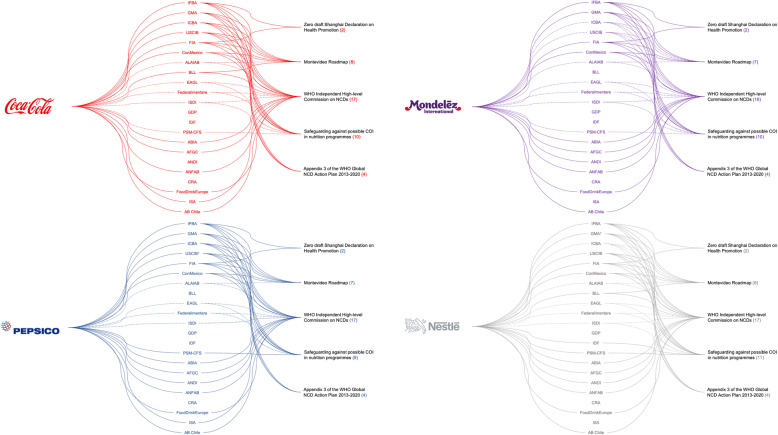
Though no individual companies responded to the consultations, the majority of participating business associations had some of the largest multinational food corporations as members. Respondents overarchingly promoted non-statutory approaches and opposed statutory regulation and conflict of interest safeguards. To this purpose, they framed the food industry as a legitimate and necessary partner in policymaking, differentiating themselves from the tobacco industry and referencing a history of successful collaboration, while also invoking multistakeholder norms and good governance principles to portray collaboration as required. Respondents contrasted this with the limits of WHO's mandate, portraying it as out of step with the SDGs and framing NCD decision-making as a matter of national sovereignty.
We observed that the UN's call for partnerships to support the SDGs is invoked to defend corporate access to NCD policy. This highlights the need for more cautious approaches which are mindful of the commercial determinants of health. Systematic opposition to regulation and to governance approaches which may compromise commercial actors' insider role in global health by food industry actors shown here, and the strategic use of the Sustainable Development agenda to this purpose, raises questions about the value of collaboration from the perspective of international health agencies such as WHO.
联合国系统向多方利益攸关方治理的转变,现已纳入可持续发展目标(SDGs),邀请了包括私营部门在内的广泛行为者参与决策。尽管烟草业被正式排除在外,但这种方法为其他不健康商品行业提供了影响世界卫生组织(WHO)非传染性疾病(NCD)议程的机会。本文聚焦于食品行业,绘制了参与世卫组织磋商的行为者图谱,并批判性地审查了行为者的政策和治理偏好,以及他们在全球背景下采用的框架来推动这些偏好。
从 2015 年 9 月至 2018 年 9 月期间,公开获取的与 NCD 相关的世卫组织磋商中,确定了所有来自食品行业行为者的书面回复,共涉及五次磋商中的四十五份回复。进行了定性框架分析,以确定受访者表达的政策立场,以及用于表达这些立场的论点和框架。
尽管没有个别公司对磋商做出回应,但大多数参与的商业协会都有一些最大的跨国食品公司作为成员。受访者总体上提倡非法定方法,反对法定监管和利益冲突保障。为此,他们将食品行业描绘为决策制定的合法和必要伙伴,将自己与烟草业区分开来,并参考成功合作的历史,同时援引多方利益攸关方规范和良好治理原则,将合作描绘为必要的。受访者将这与世卫组织任务的局限性进行了对比,将其描绘为与可持续发展目标不一致,并将 NCD 决策制定视为国家主权问题。
我们观察到,联合国呼吁建立伙伴关系以支持可持续发展目标,这被用来为企业参与 NCD 政策辩护。这凸显了需要采取更谨慎的方法,关注健康的商业决定因素。食品行业行为者在这里系统地反对监管和治理方法,这些方法可能会损害商业行为者在全球卫生领域的内部角色,并出于此目的战略性地利用可持续发展议程,这引发了人们对像世卫组织这样的国际卫生机构合作价值的质疑。