Lionett Sofie, Kiel Ida A, Camera Donny M, Vanky Eszter, Parr Evelyn B, Lydersen Stian, Hawley John A, Moholdt Trine
Department of Circulation and Medical Imaging, Faculty of Medicine and Health Sciences, Norwegian University of Science and Technology, Trondheim, Norway.
Department of Obstetrics and Gynecology, St. Olav's Hospital, Trondheim, Norway.
Front Physiol. 2020 Jul 30;11:904. doi: 10.3389/fphys.2020.00904. eCollection 2020.
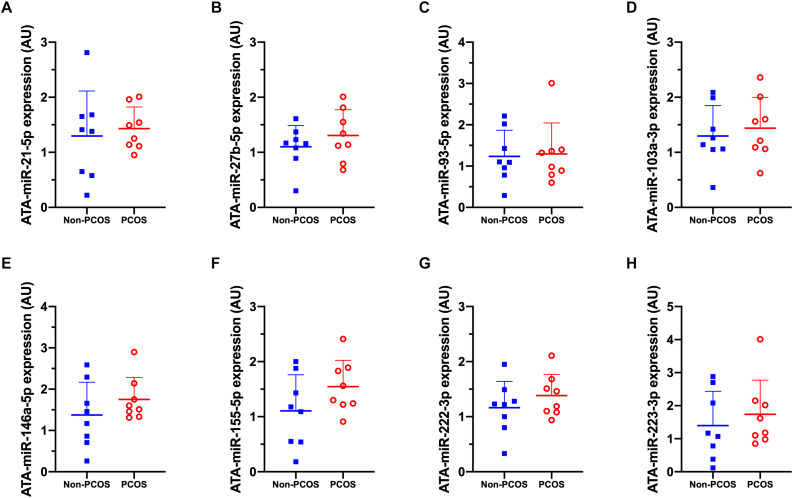
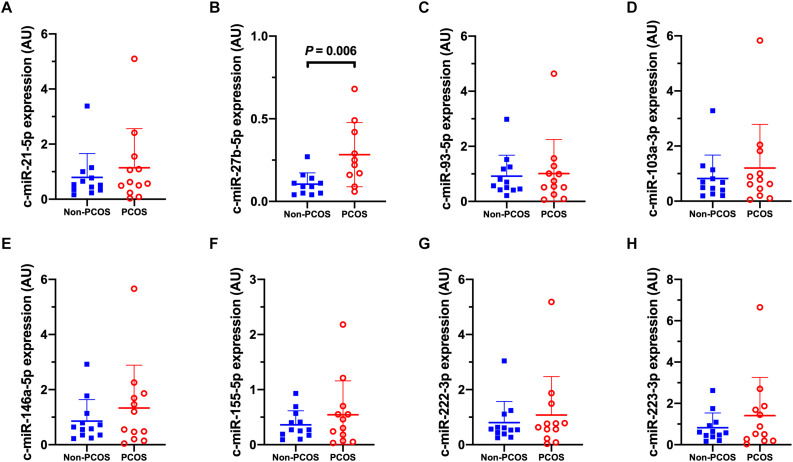
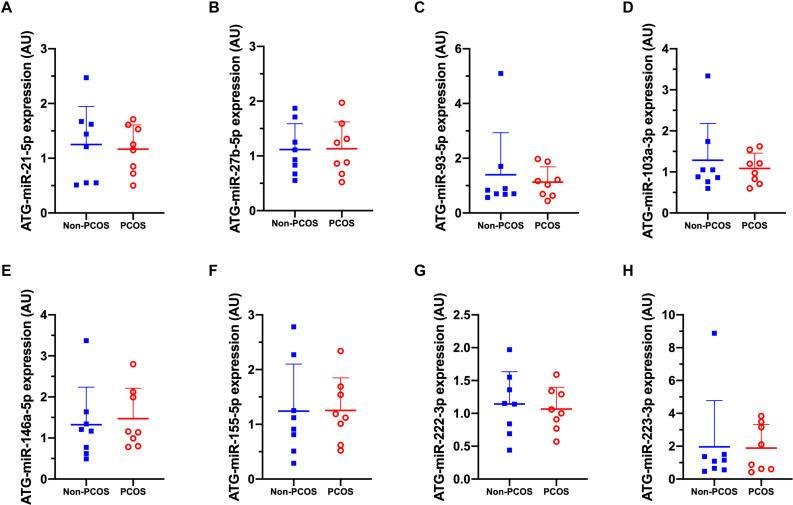
MicroRNAs (miRNAs) are small non-coding RNAs that regulate gene expression post-transcriptionally. In women with polycystic ovary syndrome (PCOS), several miRNAs are differentially expressed compared to women without PCOS, suggesting a role for miRNAs in PCOS pathophysiology. Exercise training modulates miRNA abundance and is primary lifestyle intervention for women with PCOS. Accordingly, we measured the expression of eight circulating miRNAs selected along with miRNA expression from gluteal and abdominal adipose tissue (AT) in 12 women with PCOS and 12 women matched for age and body mass index without PCOS. We also determined the miRNA expression "signatures" before and after high-intensity interval training (HIT) in 42 women with PCOS randomized to either: (1) low-volume HIT (LV-HIT, 10 × 1 min work bouts at maximal, sustainable intensity, = 13); (2) high-volume HIT (HV-HIT, 4 × 4 min work bouts reaching 90-95% of maximal heart rate, = 14); or (3) non-exercise control (Non-Ex, = 15). Both HIT groups trained three times/week for 16 weeks. miRNAs were extracted from plasma, gluteal and abdominal AT, and quantified via a customized plate array containing eight miRNAs associated with PCOS and/or exercise training responses. Basal expression of circulating miRNA-27b (c-miR-27b), implicated in fatty acid metabolism, adipocyte differentiation and inflammation, was 1.8-fold higher in women with compared to without PCOS ( = 0.006) despite no difference in gluteal or abdominal AT miR-27b expression. Only the HV-HIT protocol increased peak oxygen uptake (VOpeak L/min; 9%, = 0.008). There were no changes in body composition. In LV-HIT, but not HV-HIT, the expression of c-miR-27b decreased (0.5-fold, = 0.007). None of the remaining seven circulating miRNAs changed in LV-HIT, nor was the expression of gluteal or abdominal AT miRNAs altered. Despite increased cardiorespiratory fitness, HV-HIT did not alter the expression of any circulating, gluteal or abdominal AT miRNAs. We conclude that women with PCOS have a higher basal expression of c-miR-27b compared to women without PCOS and that 16 weeks of LV-HIT reduces the expression of this miRNA in women with PCOS. Intense exercise training had little effect on the abundance of the selected miRNAs within subcutaneous AT depots in women with PCOS.
微小RNA(miRNA)是一类小的非编码RNA,可在转录后水平调节基因表达。在多囊卵巢综合征(PCOS)女性中,与非PCOS女性相比,几种miRNA存在差异表达,提示miRNA在PCOS病理生理过程中发挥作用。运动训练可调节miRNA丰度,是PCOS女性主要的生活方式干预措施。因此,我们检测了12例PCOS女性及12例年龄和体重指数匹配的非PCOS女性中8种循环miRNA的表达,并同时检测了臀肌和腹部脂肪组织(AT)中的miRNA表达。我们还确定了42例随机分为以下三组的PCOS女性在高强度间歇训练(HIT)前后的miRNA表达“特征”:(1)低容量HIT(LV-HIT,10次1分钟的高强度持续运动,每组运动强度为最大可持续强度,n = 13);(2)高容量HIT(HV-HIT,4次4分钟的运动,心率达到最大心率的90-95%,n = 14);或(3)非运动对照组(Non-Ex,n = 15)。两个HIT组每周训练3次,共16周。从血浆、臀肌和腹部AT中提取miRNA,并通过定制的包含8种与PCOS和/或运动训练反应相关的miRNA的板阵列进行定量。参与脂肪酸代谢、脂肪细胞分化和炎症的循环miRNA-27b(c-miR-27b)的基础表达在PCOS女性中比非PCOS女性高1.8倍(P = 0.006),尽管臀肌或腹部AT中miR-27b的表达没有差异。只有HV-HIT方案增加了峰值摄氧量(VO₂peak L/min;增加9%,P = 0.008)。身体成分没有变化。在LV-HIT组中,c-miR-27b的表达降低(降低0.5倍,P = 0.007),而HV-HIT组没有。其余7种循环miRNA在LV-HIT组中均未改变,臀肌或腹部AT中miRNA的表达也未改变。尽管心肺适能增加,但HV-HIT并未改变任何循环、臀肌或腹部AT中miRNA的表达。我们得出结论,与非PCOS女性相比,PCOS女性c-miR-27b的基础表达更高,16周的LV-HIT可降低PCOS女性中该miRNA的表达。高强度运动训练对PCOS女性皮下脂肪组织中所选miRNA的丰度影响很小。