Scarfò Giorgia, Daniele Simona, Fusi Jonathan, Gesi Marco, Martini Claudia, Franzoni Ferdinando, Cela Vito, Artini Paolo Giovanni
Division of General Medicine, Department of Clinical and Experimental Medicine, University of Pisa, 56126 Pisa, Italy.
Department of Pharmacy, University of Pisa, 56126 Pisa, Italy.
Biomedicines. 2022 Jun 2;10(6):1305. doi: 10.3390/biomedicines10061305.
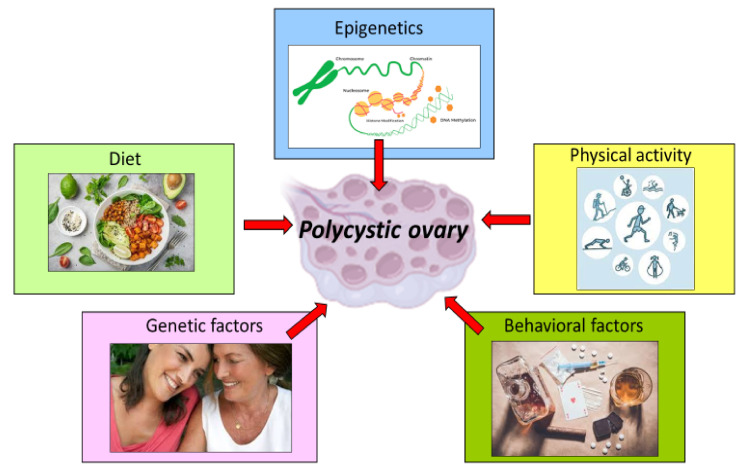
Polycystic ovary syndrome (PCOS) is an endocrine systemic disorder mainly characterized by a hormonal and metabolic disbalance that leads to oligo/anovulation, hyperandrogenism and the formation of ovarian cysts. Despite the progress that has been reached in its diagnosis and management, little is known about the molecular mechanisms and signaling pathways underlying the pathogenic mechanisms. In this sense, recent research has suggested that the influence of multiple factors, including age, environment, lifestyle and the disease state environment can change the clinical presentation of PCOS via epigenetic modifications. Variants in the genes encoding for proteins involved in steroidogenesis and glucose homeostasis play a crucial role in the development of the disease. Other genes involved in inflammation and cell proliferation seem to undergo an epigenetic control. Moreover, lifestyle factors influence the PCOS course and prognosis, including diet and physical activity, which are fundamental in reducing oxidative stress, inflammation and in improving metabolic and hormonal parameters. In the present review, literature evidence on molecular and epigenetic mechanisms related to PCOS etiology will be discussed, with a particular attention on the positive influence of diet and physical activity as nonpharmacological ways of intervention in the management of the disease.
多囊卵巢综合征(PCOS)是一种内分泌系统性疾病,主要特征是激素和代谢失衡,导致少排卵/无排卵、高雄激素血症以及卵巢囊肿形成。尽管在其诊断和治疗方面已取得进展,但对于其发病机制背后的分子机制和信号通路仍知之甚少。从这个意义上讲,最近的研究表明,包括年龄、环境、生活方式和疾病状态环境在内的多种因素的影响可通过表观遗传修饰改变PCOS的临床表现。编码参与类固醇生成和葡萄糖稳态的蛋白质的基因变异在该疾病的发展中起关键作用。其他参与炎症和细胞增殖的基因似乎受到表观遗传控制。此外,生活方式因素会影响PCOS的病程和预后,包括饮食和体育活动,这对于降低氧化应激、炎症以及改善代谢和激素参数至关重要。在本综述中,将讨论与PCOS病因相关的分子和表观遗传机制的文献证据,特别关注饮食和体育活动作为该疾病管理中非药物干预方式的积极影响。