Roel Lesur Marte, Lyn Sonia, Lenggenhager Bigna
Department of Psychology, Cognitive Neuropsychology With Focus on Body, Self, and Plasticity, University of Zurich, Zurich, Switzerland.
BeAnotherLab, Barcelona, Spain.
Front Psychol. 2020 Aug 4;11:1861. doi: 10.3389/fpsyg.2020.01861. eCollection 2020.
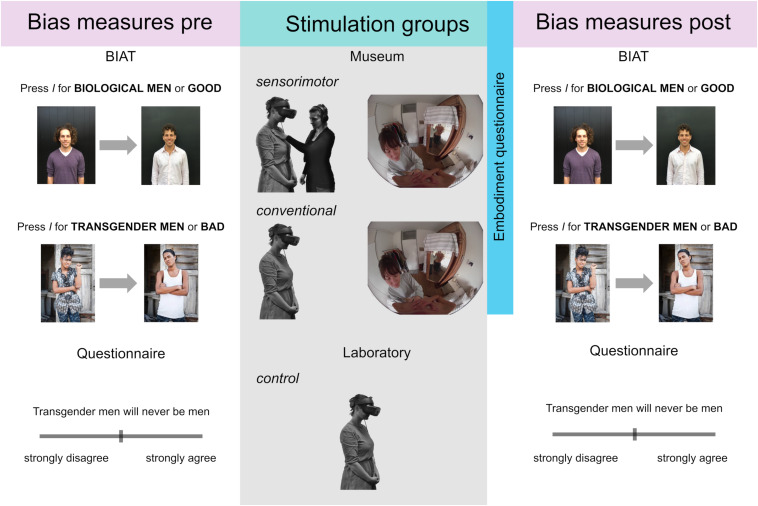
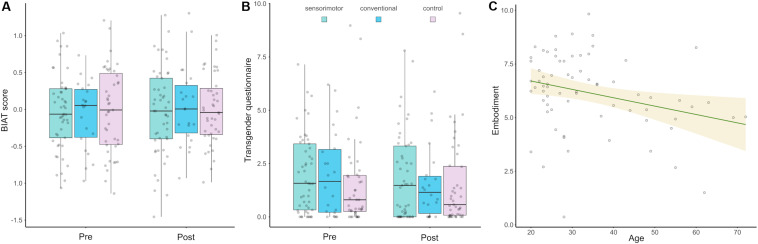
Virtual reality (VR) protocols inducing illusory embodiment of avatars have shown a positive impact on participants' perception of outgroup members, in line with the idea that the simulation of another's sensorimotor states might underlie prosocial behavior. These studies, however, have been mostly confined to laboratory settings with student populations and the use of artificial avatars. In an interdisciplinary effort benefiting from the heterogeneous sample within a museum, we aimed at quantifying changes in interpersonal perception induced by embodying a transgender man narrating his life. We compared an artistic methodology mixing VR and elaborate sensorimotor stimulation to a more conventional primarily audiovisual VR experience. We tested how these affect embodiment and the perception of transgender men as measured by a brief implicit association test and a questionnaire. Neither significant difference in embodiment nor changes in implicit or explicit bias was found, the latter potentially due to the initially low bias in the group. We further assessed participants' illusory embodiment as a function of age, finding a negative correlation between these. The results are discussed with respect to current theories of embodiment, differences between laboratory and real-life settings, and the intersection of art and science.
虚拟现实(VR)协议诱导虚拟化身的虚幻身体体验,已显示出对参与者对外群体成员的认知产生积极影响,这与模拟他人的感觉运动状态可能是亲社会行为的基础这一观点相符。然而,这些研究大多局限于实验室环境,以学生群体为研究对象,且使用的是人工虚拟化身。在一项受益于博物馆内异质样本的跨学科研究中,我们旨在量化通过化身讲述自己生活的跨性别男性所引发的人际认知变化。我们将一种融合VR与精细感觉运动刺激的艺术方法与一种更传统的主要是视听的VR体验进行了比较。我们通过简短的内隐联想测验和问卷调查来测试这些方法如何影响身体体验以及对跨性别男性的认知。在身体体验方面未发现显著差异,内隐或外显偏见也未发生变化,后者可能是由于该群体最初的偏见较低。我们进一步评估了参与者作为年龄函数的虚幻身体体验,发现两者之间存在负相关。我们结合当前的身体体验理论、实验室与现实生活环境的差异以及艺术与科学的交叉点对研究结果进行了讨论。