Department of Physics, Department of Chemistry and Biochemistry, Programs of Biophysics, Chemical Physics and Biochemistry, The Ohio State University, Columbus, OH, 43210, USA.
Center for Ultrafast Science and Technology, School of Physics and Astronomy, School of Chemistry and Chemical Engineering, Shanghai Jiao Tong University, Shanghai, 200240, China.
Nat Commun. 2020 Aug 28;11(1):4316. doi: 10.1038/s41467-020-17838-6.
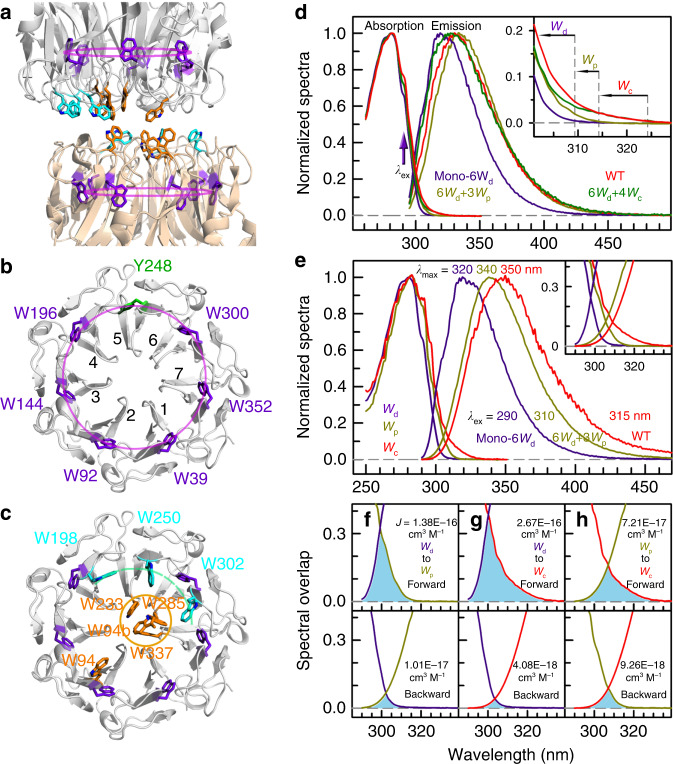
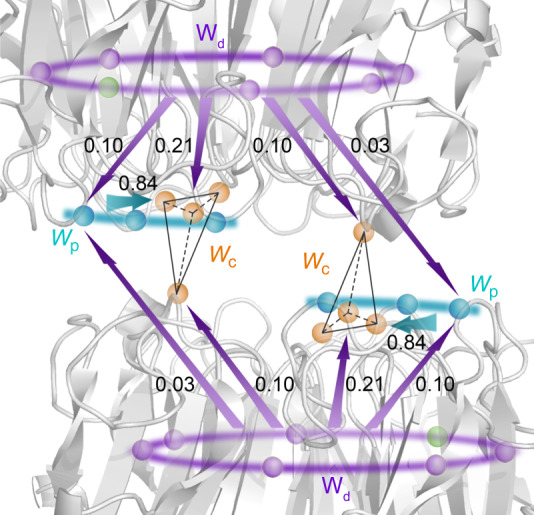
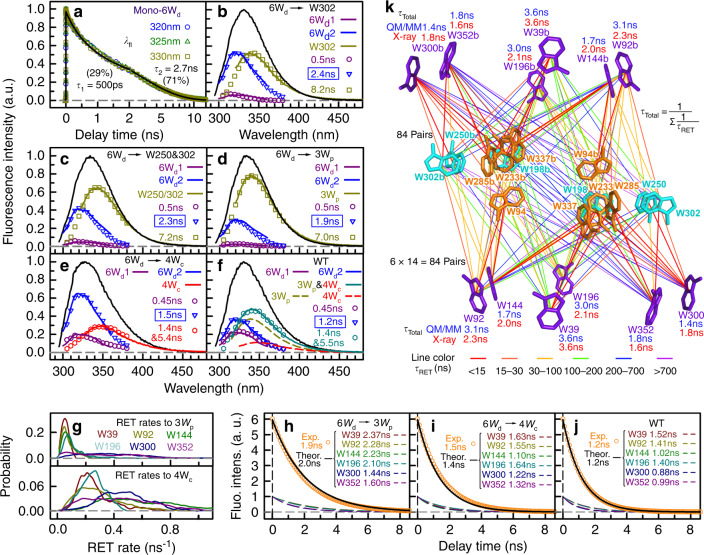
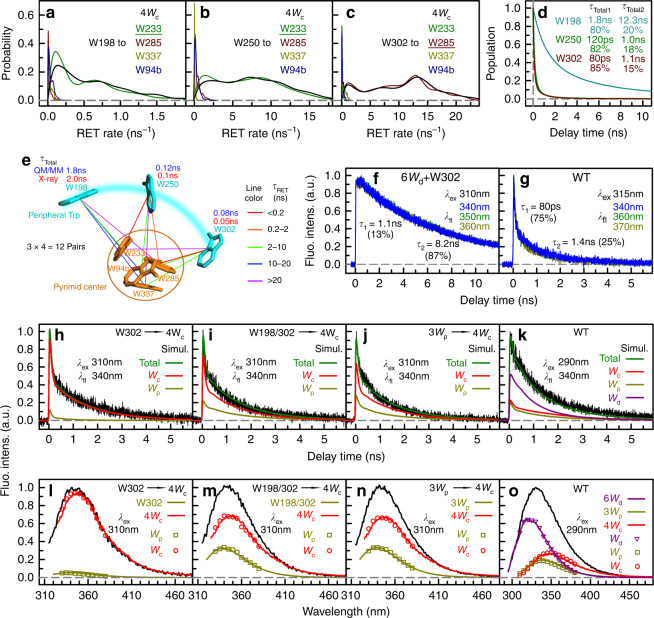
Plants utilize a UV-B (280 to 315 nm) photoreceptor UVR8 (UV RESISTANCE LOCUS 8) to sense environmental UV levels and regulate gene expression to avoid harmful UV effects. Uniquely, UVR8 uses intrinsic tryptophan for UV-B perception with a homodimer structure containing 26 structural tryptophan residues. However, besides 8 tryptophans at the dimer interface to form two critical pyramid perception centers, the other 18 tryptophans' functional role is unknown. Here, using ultrafast fluorescence spectroscopy, computational methods and extensive mutations, we find that all 18 tryptophans form light-harvesting networks and funnel their excitation energy to the pyramid centers to enhance light-perception efficiency. We determine the timescales of all elementary tryptophan-to-tryptophan energy-transfer steps in picoseconds to nanoseconds, in excellent agreement with quantum computational calculations, and finally reveal a significant leap in light-perception quantum efficiency from 35% to 73%. This photoreceptor is the first system discovered so far, to be best of our knowledge, using natural amino-acid tryptophans to form networks for both light harvesting and light perception.
植物利用 UV-B(280 至 315nm)光受体 UVR8(UV 抗性基因 8)来感知环境 UV 水平,并调节基因表达以避免有害的 UV 影响。独特的是,UVR8 使用内在色氨酸进行 UV-B 感知,其同源二聚体结构包含 26 个结构色氨酸残基。然而,除了二聚体界面上的 8 个色氨酸形成两个关键的金字塔感知中心外,其他 18 个色氨酸的功能作用尚不清楚。在这里,我们使用超快荧光光谱学、计算方法和广泛的突变,发现所有 18 个色氨酸都形成了光收集网络,并将其激发能量集中到金字塔中心,以提高光感知效率。我们确定了所有基本色氨酸-色氨酸能量转移步骤的时间尺度在皮秒到纳秒之间,与量子计算计算结果非常吻合,最终揭示了光感知量子效率从 35%到 73%的显著跃升。就我们所知,这种光受体是迄今为止第一个被发现的系统,利用天然氨基酸色氨酸形成网络,用于光收集和光感知。