• 文献检索
  • 文档翻译
  • 深度研究
  • 学术资讯
  • Suppr Zotero 插件Zotero 插件
  • 邀请有礼
  • 套餐&价格
  • 历史记录
应用&插件
Suppr Zotero 插件Zotero 插件浏览器插件Mac 客户端Windows 客户端微信小程序
定价
高级版会员购买积分包购买API积分包
服务
文献检索文档翻译深度研究API 文档MCP 服务
关于我们
关于 Suppr公司介绍联系我们用户协议隐私条款
关注我们

Suppr 超能文献

核心技术专利:CN118964589B侵权必究
粤ICP备2023148730 号-1Suppr @ 2026

文献检索

告别复杂PubMed语法,用中文像聊天一样搜索,搜遍4000万医学文献。AI智能推荐,让科研检索更轻松。

立即免费搜索

文件翻译

保留排版,准确专业,支持PDF/Word/PPT等文件格式,支持 12+语言互译。

免费翻译文档

深度研究

AI帮你快速写综述,25分钟生成高质量综述,智能提取关键信息,辅助科研写作。

立即免费体验

叶穗比(LPR):基于深度学习的一种指示粳稻源库关系的新生理性状。

Leaf to panicle ratio (LPR): a new physiological trait indicative of source and sink relation in japonica rice based on deep learning.

作者信息

Yang Zongfeng, Gao Shang, Xiao Feng, Li Ganghua, Ding Yangfeng, Guo Qinghua, Paul Matthew J, Liu Zhenghui

机构信息

College of Agriculture, Nanjing Agricultural University, Nanjing, 210095 China.

State Key Laboratory of Vegetation and Environmental Change, Institute of Botany, Chinese Academy of Sciences, Beijing, 100093 China.

出版信息

Plant Methods. 2020 Aug 26;16:117. doi: 10.1186/s13007-020-00660-y. eCollection 2020.

DOI:10.1186/s13007-020-00660-y
PMID:32863854
原文链接:https://pmc.ncbi.nlm.nih.gov/articles/PMC7449046/
Abstract

BACKGROUND

Identification and characterization of new traits with sound physiological foundation is essential for crop breeding and production management. Deep learning has been widely used in image data analysis to explore spatial and temporal information on crop growth and development, thus strengthening the power of identification of physiological traits. Taking the advantage of deep learning, this study aims to develop a novel trait of canopy structure that integrate source and sink in japonica rice.

RESULTS

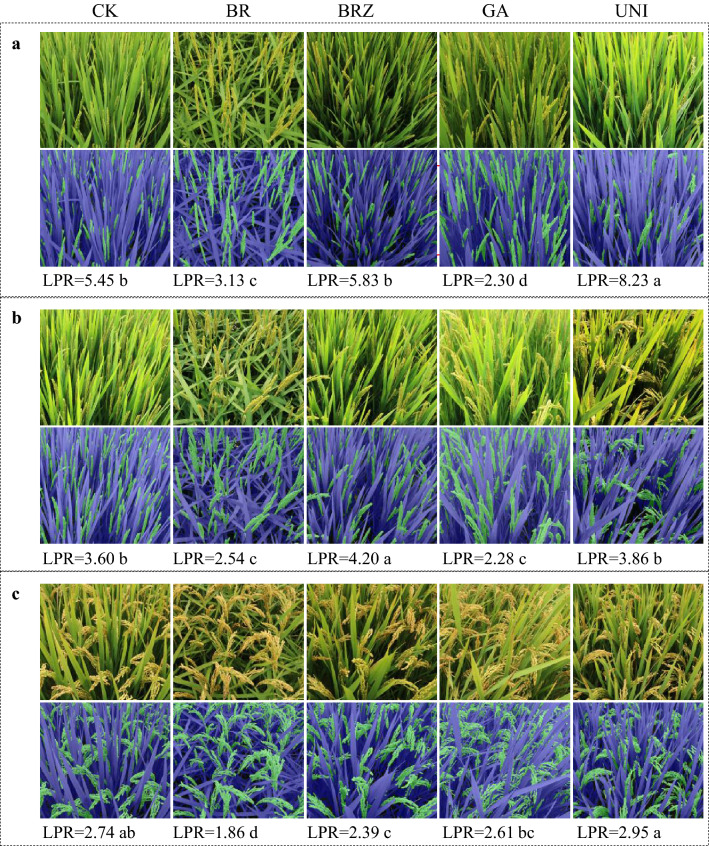
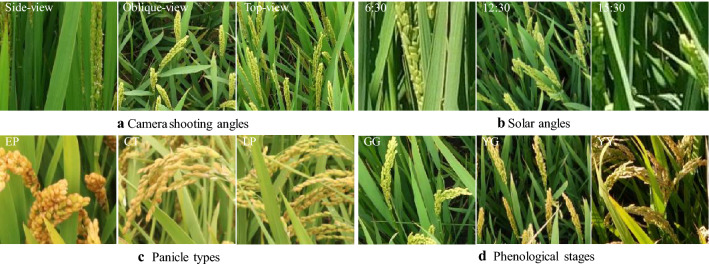
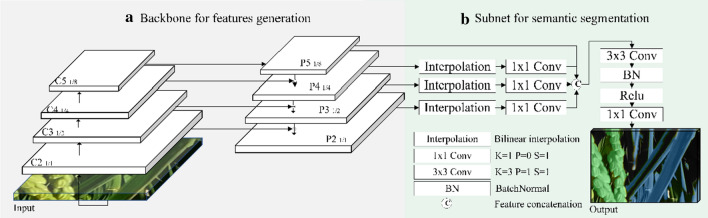
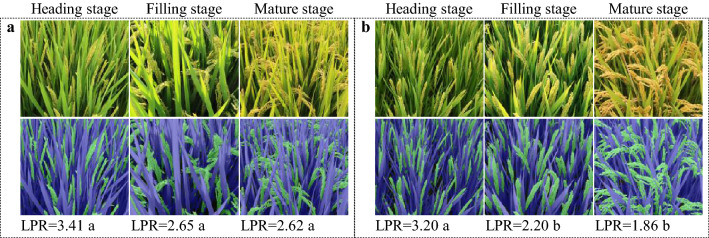
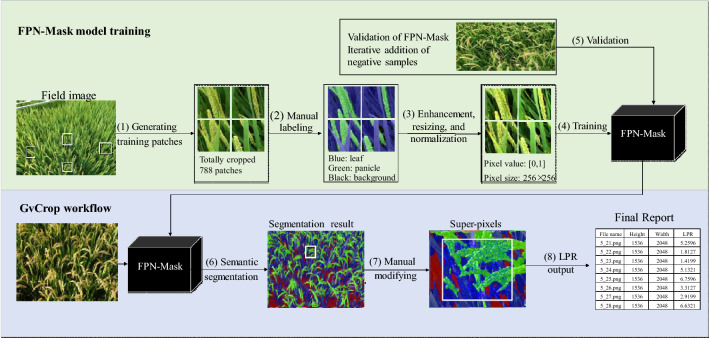
We applied a deep learning approach to accurately segment leaf and panicle, and subsequently developed the procedure of GvCrop to calculate the leaf to panicle ratio (LPR) of rice canopy during grain filling stage. Images of training dataset were captured in the field experiments, with large variations in camera shooting angle, the elevation and the azimuth angles of the sun, rice genotype, and plant phenological stages. Accurately labeled by manually annotating the panicle and leaf regions, the resulting dataset were used to train FPN-Mask (Feature Pyramid Network Mask) models, consisting of a backbone network and a task-specific sub-network. The model with the highest accuracy was then selected to check the variations in LPR among 192 rice germplasms and among agronomical practices. Despite the challenging field conditions, FPN-Mask models achieved a high detection accuracy, with Pixel Accuracy being 0.99 for panicles and 0.98 for leaves. The calculated LPR displayed large spatial and temporal variations as well as genotypic differences. In addition, it was responsive to agronomical practices such as nitrogen fertilization and spraying of plant growth regulators.

CONCLUSION

Deep learning technique can achieve high accuracy in simultaneous detection of panicle and leaf data from complex rice field images. The proposed FPN-Mask model is applicable to detect and quantify crop performance under field conditions. The newly identified trait of LPR should provide a high throughput protocol for breeders to select superior rice cultivars as well as for agronomists to precisely manage field crops that have a good balance of source and sink.

摘要

背景

鉴定和表征具有良好生理基础的新性状对于作物育种和生产管理至关重要。深度学习已广泛应用于图像数据分析,以探索作物生长发育的时空信息,从而增强生理性状的识别能力。本研究利用深度学习的优势,旨在开发一种整合粳稻源库的冠层结构新性状。

结果

我们应用深度学习方法准确分割叶片和稻穗,并随后开发了GvCrop程序来计算灌浆期水稻冠层的叶穗比(LPR)。训练数据集的图像是在田间试验中拍摄的,相机拍摄角度、太阳的仰角和方位角、水稻基因型以及植株物候期存在很大差异。通过手动标注稻穗和叶片区域进行准确标记,所得数据集用于训练FPN-Mask(特征金字塔网络掩码)模型,该模型由骨干网络和特定任务子网组成。然后选择准确率最高的模型来检查192份水稻种质以及农艺措施之间LPR的变化。尽管田间条件具有挑战性,但FPN-Mask模型仍实现了较高的检测准确率,稻穗的像素准确率为0.99,叶片的像素准确率为0.98。计算得出的LPR显示出较大的时空变化以及基因型差异。此外,它对氮肥施用和植物生长调节剂喷洒等农艺措施有响应。

结论

深度学习技术能够在从复杂的稻田图像中同时检测稻穗和叶片数据方面实现高精度。所提出的FPN-Mask模型适用于在田间条件下检测和量化作物表现。新鉴定的LPR性状应为育种者选择优良水稻品种以及农艺学家精确管理具有良好源库平衡的田间作物提供一种高通量方案。
https://cdn.ncbi.nlm.nih.gov/pmc/blobs/4997/7449046/bfba373200d2/13007_2020_660_Fig10_HTML.jpg
https://cdn.ncbi.nlm.nih.gov/pmc/blobs/4997/7449046/ffa0eb82d7d2/13007_2020_660_Fig1_HTML.jpg
https://cdn.ncbi.nlm.nih.gov/pmc/blobs/4997/7449046/55e2e5ca5a40/13007_2020_660_Fig2_HTML.jpg
https://cdn.ncbi.nlm.nih.gov/pmc/blobs/4997/7449046/415910279838/13007_2020_660_Fig3_HTML.jpg
https://cdn.ncbi.nlm.nih.gov/pmc/blobs/4997/7449046/38401857f85b/13007_2020_660_Fig4_HTML.jpg
https://cdn.ncbi.nlm.nih.gov/pmc/blobs/4997/7449046/b9c361b0cc49/13007_2020_660_Fig5_HTML.jpg
https://cdn.ncbi.nlm.nih.gov/pmc/blobs/4997/7449046/58bc29f08411/13007_2020_660_Fig6_HTML.jpg
https://cdn.ncbi.nlm.nih.gov/pmc/blobs/4997/7449046/d767fdf14b2c/13007_2020_660_Fig7_HTML.jpg
https://cdn.ncbi.nlm.nih.gov/pmc/blobs/4997/7449046/04fea8261977/13007_2020_660_Fig8_HTML.jpg
https://cdn.ncbi.nlm.nih.gov/pmc/blobs/4997/7449046/2c8986a07306/13007_2020_660_Fig9_HTML.jpg
https://cdn.ncbi.nlm.nih.gov/pmc/blobs/4997/7449046/bfba373200d2/13007_2020_660_Fig10_HTML.jpg
https://cdn.ncbi.nlm.nih.gov/pmc/blobs/4997/7449046/ffa0eb82d7d2/13007_2020_660_Fig1_HTML.jpg
https://cdn.ncbi.nlm.nih.gov/pmc/blobs/4997/7449046/55e2e5ca5a40/13007_2020_660_Fig2_HTML.jpg
https://cdn.ncbi.nlm.nih.gov/pmc/blobs/4997/7449046/415910279838/13007_2020_660_Fig3_HTML.jpg
https://cdn.ncbi.nlm.nih.gov/pmc/blobs/4997/7449046/38401857f85b/13007_2020_660_Fig4_HTML.jpg
https://cdn.ncbi.nlm.nih.gov/pmc/blobs/4997/7449046/b9c361b0cc49/13007_2020_660_Fig5_HTML.jpg
https://cdn.ncbi.nlm.nih.gov/pmc/blobs/4997/7449046/58bc29f08411/13007_2020_660_Fig6_HTML.jpg
https://cdn.ncbi.nlm.nih.gov/pmc/blobs/4997/7449046/d767fdf14b2c/13007_2020_660_Fig7_HTML.jpg
https://cdn.ncbi.nlm.nih.gov/pmc/blobs/4997/7449046/04fea8261977/13007_2020_660_Fig8_HTML.jpg
https://cdn.ncbi.nlm.nih.gov/pmc/blobs/4997/7449046/2c8986a07306/13007_2020_660_Fig9_HTML.jpg
https://cdn.ncbi.nlm.nih.gov/pmc/blobs/4997/7449046/bfba373200d2/13007_2020_660_Fig10_HTML.jpg

相似文献

1
Leaf to panicle ratio (LPR): a new physiological trait indicative of source and sink relation in japonica rice based on deep learning.叶穗比(LPR):基于深度学习的一种指示粳稻源库关系的新生理性状。
Plant Methods. 2020 Aug 26;16:117. doi: 10.1186/s13007-020-00660-y. eCollection 2020.
2
Panicle-Cloud: An Open and AI-Powered Cloud Computing Platform for Quantifying Rice Panicles from Drone-Collected Imagery to Enable the Classification of Yield Production in Rice.圆锥花序云平台:一个开放且由人工智能驱动的云计算平台,用于从无人机采集的图像中量化水稻圆锥花序,以实现水稻产量分类。
Plant Phenomics. 2023 Oct 16;5:0105. doi: 10.34133/plantphenomics.0105. eCollection 2023.
3
High-throughput and separating-free phenotyping method for on-panicle rice grains based on deep learning.基于深度学习的水稻穗上籽粒高通量免分离表型分析方法
Front Plant Sci. 2023 Sep 18;14:1219584. doi: 10.3389/fpls.2023.1219584. eCollection 2023.
4
Automated Counting Grains on the Rice Panicle Based on Deep Learning Method.基于深度学习方法的水稻穗部自动计数。
Sensors (Basel). 2021 Jan 4;21(1):281. doi: 10.3390/s21010281.
5
Panicle-SEG: a robust image segmentation method for rice panicles in the field based on deep learning and superpixel optimization.圆锥花序分割:一种基于深度学习和超像素优化的用于田间水稻圆锥花序的稳健图像分割方法。
Plant Methods. 2017 Nov 28;13:104. doi: 10.1186/s13007-017-0254-7. eCollection 2017.
6
Image analysis-based recognition and quantification of grain number per panicle in rice.基于图像分析的水稻每穗粒数识别与定量分析
Plant Methods. 2019 Oct 31;15:122. doi: 10.1186/s13007-019-0510-0. eCollection 2019.
7
Field rice panicle detection and counting based on deep learning.基于深度学习的田间稻穗检测与计数
Front Plant Sci. 2022 Aug 12;13:966495. doi: 10.3389/fpls.2022.966495. eCollection 2022.
8
Partitioning of 13C-labelled photosynthate varies with growth stage and panicle size in high-yielding rice.在高产水稻中,13C标记光合产物的分配随生长阶段和穗大小而变化。
Funct Plant Biol. 2004 Mar;31(2):131-139. doi: 10.1071/FP03177.
9
Active learning with point supervision for cost-effective panicle detection in cereal crops.用于谷物作物中经济高效穗检测的带点监督主动学习
Plant Methods. 2020 Mar 7;16:34. doi: 10.1186/s13007-020-00575-8. eCollection 2020.
10
Automated Counting of Rice Panicle by Applying Deep Learning Model to Images from Unmanned Aerial Vehicle Platform.通过将深度学习模型应用于无人机平台图像实现水稻穗自动计数
Sensors (Basel). 2019 Jul 13;19(14):3106. doi: 10.3390/s19143106.

引用本文的文献

1
Optimizing Mask R-CNN for enhanced quinoa panicle detection and segmentation in precision agriculture.优化Mask R-CNN以增强精准农业中藜麦穗的检测与分割
Front Plant Sci. 2025 Jun 2;16:1472688. doi: 10.3389/fpls.2025.1472688. eCollection 2025.
2
A deep learning approach for deriving wheat phenology from near-surface RGB image series using spatiotemporal fusion.一种使用时空融合从近地表RGB图像序列推导小麦物候期的深度学习方法。
Plant Methods. 2024 Sep 30;20(1):153. doi: 10.1186/s13007-024-01278-0.
3
A hyperspectral deep learning attention model for predicting lettuce chlorophyll content.

本文引用的文献

1
An Exploration of Deep-Learning Based Phenotypic Analysis to Detect Spike Regions in Field Conditions for UK Bread Wheat.基于深度学习的表型分析在英国面包小麦田间条件下检测穗部区域的探索
Plant Phenomics. 2019 Jul 31;2019:7368761. doi: 10.34133/2019/7368761. eCollection 2019.
2
5Gs for crop genetic improvement.作物遗传改良的 5Gs。
Curr Opin Plant Biol. 2020 Aug;56:190-196. doi: 10.1016/j.pbi.2019.12.004. Epub 2020 Jan 28.
3
Crop Phenomics and High-Throughput Phenotyping: Past Decades, Current Challenges, and Future Perspectives.
一种用于预测生菜叶绿素含量的高光谱深度学习注意力模型。
Plant Methods. 2024 Feb 3;20(1):22. doi: 10.1186/s13007-024-01148-9.
4
Deep learning-empowered crop breeding: intelligent, efficient and promising.深度学习助力作物育种:智能、高效且前景广阔。
Front Plant Sci. 2023 Oct 3;14:1260089. doi: 10.3389/fpls.2023.1260089. eCollection 2023.
5
Panicle-Cloud: An Open and AI-Powered Cloud Computing Platform for Quantifying Rice Panicles from Drone-Collected Imagery to Enable the Classification of Yield Production in Rice.圆锥花序云平台:一个开放且由人工智能驱动的云计算平台,用于从无人机采集的图像中量化水稻圆锥花序,以实现水稻产量分类。
Plant Phenomics. 2023 Oct 16;5:0105. doi: 10.34133/plantphenomics.0105. eCollection 2023.
6
Analyzing Nitrogen Effects on Rice Panicle Development by Panicle Detection and Time-Series Tracking.通过穗检测和时间序列跟踪分析氮素对水稻穗发育的影响。
Plant Phenomics. 2023 Jun 23;5:0048. doi: 10.34133/plantphenomics.0048. eCollection 2023.
7
Universal detection of curved rice panicles in complex environments using aerial images and improved YOLOv4 model.利用航空图像和改进的YOLOv4模型在复杂环境中对弯曲水稻穗进行通用检测。
Front Plant Sci. 2022 Nov 7;13:1021398. doi: 10.3389/fpls.2022.1021398. eCollection 2022.
8
Field rice panicle detection and counting based on deep learning.基于深度学习的田间稻穗检测与计数
Front Plant Sci. 2022 Aug 12;13:966495. doi: 10.3389/fpls.2022.966495. eCollection 2022.
9
Image-Based Phenotyping for Non-Destructive In Situ Rice ( L.) Tiller Counting Using Proximal Sensing.基于图像的表型分析在利用近地感知进行非破坏性原位水稻(L.)分蘖计数中的应用。
Sensors (Basel). 2022 Jul 25;22(15):5547. doi: 10.3390/s22155547.
10
Proximal and remote sensing in plant phenomics: 20 years of progress, challenges, and perspectives.植物表型组学中的近远程感应:20 年的进展、挑战与展望。
Plant Commun. 2022 Nov 14;3(6):100344. doi: 10.1016/j.xplc.2022.100344. Epub 2022 Jun 2.
作物表型组学和高通量表型分析:过去几十年、当前挑战和未来展望。
Mol Plant. 2020 Feb 3;13(2):187-214. doi: 10.1016/j.molp.2020.01.008. Epub 2020 Jan 22.
4
: In-Field Automatic Quantification of Wheat Spikes Using Simple Linear Iterative Clustering and Deep Convolutional Neural Networks.使用简单线性迭代聚类和深度卷积神经网络对小麦穗进行田间自动量化
Front Plant Sci. 2019 Sep 26;10:1176. doi: 10.3389/fpls.2019.01176. eCollection 2019.
5
Automatic estimation of heading date of paddy rice using deep learning.利用深度学习自动估计水稻抽穗期
Plant Methods. 2019 Jul 13;15:76. doi: 10.1186/s13007-019-0457-1. eCollection 2019.
6
Detection and analysis of wheat spikes using Convolutional Neural Networks.使用卷积神经网络对小麦穗进行检测与分析。
Plant Methods. 2018 Nov 15;14:100. doi: 10.1186/s13007-018-0366-8. eCollection 2018.
7
Functional Specificities of Brassinosteroid and Potential Utilization for Crop Improvement.植物生长调节剂油菜素内酯的功能特性及其在作物改良中的潜在应用
Trends Plant Sci. 2018 Nov;23(11):1016-1028. doi: 10.1016/j.tplants.2018.08.007. Epub 2018 Sep 13.
8
Focal Loss for Dense Object Detection.用于密集目标检测的焦散损失
IEEE Trans Pattern Anal Mach Intell. 2020 Feb;42(2):318-327. doi: 10.1109/TPAMI.2018.2858826. Epub 2018 Jul 23.
9
Deep Learning: Individual Maize Segmentation From Terrestrial Lidar Data Using Faster R-CNN and Regional Growth Algorithms.深度学习:使用更快的区域卷积神经网络(Faster R-CNN)和区域生长算法从地面激光雷达数据中进行单个玉米分割
Front Plant Sci. 2018 Jun 22;9:866. doi: 10.3389/fpls.2018.00866. eCollection 2018.
10
Wheat ear counting in-field conditions: high throughput and low-cost approach using RGB images.田间条件下的麦穗计数:使用RGB图像的高通量低成本方法
Plant Methods. 2018 Mar 17;14:22. doi: 10.1186/s13007-018-0289-4. eCollection 2018.