Bianconi Vanessa, Bronzo Paola, Banach Maciej, Sahebkar Amirhossein, Mannarino Massimo R, Pirro Matteo
Unit of Internal Medicine, Department of Medicine, University of Perugia, Perugia, Italy.
Department of Hypertension, WAM University Hospital, Medical University of Lodz, Lodz, Poland.
Arch Med Sci. 2020 May 13;16(5):985-992. doi: 10.5114/aoms.2020.95336. eCollection 2020.
Particulate matter exposure has been associated with the appearance and severity of several diseases, including viral infections. The aim of this study was to investigate whether coronavirus disease 2019 (COVID-19) cases and deaths across Italian regions and provinces in March 2020 were linked to past exposure to fine and coarse particulate matter (namely, PM and PM, respectively).
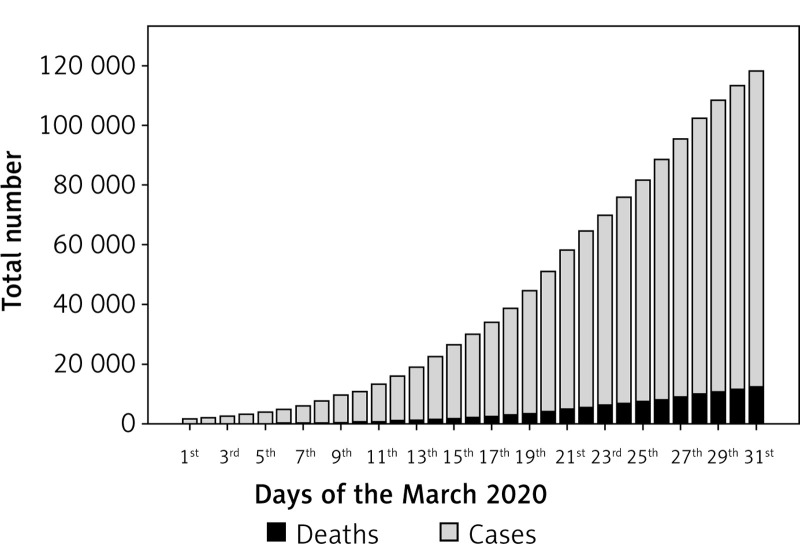
Geographical distributions of COVID-19 cases and deaths (105,792 and 12,428, respectively, up to 31 March 2020), PM and PM exposure, and demographic characteristics were extracted from publicly accessible databases. Adjusted regression models were performed to test the association between particulate matter exposure in different Italian regions and provinces and COVID-19 incidence proportions and death rates.
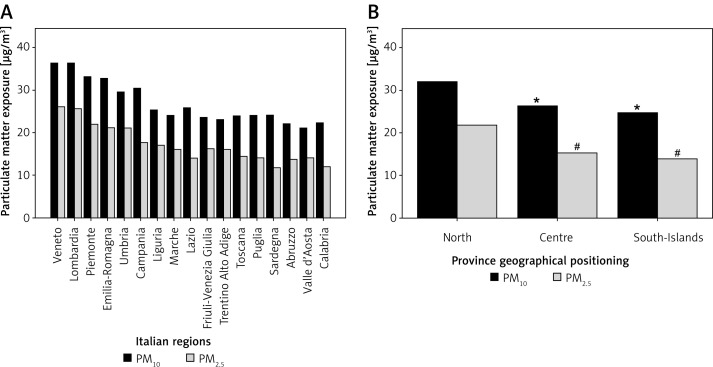
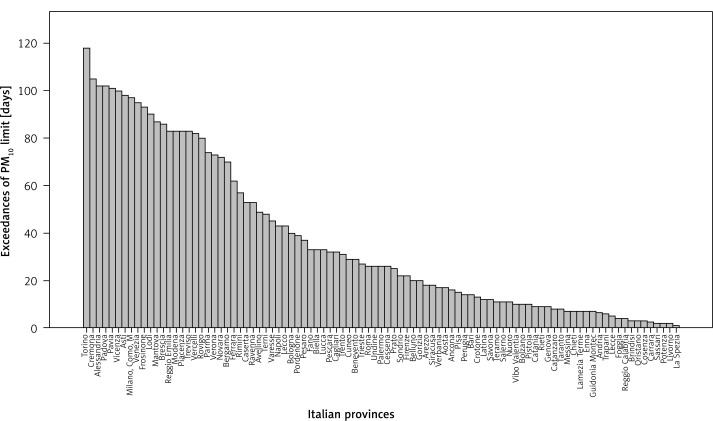
A heterogeneous distribution of COVID-19 cases/deaths and particulate matter exposure was observed in Italy, with the highest numbers in Northern Italy regions and provinces. Independent associations between regional PM/PM exposure and COVID-19 incidence proportion and death rate were observed (COVID-19 incidence proportion: β = 0.71, = 0.003, β = 0.61, = 0.031, respectively; COVID-19 death rate: β = 0.68, = 0.004 and β = 0.61, = 0.029, respectively). Similarly, PM/PM exposures were independently associated with COVID-19 incidence proportion (β = 0.26, = 0.024 and β = 0.27, = 0.006, respectively) at the provincial level. The number of days exceeding the provincial limit value of exposure to PM (50 µg/m) was also independently associated with the COVID-19 incidence proportion (β = 0.30, = 0.008).
Exposure to PM and PM is associated with COVID-19 cases and deaths, suggesting that particulate matter pollution may play a role in the COVID-19 outbreak and explain the heterogeneous distribution of COVID-19 in Italian regions and provinces.
接触颗粒物与包括病毒感染在内的多种疾病的出现和严重程度有关。本研究的目的是调查2020年3月意大利各地区和省份的2019冠状病毒病(COVID-19)病例和死亡是否与过去接触细颗粒物和粗颗粒物(分别为PM₂.₅和PM₁₀)有关。
从可公开获取的数据库中提取COVID-19病例和死亡(截至2020年3月31日分别为105792例和12428例)、PM₂.₅和PM₁₀暴露以及人口统计学特征的地理分布。进行调整后的回归模型,以检验意大利不同地区和省份的颗粒物暴露与COVID-19发病率和死亡率之间的关联。
在意大利观察到COVID-19病例/死亡和颗粒物暴露的分布不均,意大利北部地区和省份的数量最多。观察到地区PM₂.₅/PM₁₀暴露与COVID-19发病率和死亡率之间存在独立关联(COVID-19发病率:β分别为0.71,P = 0.003;β为0.61,P = 0.031;COVID-19死亡率:β分别为0.68,P = 0.004和β为0.61,P = 0.029)。同样,在省级层面,PM₂.₅/PM₁₀暴露与COVID-19发病率也存在独立关联(β分别为0.26,P = 0.024和β为0.27,P = 0.006)。超过省级PM₁₀暴露限值(50μg/m³)的天数也与COVID-19发病率独立相关(β = 0.30,P = 0.008)。
接触PM₂.₅和PM₁₀与COVID-19病例和死亡有关,这表明颗粒物污染可能在COVID-19疫情中起作用,并解释了COVID-19在意大利各地区和省份的分布不均。