Liver Res. 2020 Sep;4(3):109-117. doi: 10.1016/j.livres.2020.08.001. Epub 2020 Aug 25.
Severe/critical cases account for 18-20% of all novel coronavirus disease 2019 (COVID-19) patients, but their mortality rate can be up to 61.5%. Furthermore, all deceased patients were severe/critical cases. The main reasons for the high mortality of severe/critical patients are advanced age (>60 years old) and combined underlying diseases. Elderly patients with comorbidities show decreased organ function and low compensation for damage such as hypoxia and inflammation, which accelerates disease progression. The lung is the main target organ attacked by severe acute respiratory syndrome coronavirus 2 (SARS-CoV-2) while immune organs, liver, blood vessels and other organs are damaged to varying degrees. Liver volume is increased, and mild active inflammation and focal necrosis are observed in the portal area. Virus particles have also been detected in liver cells. Therefore, multidisciplinary teams (MDTs) and individualized treatment plans, accurate prediction of disease progression and timely interventions are vital to effectively reduce mortality. Specifically, a "multidisciplinary three-dimensional management, individualized comprehensive plan" should be implemented. The treatment plan complies with three principles, namely, multidisciplinary management of patients, individualized diagnosis and treatment plans, and timely monitoring and intervention of disease. MDT members are mainly physicians from critical medicine, infection and respiratory disciplines, but also include cardiovascular, kidney, endocrine, digestion, nerve, nutrition, rehabilitation, psychology and specialty care. According to a patient's specific disease condition, an individualized diagnosis and treatment plan is formulated (one plan for one patient). While selecting individualized antiviral, anti-inflammatory and immunomodulatory treatment, we also strengthen nutritional support, psychological intervention, comprehensive rehabilitation and timely and full-course intervention to develop overall and special nursing plans. In response to the rapid progression of severe/critical patients, MDT members need to establish a three-dimensional management model with close observation and timely evaluation. The MDT should make rounds of the quarantine wards both morning and night, and of critical patient wards nightly, to implement "round-the-clock rounds management", to accurately predict disease progression, perform the quick intervention and prevent rapid deterioration of the patient. Our MDT has cumulatively treated 77 severe/critical COVID-19 cases, including 62 (80.5%) severe cases and 15 (19.5%) critical cases, with an average age of 63.8 years. Fifty-three (68.8%) cases presented with more than one underlying disease and 65 (84.4%) severe cases recovered from COVID-19. The average hospital stay of severe/critical cases was 22 days, and the mortality rate was 2.6%, both of which were significantly lower than the 30-40 days and 49.0-61.5%, respectively, reported in the literature. Therefore, a multidisciplinary, three-dimensional and individualized comprehensive treatment plan can effectively reduce the mortality rate of severe/critical COVID-19 and improve the cure rate.
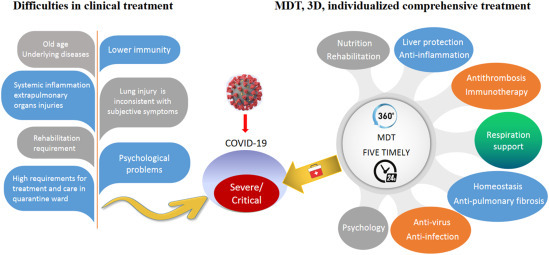
重型/危重型病例占新型冠状病毒肺炎(COVID-19)患者总数的18% - 20%,但其死亡率可达61.5%。此外,所有死亡患者均为重型/危重型病例。重型/危重型患者死亡率高的主要原因是高龄(>60岁)和合并基础疾病。合并基础疾病的老年患者器官功能下降,对缺氧和炎症等损伤的代偿能力低,这加速了疾病进展。肺是严重急性呼吸综合征冠状病毒2(SARS-CoV-2)攻击的主要靶器官,而免疫器官、肝脏、血管等器官也受到不同程度的损伤。肝脏体积增大,在门静脉区可见轻度活动性炎症和局灶性坏死。肝细胞中也检测到病毒颗粒。因此,多学科团队(MDT)和个体化治疗方案、准确预测疾病进展并及时干预对于有效降低死亡率至关重要。具体而言,应实施“多学科三维管理,个体化综合方案”。治疗方案遵循三个原则,即患者的多学科管理、个体化诊疗方案以及疾病的及时监测和干预。MDT成员主要是来自重症医学、感染和呼吸学科的医生,但也包括心血管、肾脏、内分泌、消化、神经、营养、康复、心理和专科护理等方面的人员。根据患者的具体病情制定个体化诊疗方案(一人一案)。在选择个体化的抗病毒、抗炎和免疫调节治疗的同时,我们还加强营养支持、心理干预、综合康复以及及时和全程干预,以制定全面和特殊的护理计划。针对重型/危重型患者病情快速进展的情况,MDT成员需要建立密切观察和及时评估的三维管理模式。MDT应早晚对隔离病房进行查房,夜间对重症患者病房进行查房,实施“全天候查房管理”,以准确预测疾病进展,进行快速干预并防止患者病情迅速恶化。我们的MDT累计治疗了77例重型/危重型COVID-19病例,其中包括62例(80.5%)重型病例和15例(19.5%)危重型病例,平均年龄为63.8岁。53例(68.8%)病例合并有一种以上基础疾病,65例(84.4%)重型病例从COVID-19中康复。重型/危重型病例的平均住院天数为22天,死亡率为2.6%,均显著低于文献报道的30 - 40天和49.0% - 61.5%。因此,多学科、三维和个体化的综合治疗方案可有效降低重型/危重型COVID-19的死亡率并提高治愈率。
