English Kirk L, Downs Meghan, Goetchius Elizabeth, Buxton Roxanne, Ryder Jeffrey W, Ploutz-Snyder Robert, Guilliams Mark, Scott Jessica M, Ploutz-Snyder Lori L
University of Houston-Clear Lake, Houston, TX USA.
Health and Human Performance Institute, Houston, TX USA.
NPJ Microgravity. 2020 Aug 18;6:21. doi: 10.1038/s41526-020-00111-x. eCollection 2020.
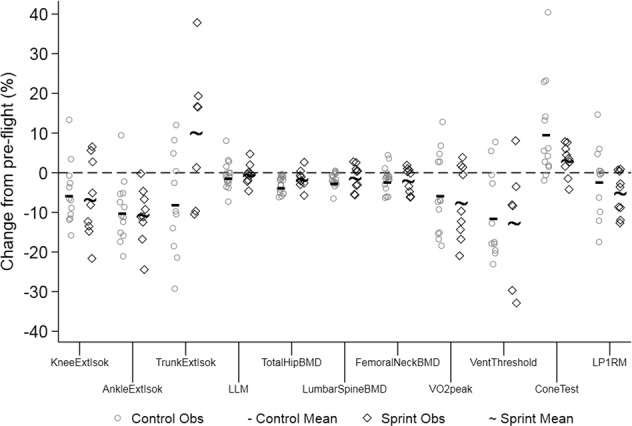
Historically, International Space Station (ISS) exercise countermeasures have not fully protected astronauts' musculoskeletal and cardiorespiratory fitness. Although these losses have been reduced on more recent missions, decreasing the time required to perform in-flight exercise would permit reallocation of that time to other tasks. To evaluate the effectiveness of a new training prescription, ISS crewmembers performed either the high intensity/lower volume integrated Sprint resistance (3 d wk) and aerobic (interval and continuous workouts, each 3 d wk in alternating fashion) exercise program ( = 9: 8M/1F, 48 ± 7 y, 178 ± 5 cm, 77.7 ± 12.0 kg) or the standard ISS countermeasure consisting of daily resistance and aerobic exercise ( = 17: 14M/3F, 46 ± 6 y, 176 ± 6 cm, 80.6 ± 10.5 kg) during long-duration spaceflight. Bone mineral density (dual energy X-ray absorptiometry (DXA)), muscle strength (isokinetic dynamometry), muscle function (cone agility test), and cardiorespiratory fitness (VO) were assessed pre- and postflight. Mixed-effects modeling was used to analyze dependent measures with alpha set at < 0.05. After spaceflight, femoral neck bone mineral density (-1.7%), knee extensor peak torque (-5.8%), cone agility test time (+7.4%), and VO (-6.1%) were decreased in both groups (simple main effects of time, all < 0.05) with a few group × time interaction effects detected for which Sprint experienced either attenuated or no loss compared to control. Although physiologic outcomes were not appreciably different between the two exercise programs, to conserve time and optimally prepare crewmembers for the performance of physically demanding mission tasks, high intensity/lower volume training should be an indispensable component of spaceflight exercise countermeasure prescriptions.
从历史上看,国际空间站(ISS)的运动对策未能充分保护宇航员的肌肉骨骼和心肺功能。尽管在最近的任务中这些功能下降有所减少,但减少飞行中运动所需的时间将允许将该时间重新分配用于其他任务。为了评估一种新训练方案的有效性,国际空间站的机组人员在长期太空飞行期间,要么进行高强度/低运动量的综合短跑阻力训练(每周3天)和有氧运动(间歇训练和持续训练,每周各3天,交替进行)方案(n = 9:8名男性/1名女性,年龄48±7岁,身高178±5厘米,体重77.7±12.0千克),要么进行由每日阻力训练和有氧运动组成的标准国际空间站对策训练(n = 17:14名男性/3名女性,年龄46±6岁,身高176±6厘米,体重80.6±10.5千克)。在飞行前和飞行后评估骨矿物质密度(双能X线吸收法(DXA))、肌肉力量(等速测力法)、肌肉功能(锥体敏捷性测试)和心肺功能(VO₂)。采用混合效应模型分析相关指标,将α设定为<0.05。太空飞行后,两组的股骨颈骨矿物质密度(-1.7%)、膝关节伸肌峰值扭矩(-5.8%)、锥体敏捷性测试时间(+7.4%)和VO₂(-6.1%)均下降(时间的简单主效应,均<0.05),检测到一些组×时间交互效应,与对照组相比,短跑组的这些指标下降程度减弱或未下降。尽管两种运动方案的生理结果没有明显差异,但为了节省时间并使机组人员为执行体力要求高的任务做好最佳准备,高强度/低运动量训练应成为太空飞行运动对策方案中不可或缺的一部分。