Department of Urology, Xiangya Hospital, Central South University, Changsha, PR China.
Pharm Biol. 2020 Dec;58(1):828-837. doi: 10.1080/13880209.2020.1809462.
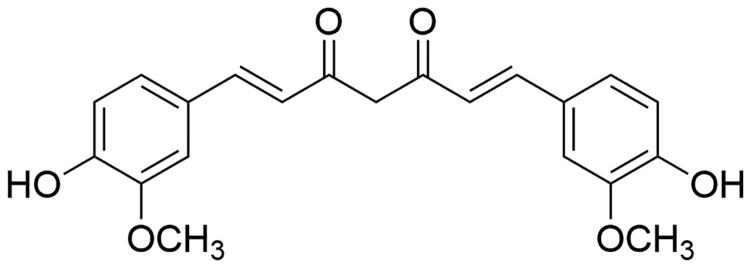
Renal interstitial fibrosis (RIF) is characterized by the accumulation of inflammatory cytokines and epithelial-mesenchymal transition (EMT). Curcumin exerts antifibrogenic, anti-inflammatory and antiproliferative effects.
To explore the mechanisms underlying the effects of curcumin on RIF.
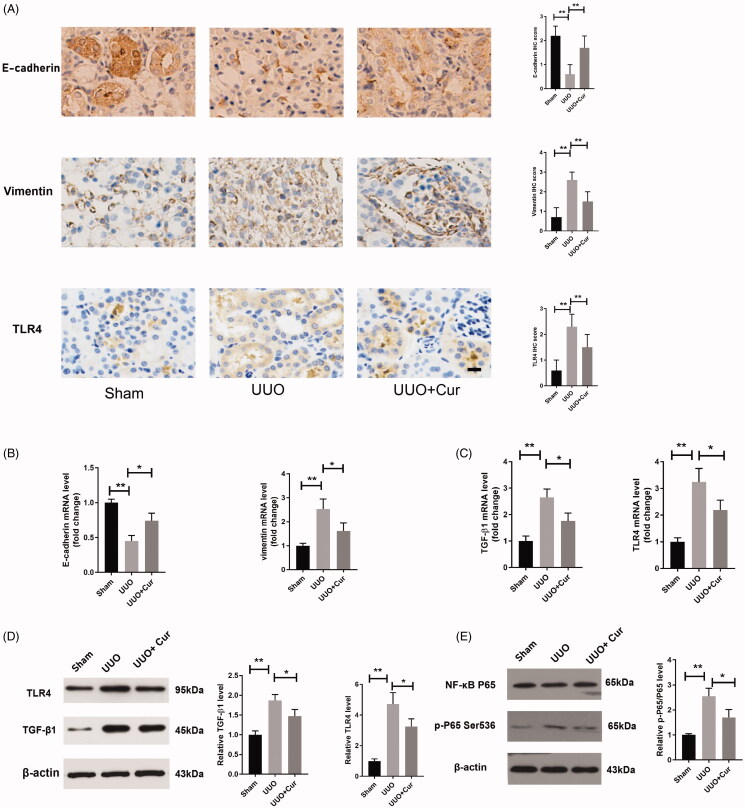
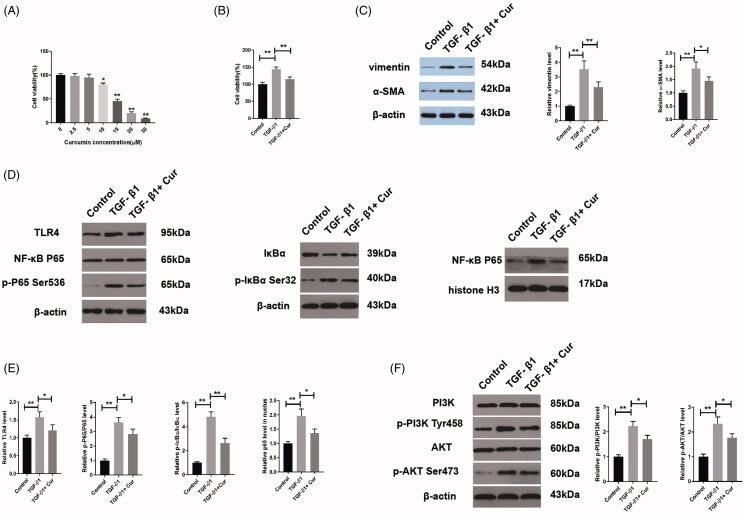
Eight-week-old male C57BL/6 mice were intragastrically administered curcumin (50 mg/kg/day) for 14 days after undergoing unilateral ureteral obstruction (UUO) operations. Renal function (blood urea nitrogen [BUN] and serum creatinine [Scr]) and inflammatory cytokine levels were tested using colorimetric assays and ELISA, respectively. EMT markers were evaluated through immunohistochemistry, western blotting and qPCR. Transforming growth factor beta 1 (TGF-β1; 10 ng/mL) and lipopolysaccharides (LPS; 100 ng/mL) were used to stimulate EMT and an inflammatory response in human renal proximal tubular epithelial (HK-2) cells, respectively, for further investigation.
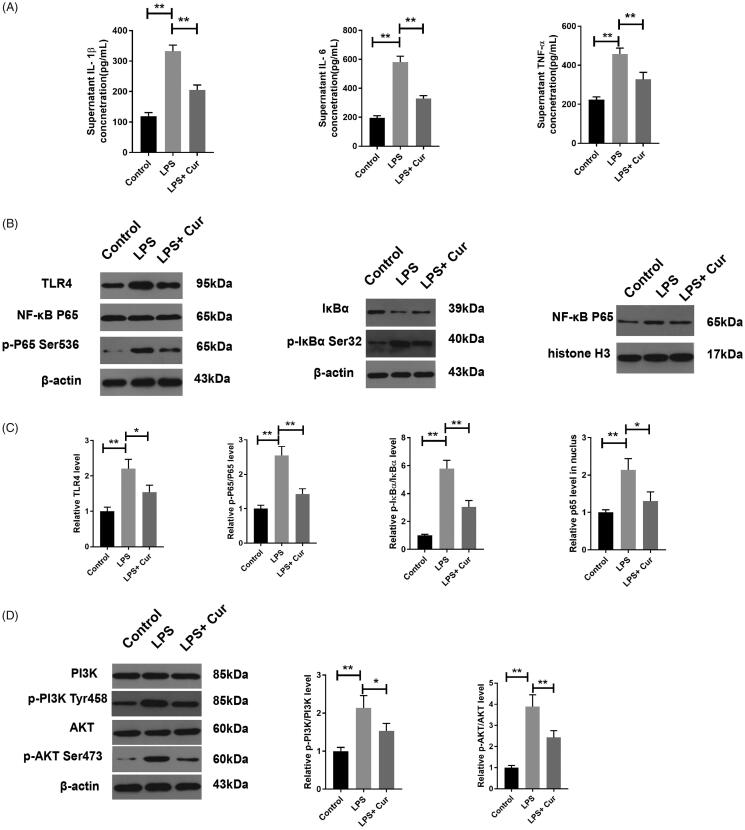
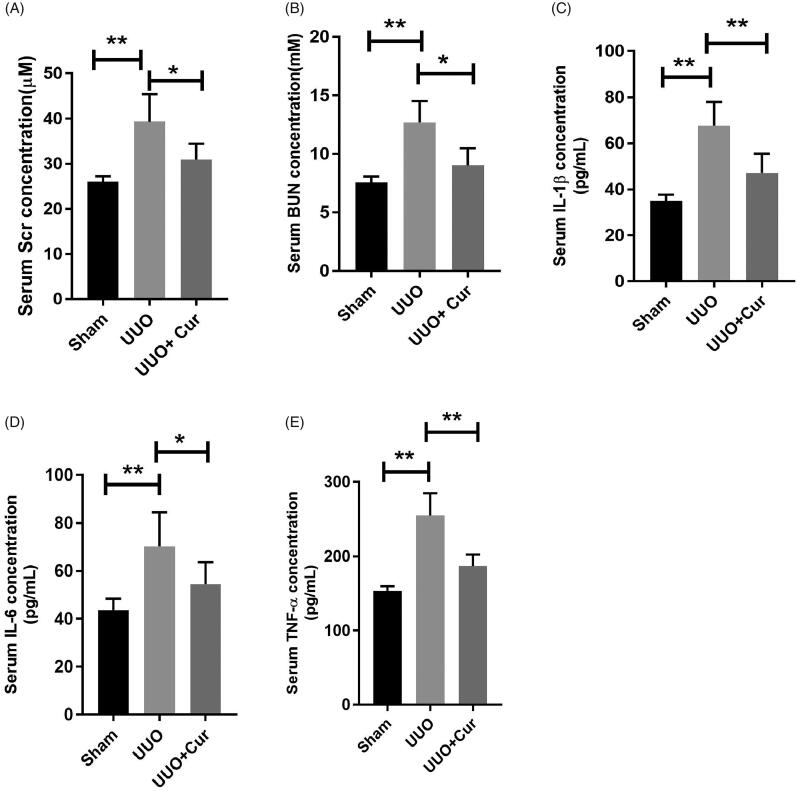
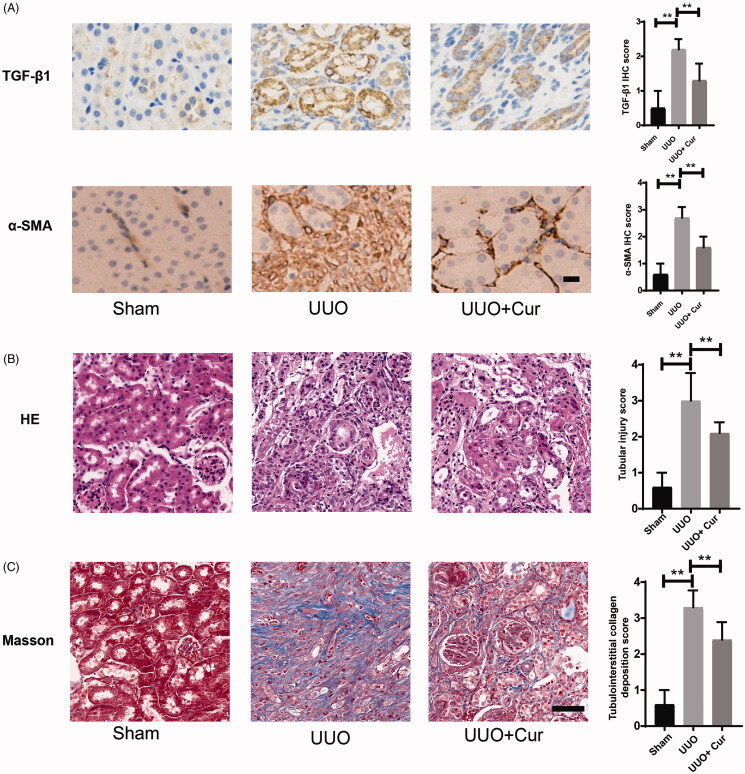
, curcumin significantly improved the levels of BUN and Scr by 28.7% and 21.3%, respectively. Moreover, curcumin reduced the levels of IL-6, IL-1β and TNF-α by 22.5%, 30.3% and 26.7%, respectively, and suppressed vimentin expression in UUO mice. , curcumin reduced the expression of vimentin and α-smooth muscle actin in TGF-β1-induced HK-2 cells. In LPS-induced HK-2 cells, curcumin decreased the release of IL-6, IL-1β and TNF-α by 43.4%, 38.1% and 28.3%, respectively. In addition, curcumin reduced the expression of TLR4, p-PI3K, p-AKT, p-NF- κB and p-IκBα in both LPS- and TGF-β1-induced HK-2 cells.
Curcumin repressed EMT and the inflammatory response by inhibiting the TLR4/NF-κB and PI3K/AKT pathways, demonstrating its potential utility in RIF treatment.
肾间质纤维化(RIF)的特征是炎症细胞因子的积累和上皮-间充质转化(EMT)。姜黄素具有抗纤维化、抗炎和抗增殖作用。
探讨姜黄素对 RIF 的作用机制。
8 周龄雄性 C57BL/6 小鼠在接受单侧输尿管梗阻(UUO)手术后,每天经胃内给予姜黄素(50mg/kg)14 天。通过比色法和 ELISA 分别检测肾功能(血尿素氮[BUN]和血清肌酐[Scr])和炎症细胞因子水平。通过免疫组织化学、Western blot 和 qPCR 评估 EMT 标志物。使用转化生长因子β1(TGF-β1;10ng/mL)和脂多糖(LPS;100ng/mL)分别刺激人肾近端小管上皮(HK-2)细胞的 EMT 和炎症反应,以进一步研究。
与模型组相比,姜黄素使 BUN 和 Scr 分别降低了 28.7%和 21.3%。此外,姜黄素使 IL-6、IL-1β和 TNF-α的水平分别降低了 22.5%、30.3%和 26.7%,并抑制 UUO 小鼠中波形蛋白的表达。体外实验中,姜黄素降低了 TGF-β1 诱导的 HK-2 细胞中波形蛋白和α-平滑肌肌动蛋白的表达。在 LPS 诱导的 HK-2 细胞中,姜黄素使 IL-6、IL-1β和 TNF-α的释放分别降低了 43.4%、38.1%和 28.3%。此外,姜黄素降低了 LPS 和 TGF-β1 诱导的 HK-2 细胞中 TLR4、p-PI3K、p-AKT、p-NF-κB 和 p-IκBα 的表达。
姜黄素通过抑制 TLR4/NF-κB 和 PI3K/AKT 通路抑制 EMT 和炎症反应,表明其在 RIF 治疗中的潜在应用价值。