Kanner Joseph
Department of Food Science, ARO Volcani Center, Bet Dagan POB 6, Israel.
Institute of Biochemistry, Food Science and Nutrition, Faculty of Agriculture Food and Environment, The Hebrew University of Jerusalem, Rehovot POB12, Israel.
Antioxidants (Basel). 2020 Aug 27;9(9):797. doi: 10.3390/antiox9090797.
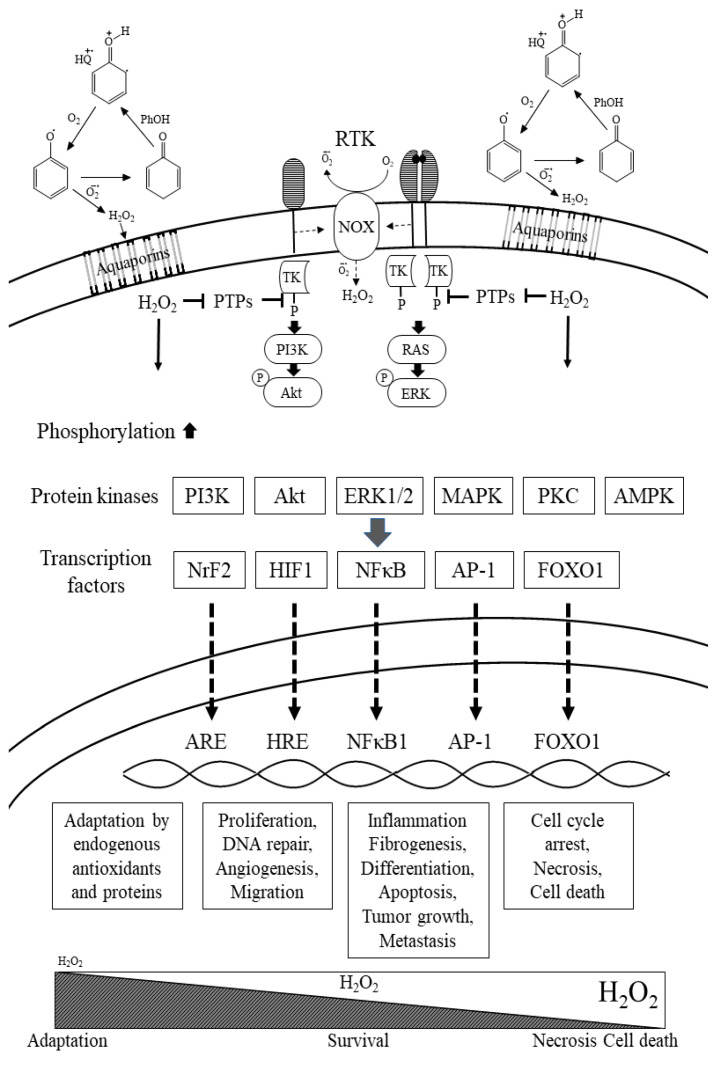
Human health benefits from different polyphenols molecules consumption in the diet, derived mainly by their common activities in the gastrointestinal tract and at the level of blood micro-capillary. In the stomach, intestine and colon, polyphenols act as reducing agents preventing lipid peroxidation, generation and absorption of AGEs/ALEs (advanced glycation end products/advanced lipid oxidation end products) and postprandial oxidative stress. The low absorption of polyphenols in blood does not support their activity as antioxidants and their mechanism of activity is not fully understood. The results are from in vitro, animal and human studies, detected by relevant oxidative stress markers. The review carries evidences that polyphenols, by generating HO at nM concentration, exogenous to cells and organs, act as activators of signaling factors increasing cell Eustress. When polyphenols attain high concentration in the blood system, they generate HO at µM concentration, acting as cytotoxic agents and Distress. Pre-treatment of cells or organisms with polyphenols, by generating HO at low levels, inhibits cellular PTPs (protein tyrosine phosphatases), inducing cell signaling through transcription of the Nrf2 (nuclear factor erythroid 2-related factor 2) axis of adaptation and protection to oxidation stress. Polyphenols ingestion at the right amount and time during the meal acts synergistically at the level of the gastrointestinal tract (GIT) and blood system, for keeping the redox homeostasis in our organism and better balancing human health.
人类健康受益于饮食中摄入的不同多酚分子,这主要源于它们在胃肠道和血液微毛细血管水平上的共同作用。在胃、小肠和结肠中,多酚作为还原剂,可防止脂质过氧化、晚期糖基化终产物/晚期脂质氧化终产物(AGEs/ALEs)的生成与吸收以及餐后氧化应激。多酚在血液中的低吸收率并不支持它们作为抗氧化剂的活性,其作用机制也尚未完全明确。这些结果来自体外、动物和人体研究,通过相关氧化应激标志物进行检测。该综述表明,多酚在细胞和器官外以纳摩尔浓度产生羟基自由基(HO),作为信号因子的激活剂,增加细胞的适度应激(Eustress)。当多酚在血液系统中达到高浓度时,它们以微摩尔浓度产生HO,充当细胞毒性剂并导致应激(Distress)。用多酚对细胞或生物体进行预处理,通过低水平产生HO,抑制细胞蛋白酪氨酸磷酸酶(PTPs)通过核因子红细胞2相关因子2(Nrf2)氧化应激适应和保护轴的转录来诱导细胞信号传导。用餐期间在适当的时间摄入适量的多酚,在胃肠道(GIT)和血液系统水平上发挥协同作用,以维持我们机体的氧化还原稳态并更好地平衡人类健康。