Liu Meijun, Zhang Peihai
Department of Neurology, Hospital of Chengdu University of Traditional Chinese Medicine, Sichuan, Chengdu 610072, China.
Department of Urology, Hospital of Chengdu University of Traditional Chinese Medicine, Sichuan, Chengdu 610072, China.
Sex Med. 2025 Jan 9;12(6):qfae092. doi: 10.1093/sexmed/qfae092. eCollection 2024 Dec.
Increasing evidence suggests that a diet rich in antioxidants may prevent erectile dysfunction (ED), but the impact of comprehensive dietary antioxidants on ED has been little studied.
To investigate the association between the composite dietary antioxidant index (CDAI) and ED risk in adult men.
The study performed a cross-sectional analysis using data from the 2001-2004 National Health and Nutrition Examination Survey to investigate the association between the composite dietary antioxidant index (CDAI) and ED. The connection between the CDAI and ED was assessed using univariate and multivariate weighted logistic regression models, as well as the restricted cubic spline.
Association between the CDAI and the prevalence of ED.
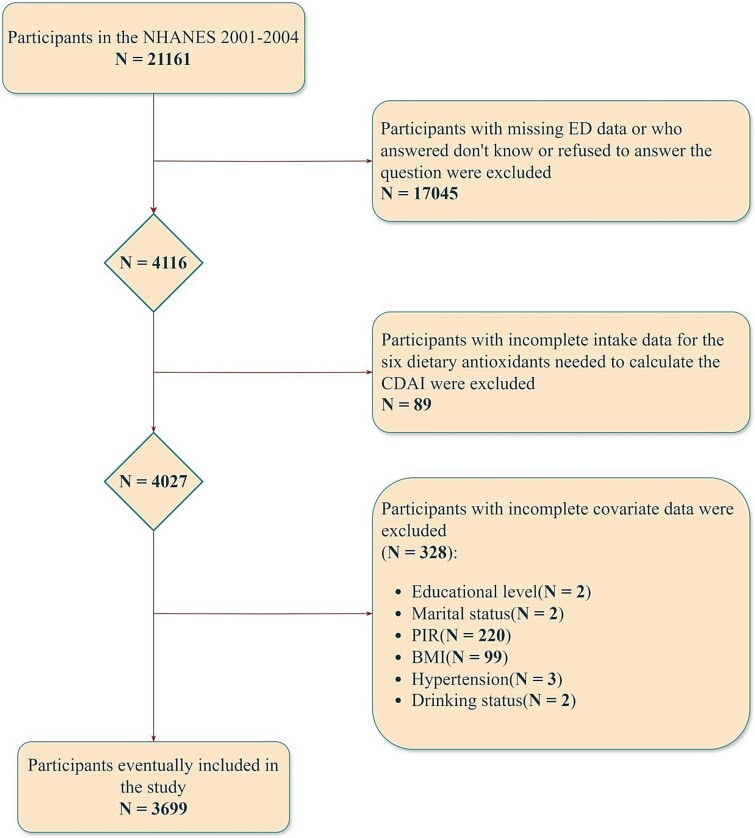
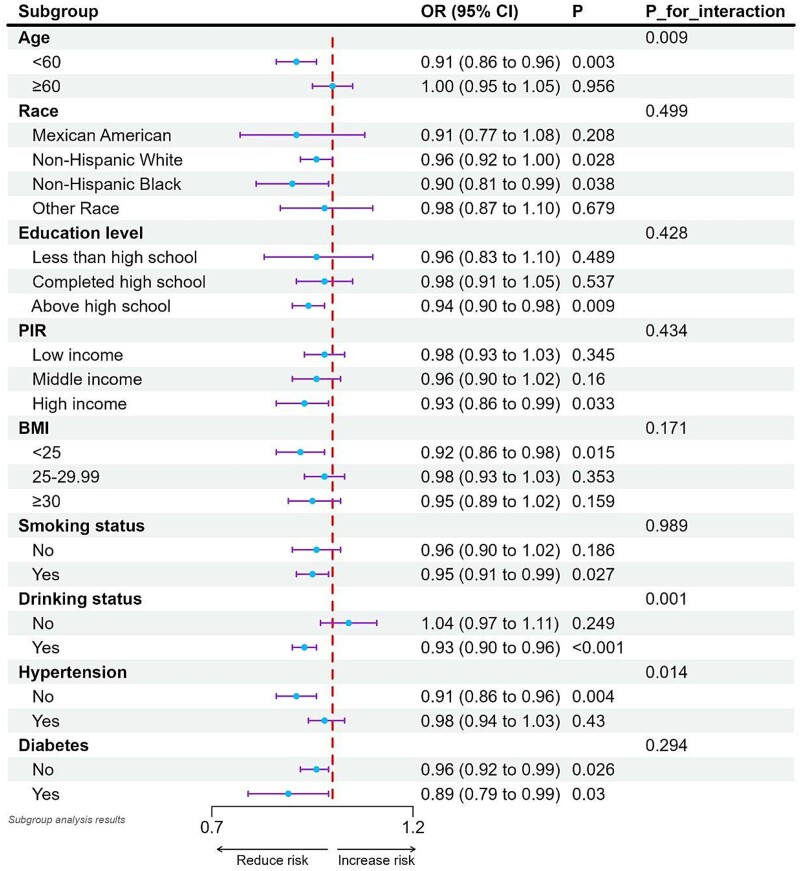
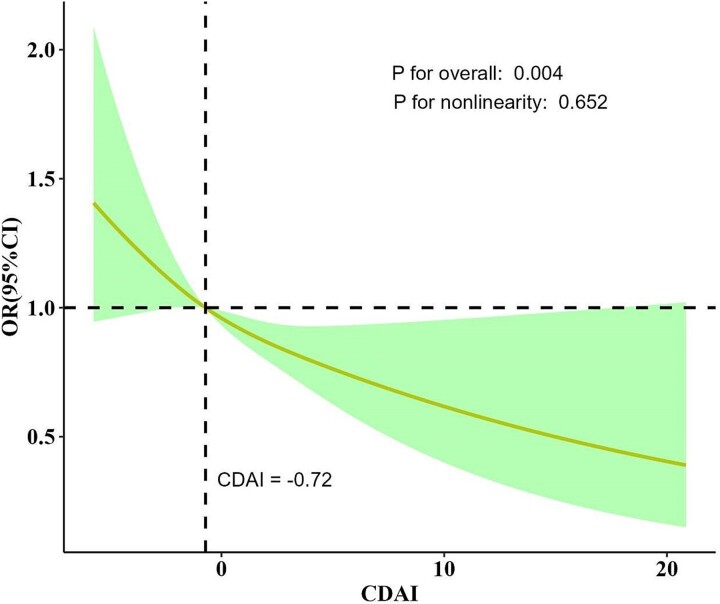
The study included a total of 3699 participants, among whom 1042 were diagnosed with ED, resulting in a prevalence of 28.17%. Multivariate weighted logistic regression consistently showed a negative association between the CDAI and ED (OR = 0.95, 95% CI: 0.92-0.98, = .005). The group with the highest CDAI (Q4) had a 33% reduced risk of ED than the group with the lowest CDAI (Q1) when the CDAI was regarded as a categorical variable (OR = 0.67, 95% CI: 0.49-0.91, = .014). Restricted cubic spline analysis showed that the CDAI was linearly related to the risk of ED (non-linearity = .652). Furthermore, subgroup analysis indicated that the inverse relationship between CDAI and ED was more pronounced in individuals under 60 years of age, those with diabetes, and those without hypertension.
Dietary strategies to increase antioxidant intake might offer a potential approach to reducing ED risk and supporting men's sexual health.
This is a large-scale study investigating the association between the CDAI and ED. However, as a cross-sectional study, the timeliness of the dataset and the recall bias inherent in dietary data somewhat limit the reliability of the results.
This study identified a significant inverse association between the CDAI and ED risk among adult men in the United States; however, as a cross-sectional study, this research cannot establish causation, and further longitudinal studies are needed to validate these findings and provide more definitive evidence.
越来越多的证据表明,富含抗氧化剂的饮食可能预防勃起功能障碍(ED),但综合膳食抗氧化剂对ED的影响鲜有研究。
探讨成年男性的综合膳食抗氧化剂指数(CDAI)与ED风险之间的关联。
本研究使用2001 - 2004年国家健康和营养检查调查的数据进行横断面分析,以研究综合膳食抗氧化剂指数(CDAI)与ED之间的关联。使用单变量和多变量加权逻辑回归模型以及受限立方样条评估CDAI与ED之间的联系。
CDAI与ED患病率之间的关联。
该研究共纳入3699名参与者,其中1042人被诊断为ED,患病率为28.17%。多变量加权逻辑回归一致显示CDAI与ED之间存在负相关(OR = 0.95,95% CI:0.92 - 0.98,P = 0.005)。当将CDAI视为分类变量时,CDAI最高的组(Q4)比CDAI最低的组(Q1)患ED的风险降低33%(OR = 0.67,95% CI:0.49 - 0.91,P = 0.014)。受限立方样条分析表明CDAI与ED风险呈线性相关(非线性P = 0.652)。此外,亚组分析表明,CDAI与ED之间的负相关在60岁以下个体、糖尿病患者和非高血压患者中更为明显。
增加抗氧化剂摄入量的饮食策略可能为降低ED风险和维护男性性健康提供一种潜在方法。
这是一项调查CDAI与ED之间关联的大规模研究。然而,作为一项横断面研究,数据集的时效性以及膳食数据中固有的回忆偏差在一定程度上限制了结果的可靠性。
本研究确定了美国成年男性中CDAI与ED风险之间存在显著的负相关;然而,作为一项横断面研究,本研究无法确定因果关系,需要进一步的纵向研究来验证这些发现并提供更确凿的证据。