Oliver Nuria, Barber Xavier, Roomp Kirsten, Roomp Kristof
The Institute for Human(ity)-Centric Artificial Intelligence, ELLIS Unit Alicante Foundation, Alicante, Spain.
Center of Operations Research, Universidad Miguel Hernández, Elche, Spain.
J Med Internet Res. 2020 Sep 10;22(9):e21319. doi: 10.2196/21319.
Spain has been one of the countries most impacted by the COVID-19 pandemic. Since the first confirmed case was reported on January 31, 2020, there have been over 405,000 cases and 28,000 deaths in Spain. The economic and social impact is without precedent. Thus, it is important to quickly assess the situation and perception of the population. Large-scale online surveys have been shown to be an effective tool for this purpose.
We aim to assess the situation and perception of the Spanish population in four key areas related to the COVID-19 pandemic: social contact behavior during confinement, personal economic impact, labor situation, and health status.
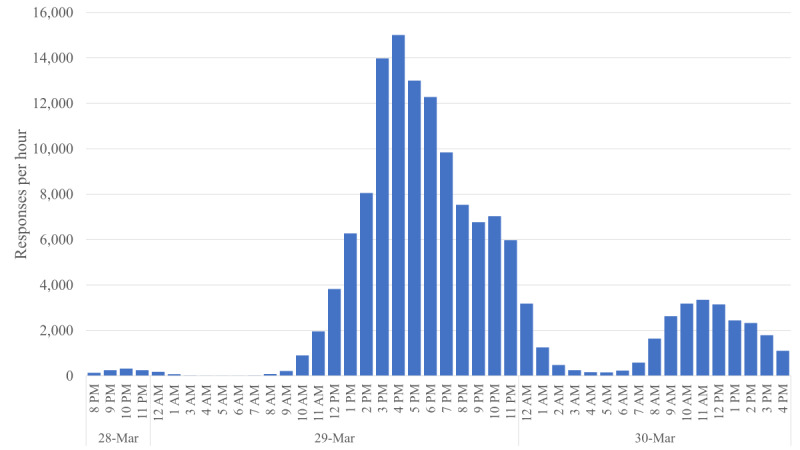
We obtained a large sample using an online survey with 24 questions related to COVID-19 in the week of March 28-April 2, 2020, during the peak of the first wave of COVID-19 in Spain. The self-selection online survey method of nonprobability sampling was used to recruit 156,614 participants via social media posts that targeted the general adult population (age >18 years). Given such a large sample, the 95% CI was ±0.843 for all reported proportions.
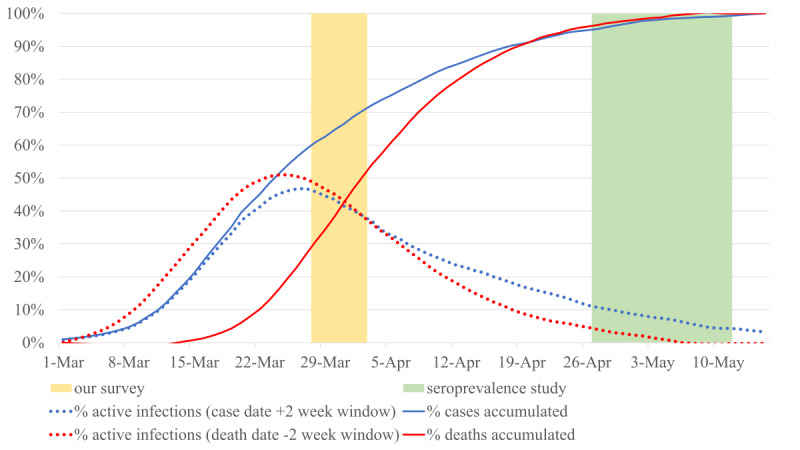
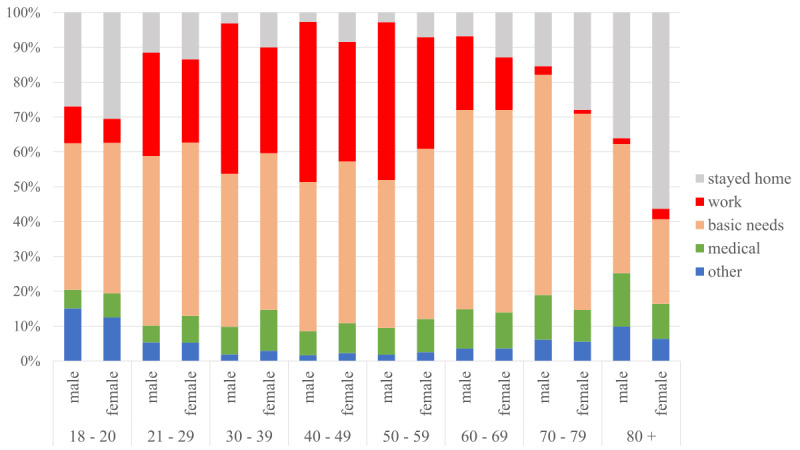
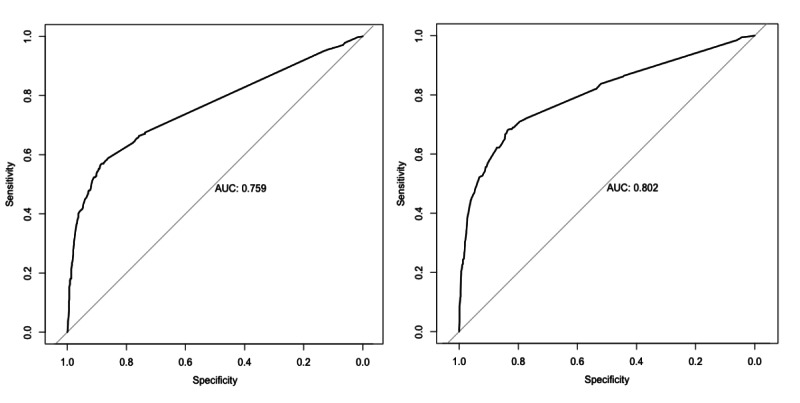
Regarding social behavior during confinement, participants mainly left their homes to satisfy basic needs. We found several statistically significant differences in social behavior across genders and age groups. The population's willingness to comply with the confinement measures is evident. From the survey answers, we identified a significant adverse economic impact of the pandemic on those working in small businesses and a negative correlation between economic damage and willingness to stay in confinement. The survey revealed that close contacts play an important role in the transmission of the disease, and 28% of the participants lacked the necessary resources to properly isolate themselves. We also identified a significant lack of testing, with only 1% of the population tested and 6% of respondents unable to be tested despite their doctor's recommendation. We developed a generalized linear model to identify the variables that were correlated with a positive SARS-CoV-2 test result. Using this model, we estimated an average of 5% for SARS-CoV-2 prevalence in the Spanish population during the time of the study. A seroprevalence study carried out later by the Spanish Ministry of Health reported a similar level of disease prevalence (5%).
Large-scale online population surveys, distributed via social media and online messaging platforms, can be an effective, cheap, and fast tool to assess the impact and prevalence of an infectious disease in the context of a pandemic, particularly when there is a scarcity of official data and limited testing capacity.
西班牙是受新冠疫情影响最严重的国家之一。自2020年1月31日报告首例确诊病例以来,西班牙已有超过40.5万例病例,2.8万人死亡。其经济和社会影响史无前例。因此,快速评估民众的情况和认知很重要。大规模在线调查已被证明是实现这一目的的有效工具。
我们旨在评估西班牙民众在与新冠疫情相关的四个关键领域的情况和认知:居家隔离期间的社交接触行为、个人经济影响、劳动状况和健康状况。
在2020年3月28日至4月2日这一周,西班牙第一波新冠疫情高峰期,我们通过一项包含24个与新冠疫情相关问题的在线调查获得了一个大样本。采用非概率抽样的自选在线调查方法,通过针对一般成年人群(年龄>18岁)的社交媒体帖子招募了156614名参与者。鉴于样本量如此之大,所有报告比例的95%置信区间为±0.843。
关于居家隔离期间的社交行为,参与者主要出门是为了满足基本需求。我们发现不同性别和年龄组在社交行为方面存在一些具有统计学意义的差异。民众遵守隔离措施的意愿很明显。从调查答案中,我们确定疫情对小企业从业者有重大不利经济影响,且经济损失与居家隔离意愿之间存在负相关。调查显示密切接触在疾病传播中起重要作用,28%的参与者缺乏适当隔离所需的资源。我们还发现检测严重不足,只有1%的人口接受了检测,6%的受访者尽管医生建议但仍无法接受检测。我们建立了一个广义线性模型来确定与新冠病毒检测呈阳性结果相关的变量。使用该模型,我们估计在研究期间西班牙人口中新冠病毒的平均流行率为5%。西班牙卫生部后来进行的一项血清流行率研究报告了类似的疾病流行水平(5%)。
通过社交媒体和在线消息平台进行的大规模在线人群调查,可以成为在疫情背景下评估传染病影响和流行率的有效、廉价且快速的工具,特别是在官方数据稀缺且检测能力有限的情况下。