Institute of Clinical Physiology, CNR, San Cataldo Research Area, Via Moruzzi, 1, 56124 Pisa, Italy.
Department of Information Engineering, Telemedicine Section, University of Pisa, Italy.
Thromb Res. 2020 Dec;196:143-151. doi: 10.1016/j.thromres.2020.08.039. Epub 2020 Aug 27.
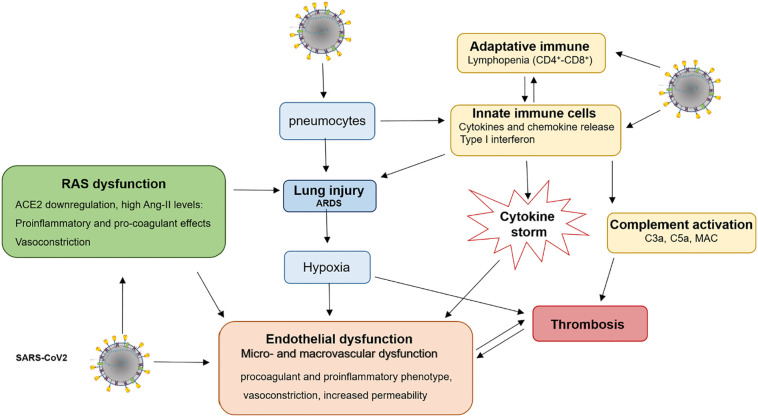
A Severe Acute Respiratory Syndrome-Coronavirus-2 (SARS-CoV-2) has become a pandemic disease named Coronavirus Disease-19 (COVID-19) of epochal dimension. The clinical spectrum of COVID-19 is wide, ranging from asymptomatic forms to severe pneumonia, sepsis and multiple organ dysfunction syndromes resulting in poor outcomes. Among the various consequences of severe COVID-19, cardiovascular (CV) collapse appears the most serious and potentially lethal. On the other hand, pre-existent CV comorbidities are also associated with higher mortality. The most reliable hypothetical pathogenetic mechanism for CV complications and cardiac injury in severe COVID-19 patients appears to be a sustained endothelial dysfunction, caused by the interplay of inflammation and coagulation. In this review, we survey papers addressing issues related to severe COVID-19, characterized by enhanced lung microvascular loss, hypercytokinemia, hypoxemia and thrombosis. We discuss about how the virus-induced downregulation of the angiotensin converting enzyme-2 (ACE2) receptor, used to enter the host cell, could affect the renin-angiotensin system, attempting to clarify the doubts about the use of ACE inhibitors and Angiotensin-II receptor blockers in COVID-19 patients. Finally, we point out how the delicate and physiological homeostatic function of the endothelium, which turns into a disastrous battlefield of the complex interaction between "cytokine and coagulative storms", can be irreparably compromised and result in systemic inflammatory complications.
一种严重急性呼吸系统综合症冠状病毒 2 型(SARS-CoV-2)已经成为一种名为 COVID-19 的纪元性大流行疾病。COVID-19 的临床谱很广,从无症状到严重肺炎、败血症和多器官功能障碍综合征,导致不良结局。在严重 COVID-19 的各种后果中,心血管(CV)衰竭似乎最为严重和潜在致命。另一方面,预先存在的 CV 合并症也与更高的死亡率相关。严重 COVID-19 患者 CV 并发症和心脏损伤最可靠的假设发病机制似乎是持续的内皮功能障碍,这是由炎症和凝血的相互作用引起的。在这篇综述中,我们调查了与严重 COVID-19 相关的论文,其特征是增强的肺微血管丧失、高细胞因子血症、低氧血症和血栓形成。我们讨论了病毒诱导的血管紧张素转换酶-2(ACE2)受体下调如何影响肾素-血管紧张素系统,试图澄清关于在 COVID-19 患者中使用 ACE 抑制剂和血管紧张素-II 受体阻滞剂的疑虑。最后,我们指出内皮细胞的微妙和生理稳态功能如何变成“细胞因子和凝血风暴”之间复杂相互作用的灾难性战场,并可能不可挽回地受损,导致全身炎症并发症。